Dachangshu 大腸兪
Low back (lumbar region), 1.5 cun out from the back midline at the level of L4.
Open the 3D Acupoint Map →
🖼See it in pictures


Location and structures come from our 3D model; only the drawing style was refined with AI. Labels are added by us.
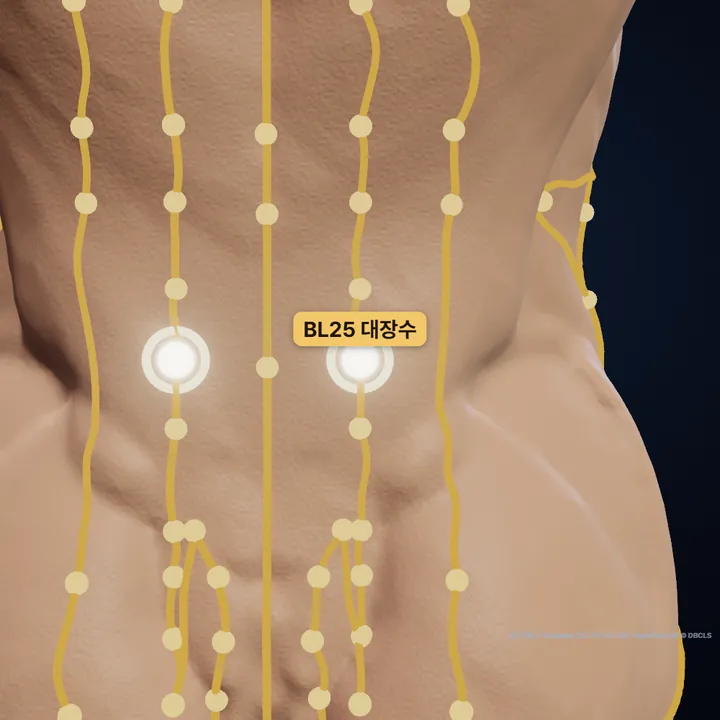

Vertebra l4 · Latissimus dorsi muscle · Posterior layer of thoracolumbar fascia · Iliocostalis lumborum muscle
Rendered straight from the 3D model at the computed location. The glowing ring marks Dachangshu.
On this page
1Where is Dachangshu?
Low back (lumbar region), 1.5 cun out from the back midline at the level of L4.
The level is set by the lower edge of the L4 spinous process.
Vertebra l4 · Latissimus dorsi muscle · Posterior layer of thoracolumbar fascia · Iliocostalis lumborum muscle
2How do I find it on my body?
- A line joining the highest points of both iliac crests crosses the midline at L4.
- Take the height of the lower edge of that spinous process.
- Press 1.5 cun out from the midline. Use the same width as on the upper back: half of the 3-cun midline-to-shoulder-blade distance.

A cun is a body-scaled unit of length. The precise way is to divide a bone length into equal parts (proportional bone cun); finger widths are a quick estimate.
- posterior layer of thoracolumbar fascia
- The outermost layer of the tough sheet that wraps the muscles of the lower back. Latissimus dorsi starts from it, and it covers erector spinae from behind.
- iliocostalis lumborum
- The lower-back part of the outermost column of erector spinae. It runs from the back of the pelvis to the lower ribs.
- spinous process
- The bony spike sticking backward from the middle of each spine bone. The row of bumps you feel down the middle of the back is these, and they serve as the counting marks for back points.
- latissimus dorsi
- The broad muscle covering the lower back and sides. It runs from the lower back and pelvis, behind the armpit, to the humerus, and pulls the arm down and back, as in a pull-up.
3Before you press
- Do not press this point during pregnancy.
- Points over the low back and sacrum are traditionally avoided in pregnancy (WHO acupuncture safety guidelines, 1999).
- Avoid broken or swollen skin and press only to a comfortable level.
- Acupressure is not a substitute for medical care.
4How has it been used traditionally?
- Classified as the back-shu point of the Large Intestine (Zhenjiu Jiayi Jing) — a historical classification, not a claim of effect.
- It sits on the line joining the tops of the iliac crests, which makes it easy to find.
From traditional texts — not a claim of effect.
?FAQ
Where exactly is Dachangshu?
Low back (lumbar region), 1.5 cun out from the back midline at the level of L4. The level is set by the lower edge of the L4 spinous process.
How do I find Dachangshu?
A line joining the highest points of both iliac crests crosses the midline at L4. Take the height of the lower edge of that spinous process. Press 1.5 cun out from the midline. Use the same width as on the upper back: half of the 3-cun midline-to-shoulder-blade distance. it is level with Yaoyangguan (GV3) on the midline.
Can I press it during pregnancy?
Do not press this point during pregnancy.
What should I watch out for?
Do not press this point during pregnancy. Points over the low back and sacrum are traditionally avoided in pregnancy (WHO acupuncture safety guidelines, 1999). Avoid broken or swollen skin and press only to a comfortable level. Acupressure is not a substitute for medical care.
Sources
- Location: WHO Standard Acupuncture Point Locations in the Western Pacific Region (2008), p. 112
- Standard comparison: Chinese national standard GB/T 12346-2021 (Nomenclature and location of meridian points), p. 17 — same location
- Korean anatomical terms: KMLE medical dictionary
- Traditional-use cross-check: AcuAtlas dataset (CC BY 4.0)
- Classification source: Zhenjiu Jiayi Jing vol. 3, sec. 8 (back-shu line, 1.5 cun)
- Safety: WHO Guidelines on Basic Training and Safety in Acupuncture (1999), p. 20 — lumbosacral points in pregnancy
- 3D: computed on Z-Anatomy (CC BY-SA 4.0) · BodyParts3D © DBCLS
Positions computed from the WHO standard locations (2008) on Z-Anatomy (CC BY-SA 4.0) · BodyParts3D © DBCLS. For reference only — not a substitute for diagnosis or treatment. See a clinician if you are unwell.