Qucha 曲差
On the head, 0.5 cun above the front hairline and 1.5 cun out from the front midline.
Open the 3D Acupoint Map →
🖼See it in pictures


Location and structures come from our 3D model; only the drawing style was refined with AI. Labels are added by us.

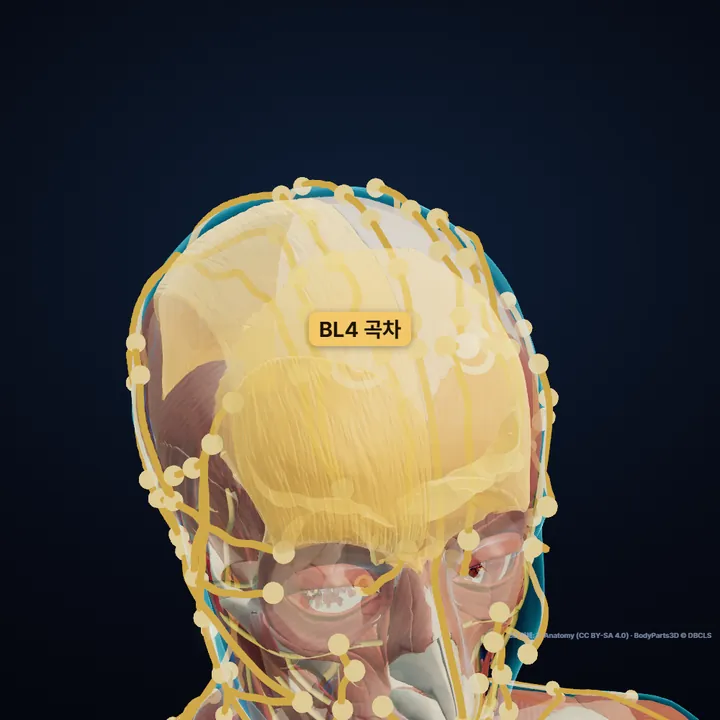
Frontal bone · Frontalis muscle · Epicranial aponeurosis
Rendered straight from the 3D model at the computed location. The glowing ring marks Qucha.
On this page
1Where is Qucha?
On the head, 0.5 cun above the front hairline and 1.5 cun out from the front midline.
It is one third of the way along the line from Shenting (GV24) to Touwei (ST8).
Frontal bone · Frontalis muscle · Epicranial aponeurosis
2How do I find it on my body?
- Find the middle of the front hairline. If the hairline is unclear, go 3 cun up from the point between the eyebrows.
- Shenting is 0.5 cun above that point. Touwei is 0.5 cun above the hairline at the forehead corner, 4.5 cun from the midline.
- Divide the line between them into thirds and press the first mark from Shenting.

A cun is a body-scaled unit of length. The precise way is to divide a bone length into equal parts (proportional bone cun); finger widths are a quick estimate.
- epicranial aponeurosis
- A thin, tough sheet of tendon covering the top of the head like a cap, joined to frontalis in front and occipitalis behind. When the scalp moves, it slides with this sheet.
- frontal bone
- The skull bone that forms the forehead and brows. Its upper part is the forehead and its lower part makes the roof of the eye sockets.
3Before you press
- Sudden severe headache or dizziness, or weakness on one side: call emergency services at once — do not try acupressure.
- Avoid broken or swollen skin and press only to a comfortable level.
- Acupressure is not a substitute for medical care.
4How has it been used traditionally?
- The name joins qu (bend) and cha (to deviate): where the channel bends aside next to Shenting.
- The Zhenjiu Jiayi Jing gives Bichong (鼻沖) as an alternative name.
From traditional texts — not a claim of effect.
?FAQ
Where exactly is Qucha?
On the head, 0.5 cun above the front hairline and 1.5 cun out from the front midline. It is one third of the way along the line from Shenting (GV24) to Touwei (ST8).
How do I find Qucha?
Find the middle of the front hairline. If the hairline is unclear, go 3 cun up from the point between the eyebrows. Shenting is 0.5 cun above that point. Touwei is 0.5 cun above the hairline at the forehead corner, 4.5 cun from the midline. Divide the line between them into thirds and press the first mark from Shenting. it is 1.5 cun from the midline and 0.5 cun above the hairline.
What should I watch out for?
Sudden severe headache or dizziness, or weakness on one side: call emergency services at once — do not try acupressure. Avoid broken or swollen skin and press only to a comfortable level. Acupressure is not a substitute for medical care.
Sources
- Location: WHO Standard Acupuncture Point Locations in the Western Pacific Region (2008), p. 101
- Standard comparison: Chinese national standard GB/T 12346-2021 (Nomenclature and location of meridian points), p. 16 — same location
- Korean anatomical terms: KMLE medical dictionary
- Traditional-use cross-check: AcuAtlas dataset (CC BY 4.0)
- Classical record: Zhenjiu Jiayi Jing vol. 3, sec. 1 (1.5 cun on each side of Shenting)
- 3D: computed on Z-Anatomy (CC BY-SA 4.0) · BodyParts3D © DBCLS
Positions computed from the WHO standard locations (2008) on Z-Anatomy (CC BY-SA 4.0) · BodyParts3D © DBCLS. For reference only — not a substitute for diagnosis or treatment. See a clinician if you are unwell.