Weizhong 委中
Behind the knee, right in the middle of the knee crease (popliteal crease).
Open the 3D Acupoint Map →
🖼See it in pictures


Location and structures come from our 3D model; only the drawing style was refined with AI. Labels are added by us.
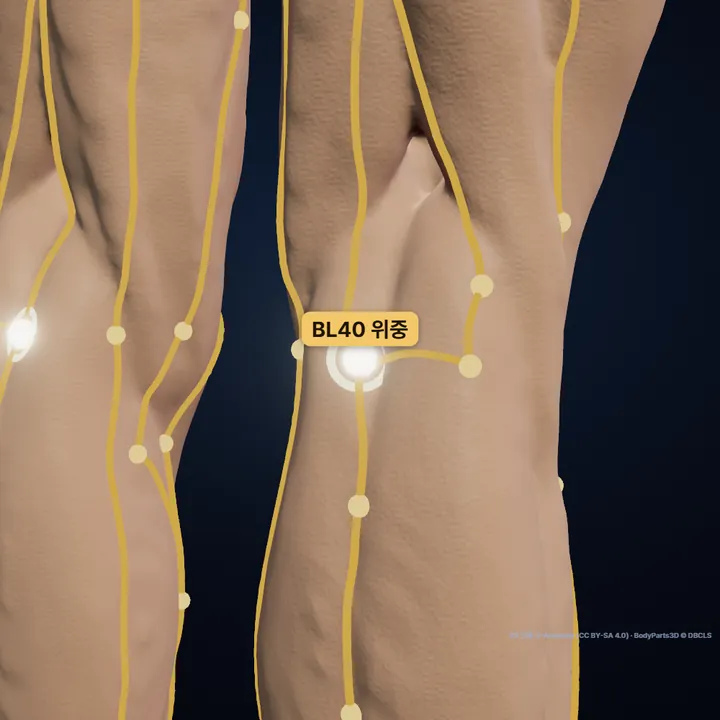

Small saphenous vein · Popliteal vein · Popliteal artery · Medial head of gastrocnemius
Rendered straight from the 3D model at the computed location. The glowing ring marks Weizhong.
On this page
1Where is Weizhong?
Behind the knee, right in the middle of the knee crease (popliteal crease).
Small saphenous vein · Popliteal vein · Popliteal artery · Medial head of gastrocnemius
2How do I find it on my body?
- Lie face down or bend the knee slightly.
- Locate the crease behind the knee from its inner to its outer end.
- Press its midpoint gently with the pad of a finger.
- medial head of gastrocnemius
- The inner of the two heads of gastrocnemius. It is bigger and reaches lower than the outer head.
- small saphenous vein
- A vein under the skin that starts on the outer foot, passes behind the outer ankle and climbs the middle of the back of the calf to the back of the knee.
- popliteal artery
- The artery deep in the back of the knee, continuing from the femoral artery. Bend the knee slightly and press deep in the middle of the back of the knee to feel its pulse.
- popliteal vein
- The vein running through the back of the knee alongside the popliteal artery.
- popliteal crease
- The horizontal crease at the back of the knee when it is slightly bent. It is the starting line for measuring lower-leg points.
- Yixue Rumen
- An introductory medical book published by Li Chan in Ming China in 1575, widely read in Joseon Korea as well.
- tibial nerve
- A branch of the sciatic nerve that runs through the middle of the back of the knee and deep in the calf, then behind the inner ankle to the sole. It handles the back calf muscles and feeling in the sole.
3The classical posture
- Lie face down; the classical texts say to take it 'with the back facing up' (Donguibogam, citing the Zhenjiu Zisheng Jing).
- Bend the knee a little so the crease shows. The Lingshu also says to take it with the knee bent.
- With the pad of a finger, find the dip with a pulse in the middle of the crease.
- Our 3D model keeps the leg straight, so the crease does not show; this is the same spot as "How to find" above (the midpoint of the knee crease).
4Before you press
- The popliteal artery and vein and the tibial nerve lie deep behind the knee.
- Do not press hard or for long.
- If the back of the knee is swollen, or one calf is swollen and painful, do not press — see a doctor.
- Classical texts forbid moxibustion at this point (Donguibogam; Yixue Rumen).
- Never try the old practice of letting blood here — the Donguibogam itself warns that knotted vessels may not stop bleeding.
- Avoid broken or swollen skin and press only to a comfortable level.
- Acupressure is not a substitute for medical care.
5How has it been used traditionally?
- Classified as the He-sea (Earth) point and the lower he-sea point of the Bladder in the Lingshu — historical classifications, not claims of effect.
- The Ming-dynasty 'Song of the Four Command Points' (Zhenjiu Juying, 1529) pairs it with the low back and back.
- The name joins wei (bend) and zhong (middle): the middle of the knee bend.
- The Zhenjiu Zisheng Jing calls it Xuexi, the 'blood cleft' (as quoted in the Donguibogam).
- The Lingshu and later texts locate it with the knee bent and the person lying face down.
From traditional texts — not a claim of effect.
6Classical text
Donguibogam (Heo Jun, 1613), Acupuncture and Moxibustion, "Weizhong"
在膕中央約文中動脈陷中《銅人》
在膝腕內膕橫紋中央動脈《入門》
委中者血郄也在膕中央可出血痼疹皆愈《資生》
在曲皈內兩筋兩骨中宛宛又云膝解後曲脚中背面取之《資生》
又於四畔紫脈上去血如藤塊者不可出血血不止令人夭《綱目》
… 禁不可灸《綱目》
- ①In the middle of the back of the knee, in the dip on the crease where a pulse beats. Tongren Shuxue Zhenjiu Tujing
- ②At the centre of the crease on the inner side of the knee bend, where a pulse beats. Yixue Rumen
- ③It is the 'blood cleft' (xuexi), in the middle of the back of the knee, and is named as a place where blood may be let (Zhenjiu Zisheng Jing); the treatment claim that follows is not translated.
- ④Inside the knee bend, in the hollow between two tendons and two bones; also described as the middle of the bend behind the knee joint, taken with the back facing up. Zhenjiu Zisheng Jing
- ⑤Warns that where the purplish vessels around it are knotted like clumps of vine, blood must not be let: the bleeding may not stop and can be fatal. Yixue Gangmu
- ⑥Moxibustion is forbidden here. Yixue Gangmu
- Source tags as given in the Donguibogam: Tongren = Tongren Shuxue Zhenjiu Tujing (1026), Rumen = Yixue Rumen (1575), Zisheng = Zhenjiu Zisheng Jing (Wang Zhizhong, Southern Song), Gangmu = Yixue Gangmu (Lou Ying, Ming).
- The garbled glyphs 坅 and 壿 in the Wikisource text have been corrected to 膕 (back of the knee) and 郄 (cleft), checked against Lingshu ch.
- 2 and the Zhenjiu Jiayi Jing vol.
- 3.
- The glyph 皈 in line ④ also looks garbled but its original could not be confirmed, so it is left as it stands.
- The 'back facing up' wording of line ④ also appears in Wang Bing's note on the Suwen, quoted in the Zhenjiu Jiayi Jing commentary.
- "…" marks the needling depth and retention time, left out because they are for licensed practitioners.
- The ban on moxibustion is kept as safety information and repeated under Caution.
Original text as written · translation is ours.
?FAQ
Where exactly is Weizhong?
Behind the knee, right in the middle of the knee crease (popliteal crease).
How do I find Weizhong?
Lie face down or bend the knee slightly. Locate the crease behind the knee from its inner to its outer end. Press its midpoint gently with the pad of a finger. a pulse can often be felt underneath.
What should I watch out for?
The popliteal artery and vein and the tibial nerve lie deep behind the knee. Do not press hard or for long. If the back of the knee is swollen, or one calf is swollen and painful, do not press — see a doctor. Classical texts forbid moxibustion at this point (Donguibogam; Yixue Rumen). Never try the old practice of letting blood here — the Donguibogam itself warns that knotted vessels may not stop bleeding. Avoid broken or swollen skin and press only to a comfortable level. Acupressure is not a substitute for medical care.
Sources
- Location: WHO Standard Acupuncture Point Locations in the Western Pacific Region (2008), p. 119
- Standard comparison: Chinese national standard GB/T 12346-2021 (Nomenclature and location of meridian points), p. 18 — same location
- Korean anatomical terms: KMLE medical dictionary
- Traditional-use cross-check: AcuAtlas dataset (CC BY 4.0)
- Posture and traditional use: Hyeoljari Seodang (Bookdramang, 2015; Korean), ch. 7 "Weizhong" and appendix (Yixue Rumen indications)
- Classical text: Donguibogam, Acupuncture and Moxibustion, "Weizhong" — Wikisource public edition (garbled glyphs 坅→膕 and 壿→郄 corrected; 皈 left as is)
- Indications: Yixue Rumen vol. 1 (Wikisource)
- Posture source: Lingshu ch. 2 ('take it with the knee bent') and ch. 4 ('take it bent')
- Classification source: Lingshu ch. 2 (He-sea) and ch. 4 (lower he-sea); Zhenjiu Jiayi Jing vol. 3, sec. 35 (Earth); Zhenjiu Juying, Song of the Four Command Points
- Safety cross-check: AcuAtlas dataset caution note (popliteal vessels, tibial nerve)
- No moxibustion: Donguibogam, Acupuncture and Moxibustion (citing Yixue Gangmu) · Yixue Rumen vol. 1
- 3D: computed on Z-Anatomy (CC BY-SA 4.0) · BodyParts3D © DBCLS
Positions computed from the WHO standard locations (2008) on Z-Anatomy (CC BY-SA 4.0) · BodyParts3D © DBCLS. For reference only — not a substitute for diagnosis or treatment. See a clinician if you are unwell.