Gaohuang 膏肓
Upper back, 3 cun out from the back midline at the level of T4.
Open the 3D Acupoint Map →
🖼See it in pictures

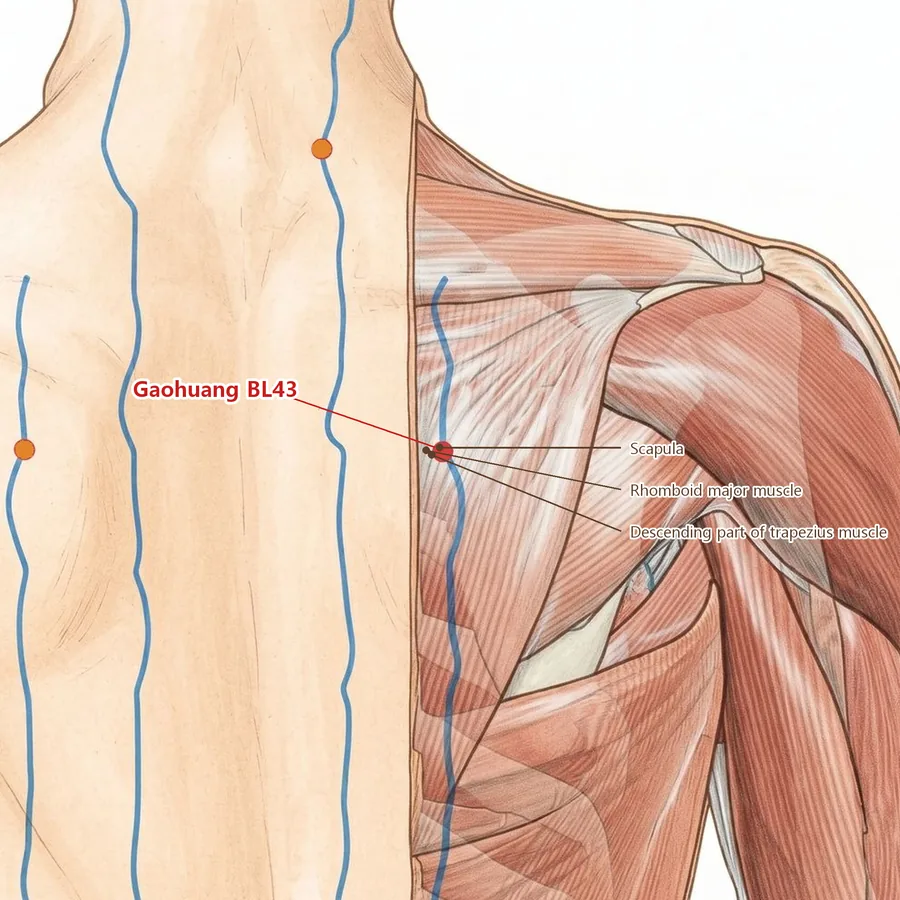
Location and structures come from our 3D model; only the drawing style was refined with AI. Labels are added by us.


Vertebra t4 · Descending part of trapezius muscle · Rhomboid major muscle · Scapula
Rendered straight from the 3D model at the computed location. The glowing ring marks Gaohuang.
On this page
1Where is Gaohuang?
Upper back, 3 cun out from the back midline at the level of T4.
The level is set by the lower edge of the T4 spinous process.
Vertebra t4 · Descending part of trapezius muscle · Rhomboid major muscle · Scapula
2How do I find it on my body?
- Find T3, level with the inner ends of the scapular spines (arms hanging). The next spinous process down is T4.
- Take the height of the lower edge of that spinous process.
- Press 3 cun out from the midline. With the arms hanging, this is the vertical line along the inner border of the shoulder blade.
- If the blade covers the spot, fold the arms in front so the shoulder blades slide outward, then press.

A cun is a body-scaled unit of length. The precise way is to divide a bone length into equal parts (proportional bone cun); finger widths are a quick estimate.
- descending part of trapezius
- The upper part of trapezius. It starts at the back of the skull and neck and runs down to the outer collarbone, and it shrugs the shoulder up.
- spinous process
- The bony spike sticking backward from the middle of each spine bone. The row of bumps you feel down the middle of the back is these, and they serve as the counting marks for back points.
- rhomboid major
- A diamond-shaped muscle under trapezius, between the upper back bones and the inner edge of the shoulder blade. It pulls the blade toward the spine.
3Before you press
- Do not bear down hard on the spine or ribs with an elbow or a tool.
- Avoid broken or swollen skin and press only to a comfortable level.
- Acupressure is not a substitute for medical care.
4How has it been used traditionally?
- Not in the Zhenjiu Jiayi Jing's 3-cun line; it appears in Sun Simiao's Qianjin Yaofang (7th century) at the 4th thoracic vertebra.
- Gao and huang name the deep region below the heart and above the diaphragm, as in the old saying that an illness has 'entered the gaohuang'.
From traditional texts — not a claim of effect.
?FAQ
Where exactly is Gaohuang?
Upper back, 3 cun out from the back midline at the level of T4. The level is set by the lower edge of the T4 spinous process.
How do I find Gaohuang?
Find T3, level with the inner ends of the scapular spines (arms hanging). The next spinous process down is T4. Take the height of the lower edge of that spinous process. Press 3 cun out from the midline. With the arms hanging, this is the vertical line along the inner border of the shoulder blade. If the blade covers the spot, fold the arms in front so the shoulder blades slide outward, then press. it is level with Jueyinshu (BL14).
What should I watch out for?
Do not bear down hard on the spine or ribs with an elbow or a tool. Avoid broken or swollen skin and press only to a comfortable level. Acupressure is not a substitute for medical care.
Sources
- Location: WHO Standard Acupuncture Point Locations in the Western Pacific Region (2008), p. 121
- Standard comparison: Chinese national standard GB/T 12346-2021 (Nomenclature and location of meridian points), p. 18–19 — same location
- Korean anatomical terms: KMLE medical dictionary
- Traditional-use cross-check: AcuAtlas dataset (CC BY 4.0)
- Classical record: absent from Zhenjiu Jiayi Jing vol. 3, sec. 9; listed in Qianjin Yaofang, Mingtang Sanren Tu (Siku Quanshu edition, vol. 87)
- 3D: computed on Z-Anatomy (CC BY-SA 4.0) · BodyParts3D © DBCLS
Positions computed from the WHO standard locations (2008) on Z-Anatomy (CC BY-SA 4.0) · BodyParts3D © DBCLS. For reference only — not a substitute for diagnosis or treatment. See a clinician if you are unwell.