Kunlun 崑崙
Back and outer side of the ankle, in the hollow between the outer ankle bone (lateral malleolus) and the calcaneal tendon.
Open the 3D Acupoint Map →
🖼See it in pictures

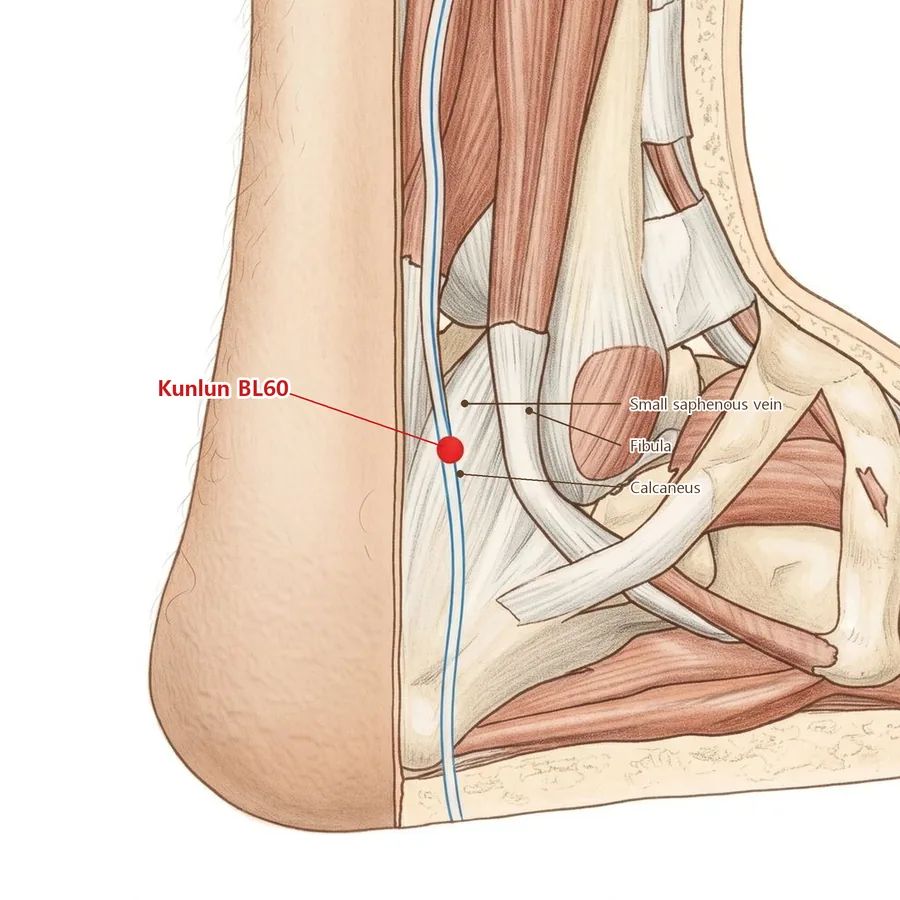
Location and structures come from our 3D model; only the drawing style was refined with AI. Labels are added by us.
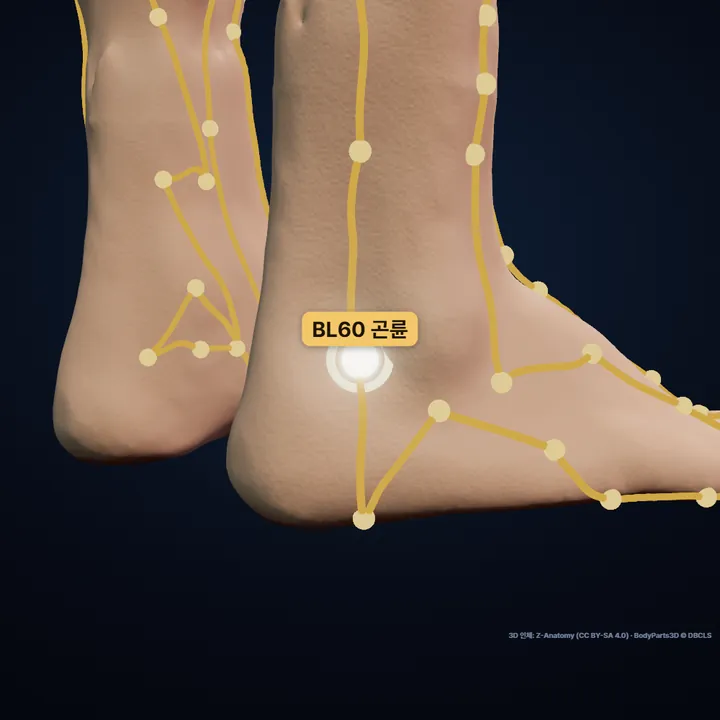
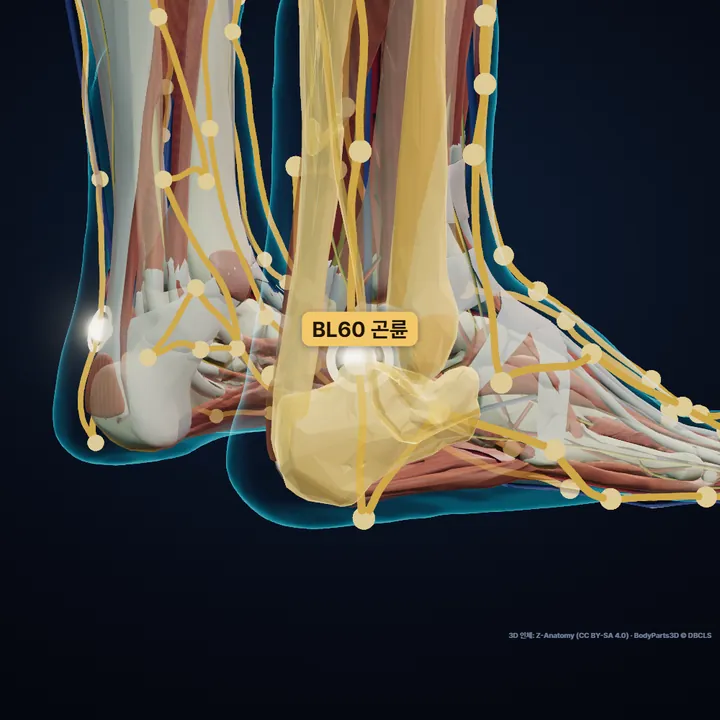
Fibula · Calcaneal tendon · Small saphenous vein · Calcaneus
Rendered straight from the 3D model at the computed location. The glowing ring marks Kunlun.
On this page
1Where is Kunlun?
Back and outer side of the ankle, in the hollow between the outer ankle bone (lateral malleolus) and the calcaneal tendon.
It is level with the highest point of the ankle bone.
Fibula · Calcaneal tendon · Small saphenous vein · Calcaneus
2How do I find it on my body?
- Find the highest point of the round bone on the outside of the ankle (lateral malleolus).
- Find the thick tendon above the heel (calcaneal tendon).
- Press the hollow between them.
- small saphenous vein
- A vein under the skin that starts on the outer foot, passes behind the outer ankle and climbs the middle of the back of the calf to the back of the knee.
- lateral malleolus
- The bump on the outer side of the ankle, the lower end of the fibula. It sits a little lower and farther back than the inner ankle bone.
3Before you press
- Do not press this point during pregnancy.
- It is traditionally avoided in pregnancy.
- Avoid broken or swollen skin and press only to a comfortable level.
- Acupressure is not a substitute for medical care.
4How has it been used traditionally?
- Classified as the Jing-river (Fire) point of the Bladder channel — a historical classification, not a claim of effect.
- Named after the Kunlun mountains, thought in ancient China to be the highest — the outer ankle bone is likened to a peak.
- The Ming-dynasty Yixue Rumen (1575) notes a pulse that can be felt at this spot, behind the outer ankle bone above the heel bone.
From traditional texts — not a claim of effect.
5Classical text
Donguibogam (Heo Jun, 1613), Acupuncture and Moxibustion, "Kunlun"
在足外踝後外骨上陷中《銅人》
在外骨上陷中細脈動應手《資生》
在外踝下一寸大筋下《資生》
足太陽脈之所行爲經 …《靈樞》
- ①Behind the outer ankle bone, in the dip above the 'outer bone' (other texts read 'heel bone'). Tongren Shuxue Zhenjiu Tujing
- ②In that dip a fine pulse can be felt under the finger. Zhenjiu Zisheng Jing
- ③Also given as 1 cun below the outer ankle bone, below the large tendon. Zhenjiu Zisheng Jing
- ④Where the Foot Taiyang channel flows on, which makes it the Jing-river point. Lingshu
- Source tags as given in the Donguibogam: Tongren = Tongren Shuxue Zhenjiu Tujing (1026), Zisheng = Zhenjiu Zisheng Jing (Wang Zhizhong, Southern Song), Lingshu = the Yellow Emperor's Inner Classic: Spiritual Pivot (the wording of line ④ is found in the Zhenjiu Jiayi Jing, vol.
- 3; Lingshu ch.
- 2 reads 'flows on at Kunlun … the Jing-river point').
- The garbled glyph 嚹 in the Wikisource text has been corrected to 踝 (ankle bone).
- '外骨' ('outer bone') reads '跟骨' (heel bone) in the Lingshu, the Zhenjiu Jiayi Jing and the Yixue Rumen, and 跟 never appears on this Wikisource page, so it may be garbled too; because 外 is also a common real character, it is left unchanged pending a check against a facsimile.
- Line ③ ('1 cun below the outer ankle bone') is an old description that differs from today's standard (WHO 2008: level with the prominence of the outer ankle bone).
- "…" marks the needling depth, retention time and moxa count, left out because they are for licensed practitioners.
Original text as written · translation is ours.
?FAQ
Where exactly is Kunlun?
Back and outer side of the ankle, in the hollow between the outer ankle bone (lateral malleolus) and the calcaneal tendon. It is level with the highest point of the ankle bone.
How do I find Kunlun?
Find the highest point of the round bone on the outside of the ankle (lateral malleolus). Find the thick tendon above the heel (calcaneal tendon). Press the hollow between them. it is level with the top of the ankle bone.
Can I press it during pregnancy?
Do not press this point during pregnancy.
What should I watch out for?
Do not press this point during pregnancy. It is traditionally avoided in pregnancy. Avoid broken or swollen skin and press only to a comfortable level. Acupressure is not a substitute for medical care.
Sources
- Location: WHO Standard Acupuncture Point Locations in the Western Pacific Region (2008), p. 129
- Standard comparison: Chinese national standard GB/T 12346-2021 (Nomenclature and location of meridian points), p. 20 — same location
- Korean anatomical terms: KMLE medical dictionary
- Traditional-use cross-check: AcuAtlas dataset (CC BY 4.0)
- Traditional use: Hyeoljari Seodang (Bookdramang, 2015; Korean), ch. 7 "Kunlun" and appendix (Yixue Rumen indications)
- Classical text: Donguibogam, Acupuncture and Moxibustion, "Kunlun" — Wikisource public edition (garbled glyph 嚹→踝 corrected; 外骨 left as is)
- Indications: Yixue Rumen vol. 1 (Wikisource)
- Classification source: Lingshu ch. 2 (Ben Shu); Zhenjiu Jiayi Jing vol. 3, sec. 35 (Fire)
- Safety: pregnancy caution point — cross-checked with the AcuAtlas dataset caution note
- 3D: computed on Z-Anatomy (CC BY-SA 4.0) · BodyParts3D © DBCLS
Positions computed from the WHO standard locations (2008) on Z-Anatomy (CC BY-SA 4.0) · BodyParts3D © DBCLS. For reference only — not a substitute for diagnosis or treatment. See a clinician if you are unwell.