Jiuwei 鳩尾
On the upper abdomen, on the front midline, 1 B-cun below the xiphisternal junction.
Open the 3D Acupoint Map →
🖼See it in pictures
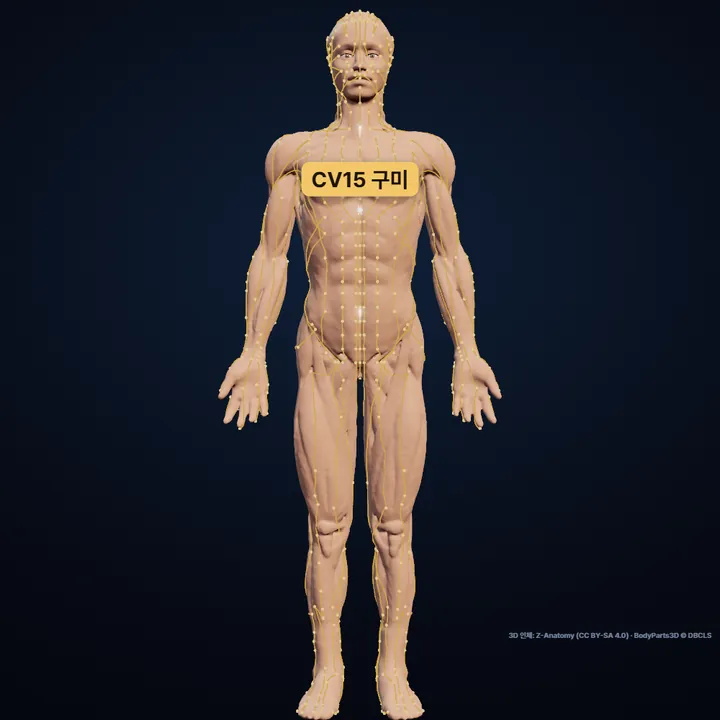
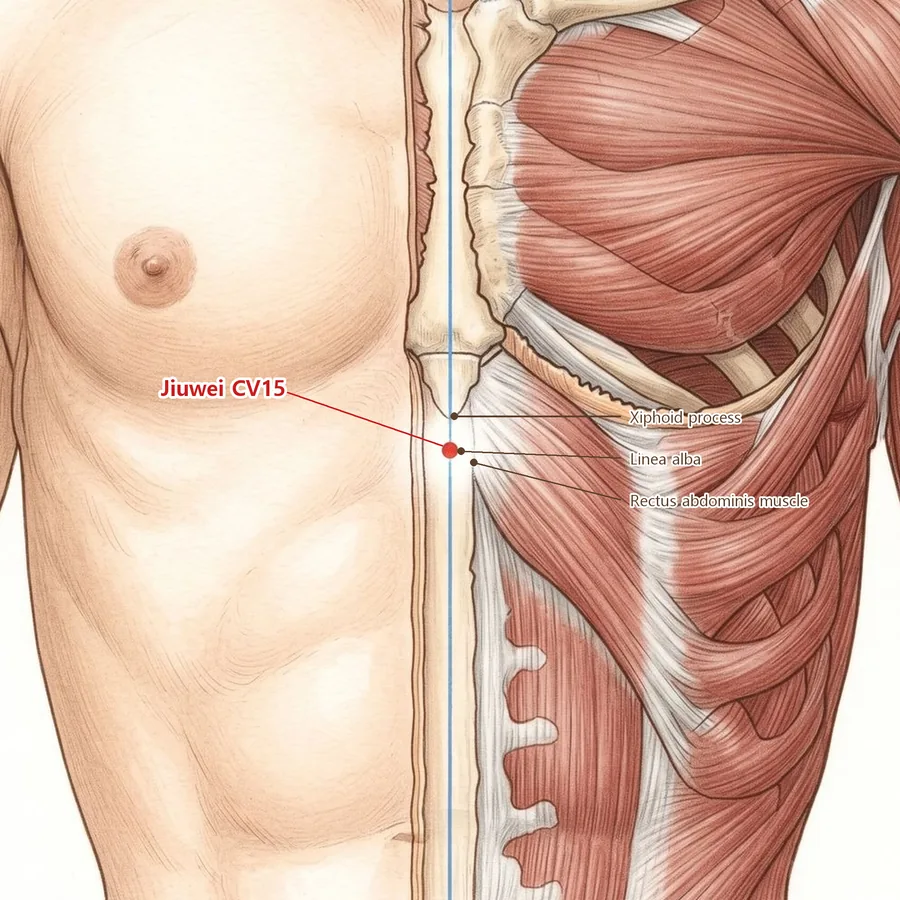
Location and structures come from our 3D model; only the drawing style was refined with AI. Labels are added by us.

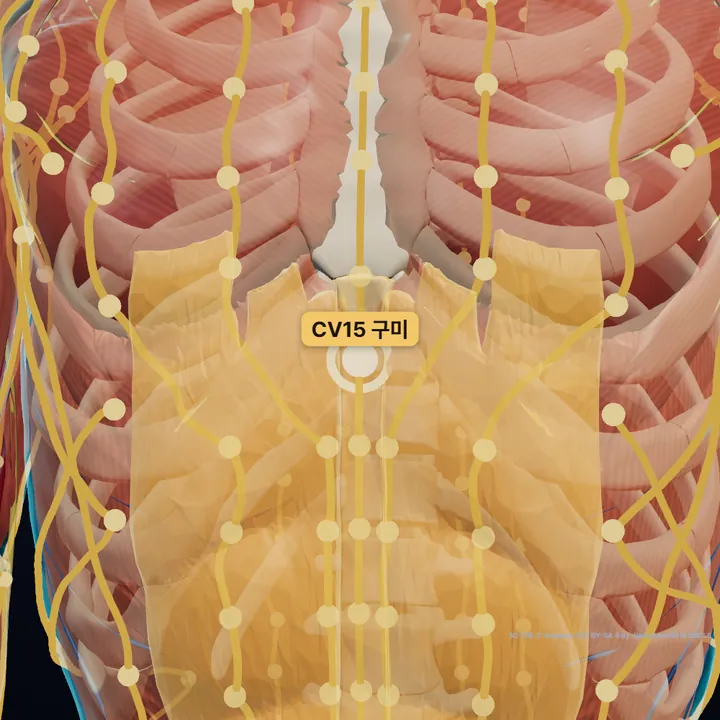
Xiphoid process · Linea alba · Rectus abdominis muscle · Rectus abdominis muscle
Rendered straight from the 3D model at the computed location. The glowing ring marks Jiuwei.
On this page
1Where is Jiuwei?
On the upper abdomen, on the front midline, 1 B-cun below the xiphisternal junction.
Xiphoid process · Linea alba · Rectus abdominis muscle · Rectus abdominis muscle
2How do I find it on my body?
- Follow the breastbone down to where the xiphoid process begins (the xiphisternal junction).
- Measure 1 B-cun down, using the abdominal scale (8 B-cun from the junction to the navel).

A cun is a body-scaled unit of length. The precise way is to divide a bone length into equal parts (proportional bone cun); finger widths are a quick estimate.
- xiphisternal junction
- Where the body of the breastbone meets the xiphoid process, just above the pit of the stomach. From here to the center of the navel is taken as 8 cun.
- rectus abdominis
- The long vertical muscle on each side of the middle of the belly, from the pubic bone to the rib cartilages, that bends the trunk forward. It makes the 'six-pack' blocks when tightened.
- linea alba
- A white line of tendon down the middle of the belly where the sheets of the belly muscles from both sides meet, from the bottom of the breastbone to the pubic bone. The navel lies on it.
- lower abdomen
- The belly below the navel, down to the pubic bone.
- xiphoid process
- The small pointed tip like a sword point at the very bottom of the breastbone, felt just above the pit of the stomach. It is fragile, so do not press hard.
3Before you press
- This is around the tip of the xiphoid process, so do not press hard or push upward.
- Crushing or squeezing pain in the centre of the chest needs emergency help: call emergency services at once and do not try acupressure.
- Do not press during pregnancy.
- WHO's acupuncture safety guidelines (1999) note that abdominal points are traditionally avoided in pregnancy (the lower abdomen in the first three months, the upper abdomen from the fourth month).
- Avoid broken or swollen skin and press only to a comfortable level.
- Acupressure is not a substitute for medical care.
4How has it been used traditionally?
- Classified as the Luo-connecting point of the Conception Vessel (Lingshu ch. 10, under its other name Weiyi) and the source point of the gao (Lingshu ch. 1) — a historical classification, not a claim of effect.
- Jiuwei, 'dove's tail', was also an old name for the xiphoid process itself.
From traditional texts — not a claim of effect.
?FAQ
Where exactly is Jiuwei?
On the upper abdomen, on the front midline, 1 B-cun below the xiphisternal junction.
How do I find Jiuwei?
Follow the breastbone down to where the xiphoid process begins (the xiphisternal junction). Measure 1 B-cun down, using the abdominal scale (8 B-cun from the junction to the navel). it is the same spot as 7 B-cun above the navel.
Can I press it during pregnancy?
Do not press during pregnancy.
What should I watch out for?
This is around the tip of the xiphoid process, so do not press hard or push upward. Crushing or squeezing pain in the centre of the chest needs emergency help: call emergency services at once and do not try acupressure. Do not press during pregnancy. WHO's acupuncture safety guidelines (1999) note that abdominal points are traditionally avoided in pregnancy (the lower abdomen in the first three months, the upper abdomen from the fourth month). Avoid broken or swollen skin and press only to a comfortable level. Acupressure is not a substitute for medical care.
Sources
- Location: WHO Standard Acupuncture Point Locations in the Western Pacific Region (2008), p. 227
- Standard comparison: Chinese national standard GB/T 12346-2021 (Nomenclature and location of meridian points)
- Korean point names: KMCRIC standard acupoint database
- Traditional-use cross-check: AcuAtlas dataset (CC BY 4.0)
- Classification source: Lingshu ch. 10 and ch. 1; Zhenjiu Jiayi Jing vols. 3 and 5
- Safety: WHO Guidelines on Basic Training and Safety in Acupuncture (1999), p. 20
- Safety: CCAOM Clean Needle Technique Manual, 7th ed. (rev. 2024), p. 13
- 3D: computed on Z-Anatomy (CC BY-SA 4.0) · BodyParts3D © DBCLS
Positions computed from the WHO standard locations (2008) on Z-Anatomy (CC BY-SA 4.0) · BodyParts3D © DBCLS. For reference only — not a substitute for diagnosis or treatment. See a clinician if you are unwell.