Fubai 浮白
On the head above and behind the mastoid process, one third of the way along a curve behind the ear.
Open the 3D Acupoint Map →
🖼See it in pictures
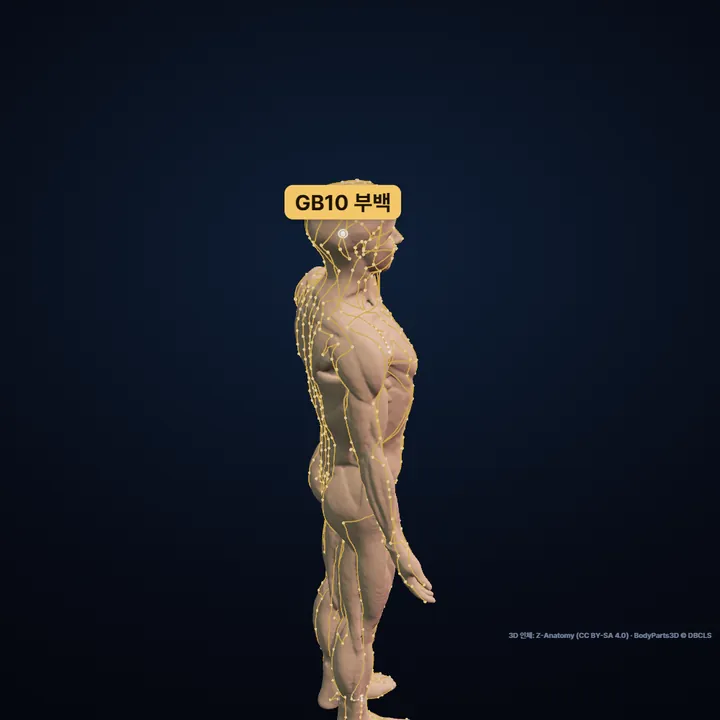
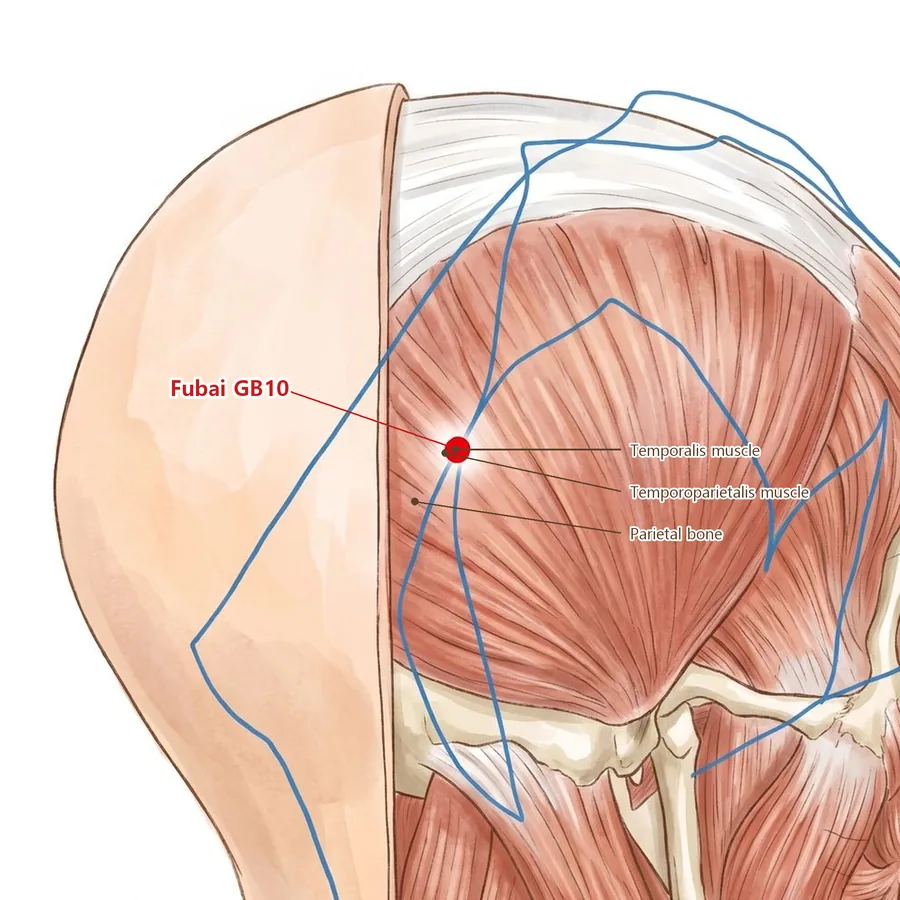
Location and structures come from our 3D model; only the drawing style was refined with AI. Labels are added by us.


Parietal bone · Temporalis muscle · Temporoparietalis muscle
Rendered straight from the 3D model at the computed location. The glowing ring marks Fubai.
On this page
1Where is Fubai?
On the head above and behind the mastoid process, one third of the way along a curve behind the ear.
The curve follows the ear from Tianchong (GB9) down to Wangu (GB12).
Parietal bone · Temporalis muscle · Temporoparietalis muscle
2How do I find it on my body?
- Find Tianchong and Wangu.
- Join them with a curve that follows the back of the ear and split it into thirds.
- Press the first mark from the top.

A cun is a body-scaled unit of length. The precise way is to divide a bone length into equal parts (proportional bone cun); finger widths are a quick estimate.
- temporoparietalis
- A thin muscle on the side of the head above the ear. Its size varies a lot between people.
- mastoid process
- The bone sticking down just behind the earlobe. It is part of the temporal bone, and sternocleidomastoid attaches to it.
- parietal bone
- The pair of wide skull bones covering the top and upper sides of the head. They meet along the middle of the crown.
3Before you press
- This is on the scalp — press lightly with a fingertip.
- After a blow to the head, do not press; get checked first.
- Avoid broken or swollen skin and press only to a comfortable level.
- Acupressure is not a substitute for medical care.
4How has it been used traditionally?
- Classified as a crossing point of the Bladder and Gallbladder meridians (Zhenjiu Jiayi Jing) — a historical classification, not a claim of effect.
- The name is usually translated as 'Floating White'.
From traditional texts — not a claim of effect.
?FAQ
Where exactly is Fubai?
On the head above and behind the mastoid process, one third of the way along a curve behind the ear. The curve follows the ear from Tianchong (GB9) down to Wangu (GB12).
How do I find Fubai?
Find Tianchong and Wangu. Join them with a curve that follows the back of the ear and split it into thirds. Press the first mark from the top. it is behind the top of the ear, about 1 B-cun above the hairline.
What should I watch out for?
This is on the scalp — press lightly with a fingertip. After a blow to the head, do not press; get checked first. Avoid broken or swollen skin and press only to a comfortable level. Acupressure is not a substitute for medical care.
Sources
- Location: WHO Standard Acupuncture Point Locations in the Western Pacific Region (2008), p. 176
- Standard comparison: Chinese national standard GB/T 12346-2021 (Nomenclature and location of meridian points)
- Korean anatomical terms and point names: KMCRIC Standard Acupoint DB (Korea)
- Classification source: Zhenjiu Jiayi Jing (Huangfu Mi), vol. 3
- Traditional use cross-check: AcuAtlas dataset (CC BY 4.0)
- 3D: computed on Z-Anatomy (CC BY-SA 4.0) · BodyParts3D © DBCLS
Positions computed from the WHO standard locations (2008) on Z-Anatomy (CC BY-SA 4.0) · BodyParts3D © DBCLS. For reference only — not a substitute for diagnosis or treatment. See a clinician if you are unwell.