Jianjing 肩井
Back of the base of the neck, halfway between the C7 spinous process and the outer tip of the acromion.
Open the 3D Acupoint Map →
🖼See it in pictures
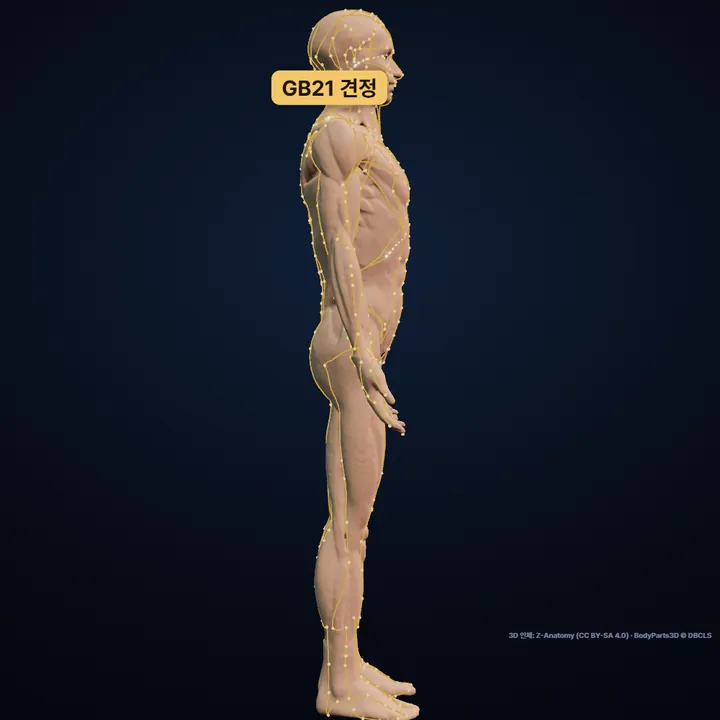

Location and structures come from our 3D model; only the drawing style was refined with AI. Labels are added by us.

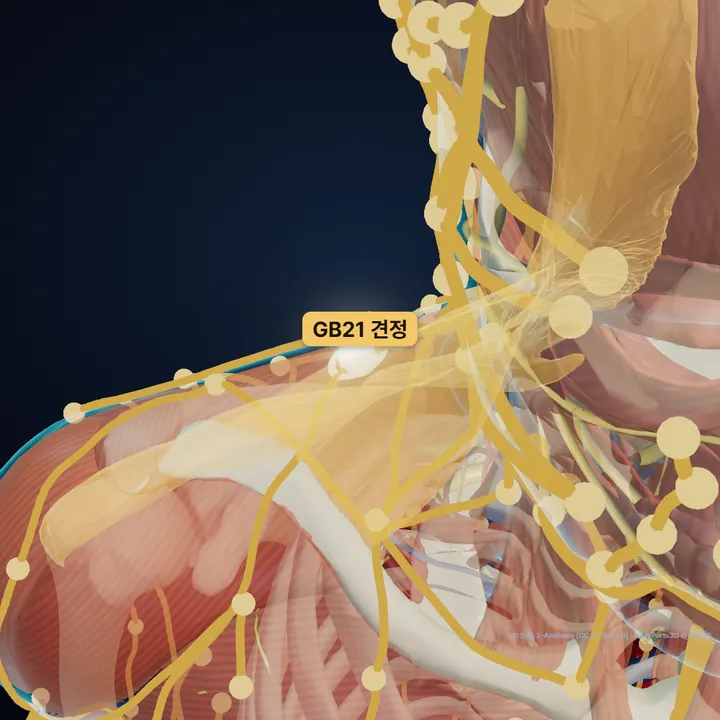
Ascending part of trapezius muscle · Supraspinatus muscle · Levator scapulae
Rendered straight from the 3D model at the computed location. The glowing ring marks Jianjing.
On this page
1Where is Jianjing?
Back of the base of the neck, halfway between the C7 spinous process and the outer tip of the acromion.
Ascending part of trapezius muscle · Supraspinatus muscle · Levator scapulae
2How do I find it on my body?
- Bend the head forward and find the most prominent bone at the base of the neck (C7 spinous process).
- Find the outermost tip of the flat bone at the top of the shoulder (acromion).
- Press halfway between them, on the crest of the shoulder muscle (trapezius).
- ascending part of trapezius
- The lower part of trapezius. It starts at the middle and lower back bones and slants up to the spine of the shoulder blade, pulling the blade down.
- levator scapulae
- A strap-like muscle on the back side of the neck, linking the upper neck bones to the top corner of the shoulder blade. As its name says, it lifts the blade.
- spinous process
- The bony spike sticking backward from the middle of each spine bone. The row of bumps you feel down the middle of the back is these, and they serve as the counting marks for back points.
- supraspinatus
- The muscle filling the hollow above the spine of the shoulder blade (supraspinous fossa). It lies under trapezius and works when you begin lifting the arm sideways.
3Before you press
- Do not press this point during pregnancy.
- The top of the lung lies not far below — do not press down hard from above.
- Avoid broken or swollen skin and press only to a comfortable level.
- Acupressure is not a substitute for medical care.
- Sudden face drooping, weakness on one side or slurred speech can mean a stroke — call emergency services at once; do not try acupressure.
4How has it been used traditionally?
- Classified as a crossing point of the Triple Energizer meridian and the Yang Wei vessel (Zhenjiu Jiayi Jing) — a historical classification, not a claim of effect.
- The name is usually translated as 'Shoulder Well'.
From traditional texts — not a claim of effect.
?FAQ
Where exactly is Jianjing?
Back of the base of the neck, halfway between the C7 spinous process and the outer tip of the acromion.
How do I find Jianjing?
Bend the head forward and find the most prominent bone at the base of the neck (C7 spinous process). Find the outermost tip of the flat bone at the top of the shoulder (acromion). Press halfway between them, on the crest of the shoulder muscle (trapezius).
Can I press it during pregnancy?
Do not press this point during pregnancy.
What should I watch out for?
Do not press this point during pregnancy. The top of the lung lies not far below — do not press down hard from above. Avoid broken or swollen skin and press only to a comfortable level. Acupressure is not a substitute for medical care. Sudden face drooping, weakness on one side or slurred speech can mean a stroke — call emergency services at once; do not try acupressure.
Sources
- Location: WHO Standard Acupuncture Point Locations in the Western Pacific Region (2008), p. 182
- Standard comparison: Chinese national standard GB/T 12346-2021 (Nomenclature and location of meridian points)
- Korean anatomical terms and point names: KMCRIC Standard Acupoint DB (Korea)
- Classification source: Zhenjiu Jiayi Jing (Huangfu Mi), vol. 3
- Traditional use cross-check: AcuAtlas dataset (CC BY 4.0)
- Seven points for wind-stroke moxibustion: Lee BH et al. (2009), Journal of Meridian & Acupoint 26(3):103–110 (Korean)
- Pregnancy caution: AcuAtlas dataset (CC BY 4.0), caution field
- 3D: computed on Z-Anatomy (CC BY-SA 4.0) · BodyParts3D © DBCLS
Positions computed from the WHO standard locations (2008) on Z-Anatomy (CC BY-SA 4.0) · BodyParts3D © DBCLS. For reference only — not a substitute for diagnosis or treatment. See a clinician if you are unwell.