Huantiao 環跳
Buttock, one third of the way from the greater trochanter's most prominent point toward the sacral hiatus (WHO main location).
Open the 3D Acupoint Map →
🖼See it in pictures
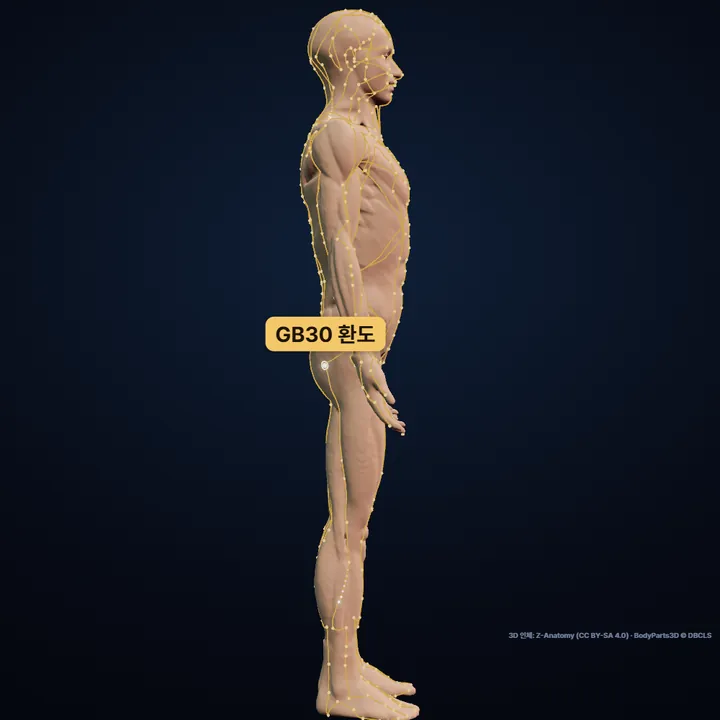
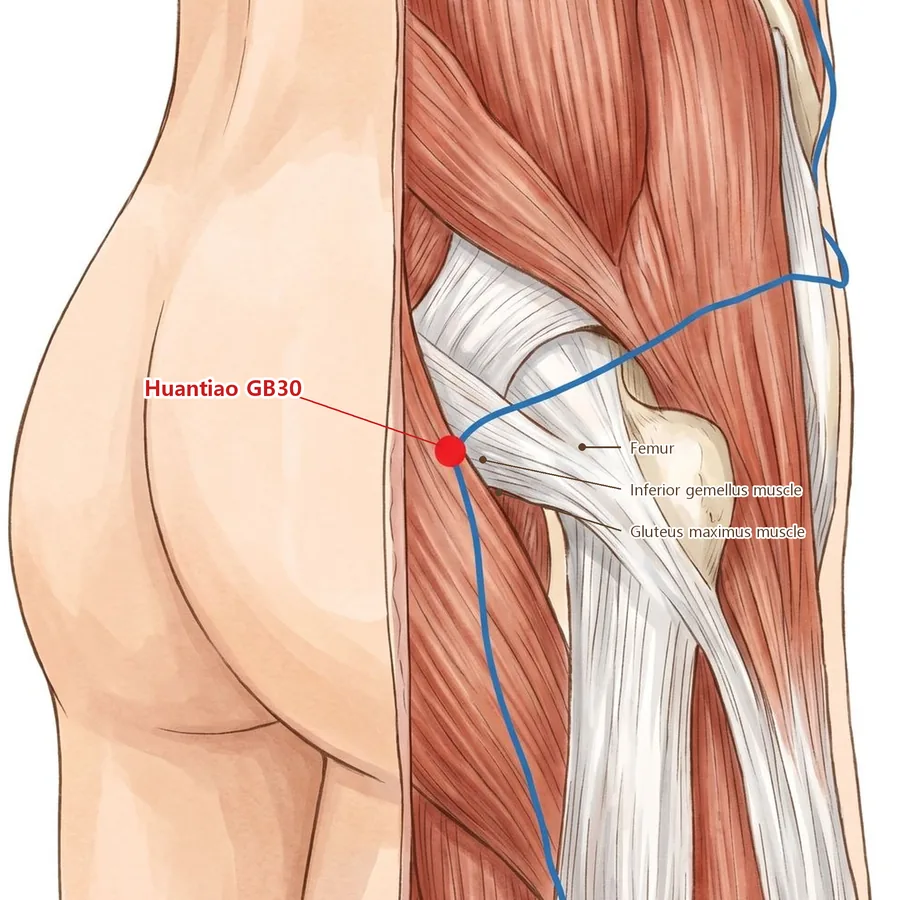
Location and structures come from our 3D model; only the drawing style was refined with AI. Labels are added by us.


Gluteus maximus muscle · Inferior gemellus muscle · Femur
Rendered straight from the 3D model at the computed location. The glowing ring marks Huantiao.
On this page
1Where is Huantiao?
Buttock, one third of the way from the greater trochanter's most prominent point toward the sacral hiatus (WHO main location).
It is easier to find lying on the side with the thigh bent.
Gluteus maximus muscle · Inferior gemellus muscle · Femur
2How do I find it on my body?
- Lie on the side with the lower leg straight and the upper hip and knee bent.
- Find the greater trochanter.
- Find the small notch at the lower end of the sacrum, just above the tailbone (sacral hiatus).
- Join the two and press one third of the way along from the trochanter.
- inferior gemellus
- A small muscle deep in the buttock, running from just above the sitting bone to the greater trochanter. It lies beside its twin (superior gemellus), hence the name, and turns the leg outward.
- sacral hiatus
- The opening at the lower back end of the sacrum where the bone does not close. You feel it as a small dip just above the top of the cleft between the buttocks.
- sciatic nerve
- The thickest nerve in the body. It comes out deep in the buttock (below piriformis) and runs down the middle of the back of the thigh, splitting above the knee into the tibial and common fibular nerves.
- gluteus maximus
- The large, thick muscle that forms the buttock. It swings the leg back and gives power for climbing stairs and standing up.
- greater trochanter
- The big bony knob at the upper outer end of the femur. Below the side of the hip, it rolls under your palm when you turn the leg in and out.
3Before you press
- The sciatic nerve runs deep in the buttock — do not lean body weight through an elbow for long, and stop if a tingling, shooting feeling runs down the leg.
- Avoid broken or swollen skin and press only to a comfortable level.
- Acupressure is not a substitute for medical care.
4How has it been used traditionally?
- A Gallbladder meridian point on the buttock; the Zhenjiu Jiayi Jing describes taking it lying on the side with the upper leg bent.
- The name is usually translated as 'Jumping Circle'.
From traditional texts — not a claim of effect.
5Alternative location
On the line from the greater trochanter's most prominent point to the anterior superior iliac spine, one third of the way from the trochanter. It lies further forward than the main location (WHO 2008 Remarks).
Chinese standard (2021) differs · China's 2021 standard gives only the main location (sacral hiatus line), with no alternative; posture: side-lying, lower leg straight, upper hip and knee bent.
?FAQ
Where exactly is Huantiao?
Buttock, one third of the way from the greater trochanter's most prominent point toward the sacral hiatus (WHO main location). It is easier to find lying on the side with the thigh bent.
How do I find Huantiao?
Lie on the side with the lower leg straight and the upper hip and knee bent. Find the greater trochanter. Find the small notch at the lower end of the sacrum, just above the tailbone (sacral hiatus). Join the two and press one third of the way along from the trochanter.
What should I watch out for?
The sciatic nerve runs deep in the buttock — do not lean body weight through an elbow for long, and stop if a tingling, shooting feeling runs down the leg. Avoid broken or swollen skin and press only to a comfortable level. Acupressure is not a substitute for medical care.
Sources
- Location: WHO Standard Acupuncture Point Locations in the Western Pacific Region (2008), p. 186
- Standard comparison: Chinese national standard GB/T 12346-2021 (Nomenclature and location of meridian points)
- Korean anatomical terms and point names: KMCRIC Standard Acupoint DB (Korea)
- Traditional use cross-check: AcuAtlas dataset (CC BY 4.0)
- 3D: computed on Z-Anatomy (CC BY-SA 4.0) · BodyParts3D © DBCLS
Positions computed from the WHO standard locations (2008) on Z-Anatomy (CC BY-SA 4.0) · BodyParts3D © DBCLS. For reference only — not a substitute for diagnosis or treatment. See a clinician if you are unwell.