Qiangjian 強間
On the head, on the back midline, 4 B-cun above the middle of the back hairline.
Open the 3D Acupoint Map →
🖼See it in pictures
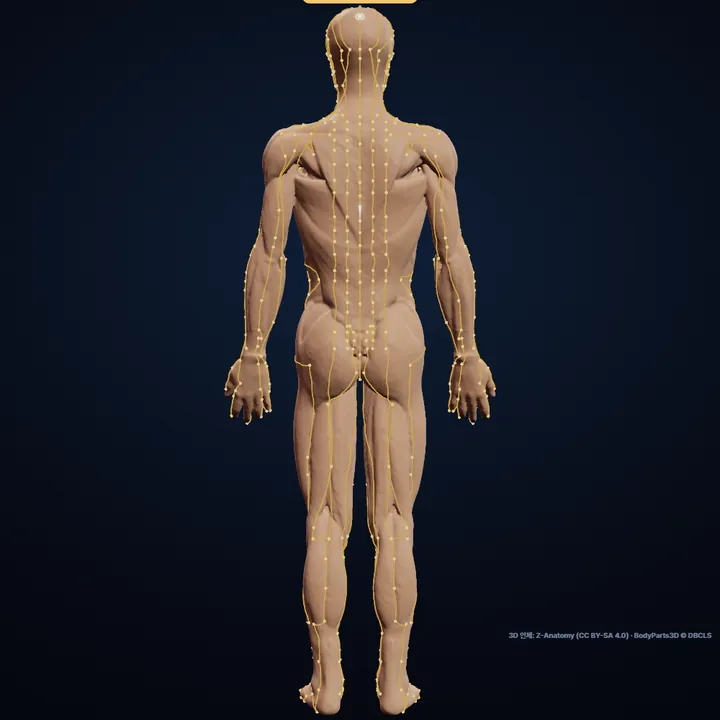
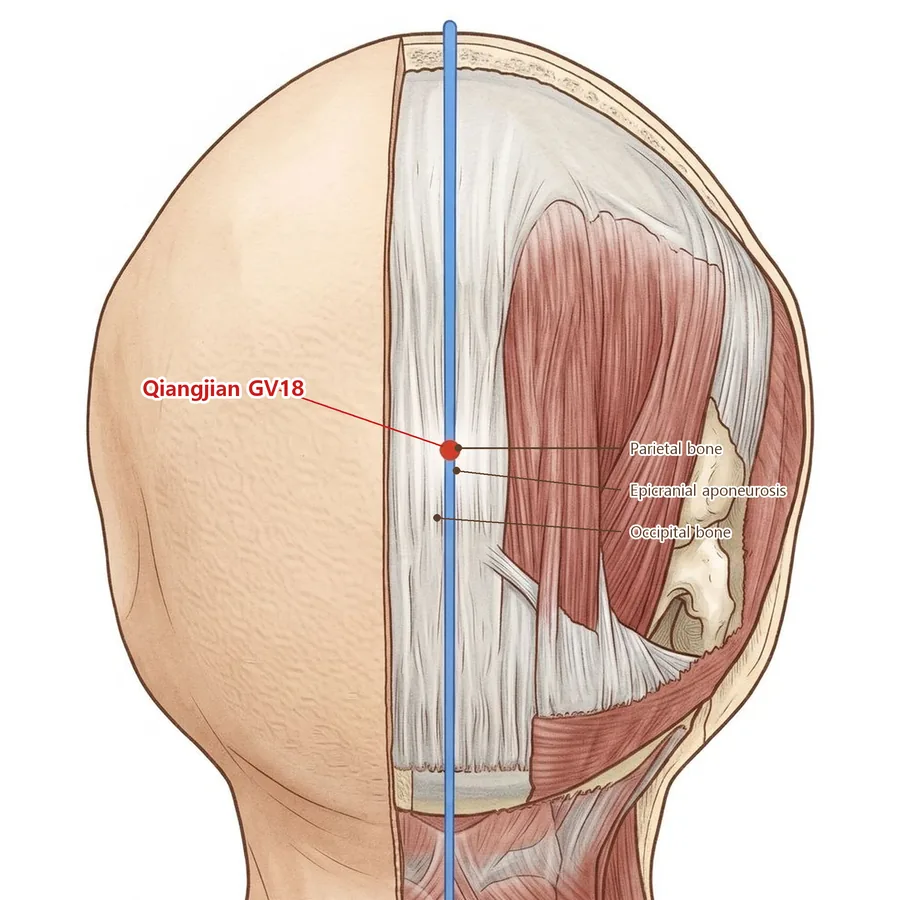
Location and structures come from our 3D model; only the drawing style was refined with AI. Labels are added by us.
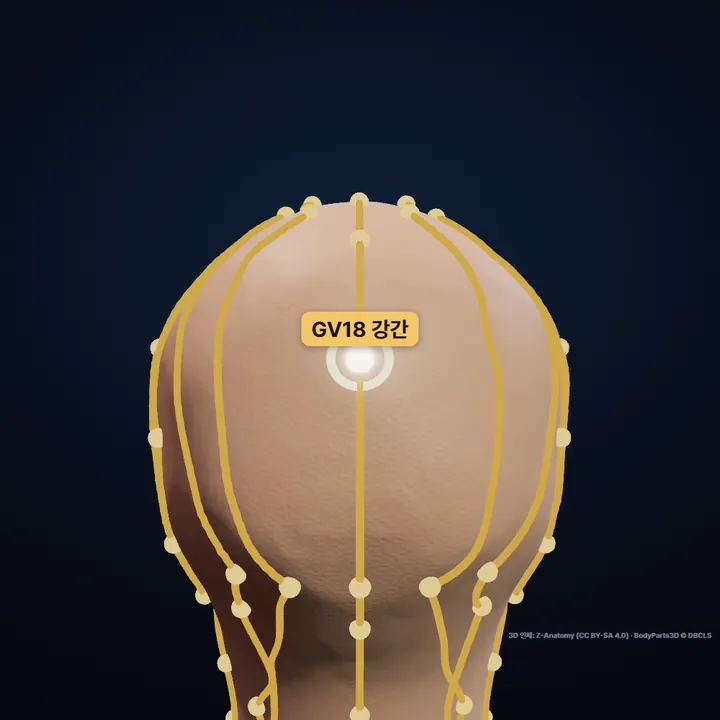
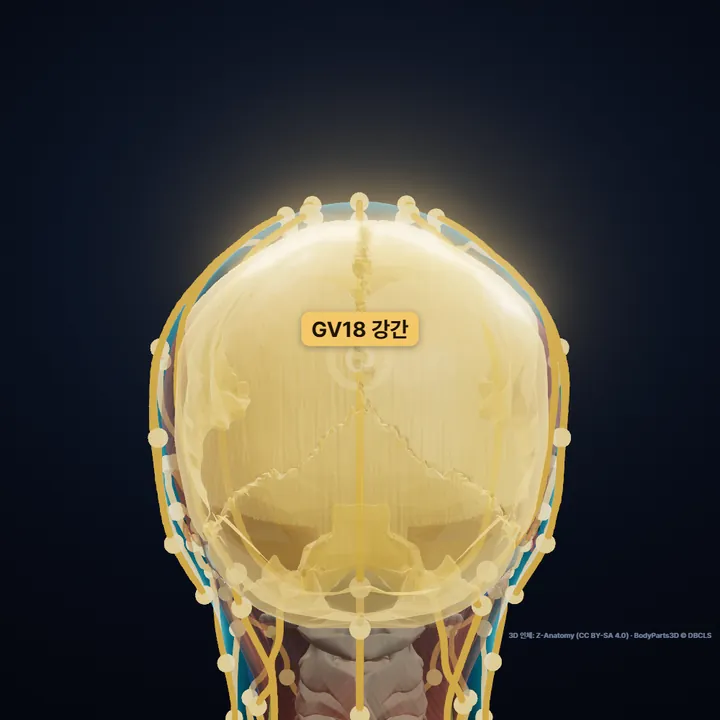
Occipital bone · Parietal bone · Epicranial aponeurosis · Parietal bone · Epicranial aponeurosis
Rendered straight from the 3D model at the computed location. The glowing ring marks Qiangjian.
On this page
1Where is Qiangjian?
On the head, on the back midline, 4 B-cun above the middle of the back hairline.
It is the hollow 1.5 B-cun above GV17 (Naohu).
Occipital bone · Parietal bone · Epicranial aponeurosis · Parietal bone · Epicranial aponeurosis
2How do I find it on my body?
- Treat the distance from the middle of the front hairline to the middle of the back hairline as 12 B-cun.
- Measure 4 B-cun up from the back hairline.

A cun is a body-scaled unit of length. The precise way is to divide a bone length into equal parts (proportional bone cun); finger widths are a quick estimate.
- epicranial aponeurosis
- A thin, tough sheet of tendon covering the top of the head like a cap, joined to frontalis in front and occipitalis behind. When the scalp moves, it slides with this sheet.
- occipital bone
- The skull bone at the lower back of the head. You can feel a bump in its middle (external occipital protuberance), and the spinal cord passes through the big hole at its base.
- parietal bone
- The pair of wide skull bones covering the top and upper sides of the head. They meet along the middle of the crown.
3Before you press
- Avoid broken or swollen skin and press only to a comfortable level.
- Acupressure is not a substitute for medical care.
4How has it been used traditionally?
- It carries no special category in the classical lists; the Zhenjiu Jiayi Jing (vol. 3) places it 1.5 cun behind GV19.
From traditional texts — not a claim of effect.
?FAQ
Where exactly is Qiangjian?
On the head, on the back midline, 4 B-cun above the middle of the back hairline. It is the hollow 1.5 B-cun above GV17 (Naohu).
How do I find Qiangjian?
Treat the distance from the middle of the front hairline to the middle of the back hairline as 12 B-cun. Measure 4 B-cun up from the back hairline. it matches the hollow 1.5 B-cun above GV17.
What should I watch out for?
Avoid broken or swollen skin and press only to a comfortable level. Acupressure is not a substitute for medical care.
Sources
- Location: WHO Standard Acupuncture Point Locations in the Western Pacific Region (2008), p. 212
- Standard comparison: Chinese national standard GB/T 12346-2021 (Nomenclature and location of meridian points)
- Traditional-use cross-check: AcuAtlas dataset (CC BY 4.0)
- Alternative name: Zhenjiu Jiayi Jing vol. 3
- 3D: computed on Z-Anatomy (CC BY-SA 4.0) · BodyParts3D © DBCLS
Positions computed from the WHO standard locations (2008) on Z-Anatomy (CC BY-SA 4.0) · BodyParts3D © DBCLS. For reference only — not a substitute for diagnosis or treatment. See a clinician if you are unwell.