Lingdao 靈道
Front-inner forearm, 1.5 cun above the palm-side wrist crease.
Open the 3D Acupoint Map →
🖼See it in pictures

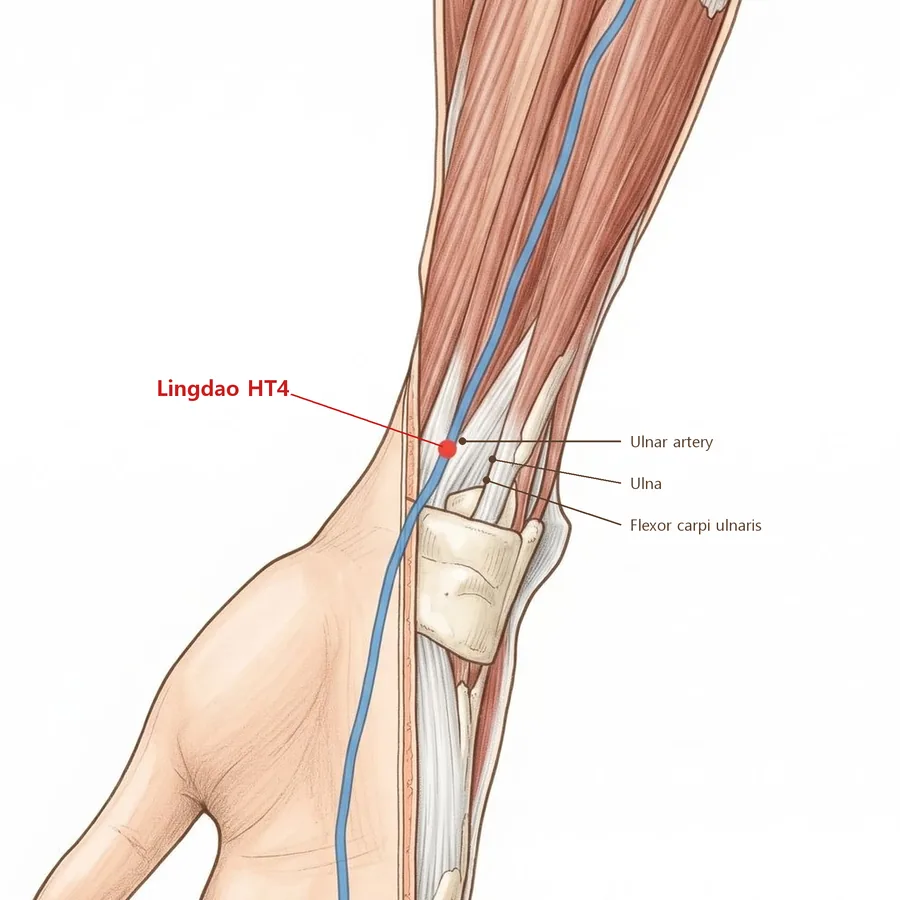
Location and structures come from our 3D model; only the drawing style was refined with AI. Labels are added by us.
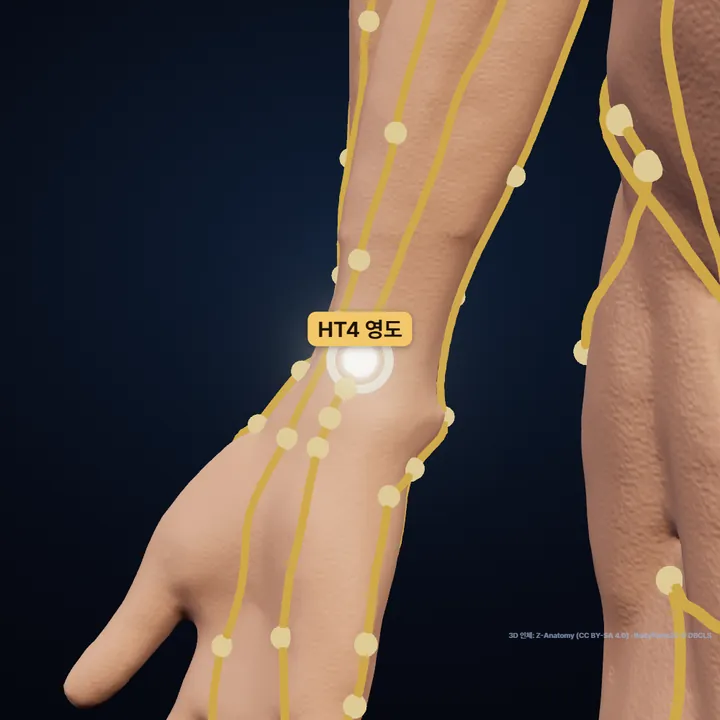

Ulna · Flexor carpi ulnaris · Ulnar artery
Rendered straight from the 3D model at the computed location. The glowing ring marks Lingdao.
On this page
1Where is Lingdao?
Front-inner forearm, 1.5 cun above the palm-side wrist crease.
It lies right on the thumb side of the flexor carpi ulnaris tendon, level with the upper edge (root) of the ulnar head.
Ulna · Flexor carpi ulnaris · Ulnar artery
2How do I find it on my body?
- Palm up, make a loose fist: the flexor carpi ulnaris tendon stands out on the little-finger side of the wrist.
- From HT7 on the wrist crease, go 1.5 cun toward the elbow (one eighth of the 12-cun wrist-to-elbow span).
- Press on the thumb-side edge of the tendon.

A cun is a body-scaled unit of length. The precise way is to divide a bone length into equal parts (proportional bone cun); finger widths are a quick estimate.
- flexor carpi ulnaris
- A muscle along the little-finger edge of the palm side of the forearm, running to the pisiform. It bends the wrist and tilts it toward the little finger.
- wrist crease
- The horizontal crease that forms at the wrist when it is slightly bent. There is one on the palm side and one on the back, and they are starting lines for measuring arm points.
- ulnar artery
- The artery running deep along the little-finger side of the forearm into the palm. A faint pulse can be felt at the little-finger side of the wrist, beside the flexor carpi ulnaris tendon.
- ulnar nerve
- The nerve running down the inner arm to the little-finger side. It passes through a bony groove at the back of the inner elbow; bump it and you feel a jolt down to the little finger (the 'funny bone').
3Before you press
- The ulnar artery and ulnar nerve run just on the thumb side of this tendon.
- Do not press hard or long where you feel a pulse.
- Ease off if the fingers tingle.
- Avoid broken or swollen skin and press only to a comfortable level.
- Acupressure is not a substitute for medical care.
- Crushing chest pain, breathlessness or a cold sweat can signal a heart emergency — call emergency services at once; do not try acupressure.
4How has it been used traditionally?
- Classified as the Jing-river (Metal) point of the Heart meridian — a historical classification, not a claim of effect.
- The name joins ling (spirit) and dao (path).
From traditional texts — not a claim of effect.
5Classical text
Donguibogam (Heo Jun, 1613), Acupuncture and Moxibustion, "Lingdao"
在掌後一寸五分手少陰脈之所行爲經 …《銅人》
① 1.5 cun behind the palm. Where the Hand Shaoyin channel moves along, which makes it the Jing-river point (Tongren Shuxue Zhenjiu Tujing).
- Source tags as given in the Donguibogam: Tongren = Tongren Shuxue Zhenjiu Tujing (1026).
- "…" marks the needling depth and moxa count, left out because they are for licensed practitioners.
Original text as written · translation is ours.
?FAQ
Where exactly is Lingdao?
Front-inner forearm, 1.5 cun above the palm-side wrist crease. It lies right on the thumb side of the flexor carpi ulnaris tendon, level with the upper edge (root) of the ulnar head.
How do I find Lingdao?
Palm up, make a loose fist: the flexor carpi ulnaris tendon stands out on the little-finger side of the wrist. From HT7 on the wrist crease, go 1.5 cun toward the elbow (one eighth of the 12-cun wrist-to-elbow span). Press on the thumb-side edge of the tendon. it is level with the upper edge of the ulnar head, felt on the back of the wrist.
What should I watch out for?
The ulnar artery and ulnar nerve run just on the thumb side of this tendon. Do not press hard or long where you feel a pulse. Ease off if the fingers tingle. Avoid broken or swollen skin and press only to a comfortable level. Acupressure is not a substitute for medical care. Crushing chest pain, breathlessness or a cold sweat can signal a heart emergency — call emergency services at once; do not try acupressure.
Sources
- Location: WHO Standard Acupuncture Point Locations in the Western Pacific Region (2008), p. 83
- Standard comparison: Chinese national standard GB/T 12346-2021 (Nomenclature and location of meridian points), p. 14
- Korean anatomical terms: KMLE medical dictionary (Korean Medical Association terms)
- Classification source: Zhenjiu Jiayi Jing vol. 3 for the Heart five transport points (Lingshu ch. 2 lists the Pericardium points under 'Heart'); Nanjing ch. 64 for the phases
- Traditional use: Hyeoljari Seodang (Bookdramang, 2015; Korean), ch. 5 "Lingdao" and appendix (Yixue Rumen indications)
- Classical text: Donguibogam, Acupuncture and Moxibustion, "Lingdao" — Wikisource public edition
- Indications: Yixue Rumen vol. 1 (Wikisource)
- Classification and traditional-use cross-check: AcuAtlas dataset (CC BY 4.0)
- 3D: computed on Z-Anatomy (CC BY-SA 4.0) · BodyParts3D © DBCLS
Positions computed from the WHO standard locations (2008) on Z-Anatomy (CC BY-SA 4.0) · BodyParts3D © DBCLS. For reference only — not a substitute for diagnosis or treatment. See a clinician if you are unwell.