Yingu 陰谷
Back-inner side of the knee, on the knee crease, just to the outer side of the semitendinosus tendon.
Open the 3D Acupoint Map →
🖼See it in pictures
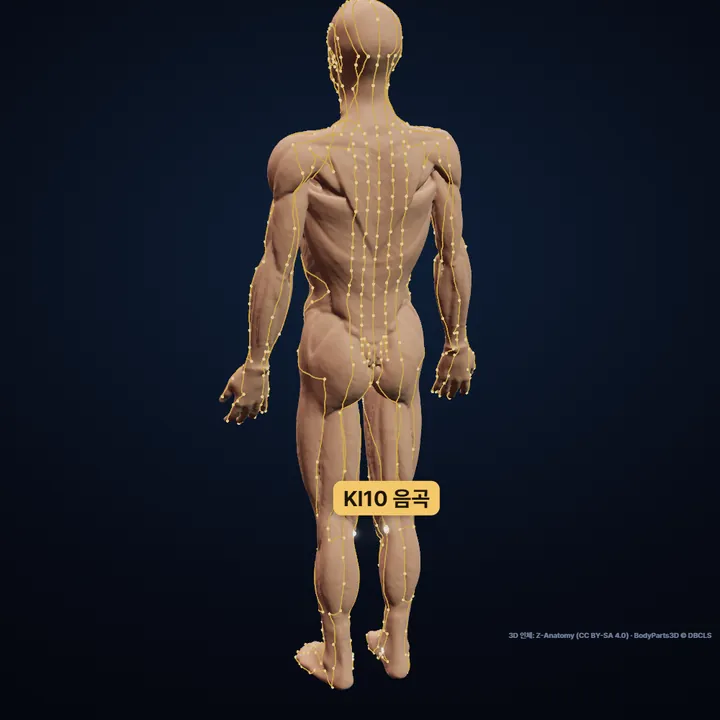
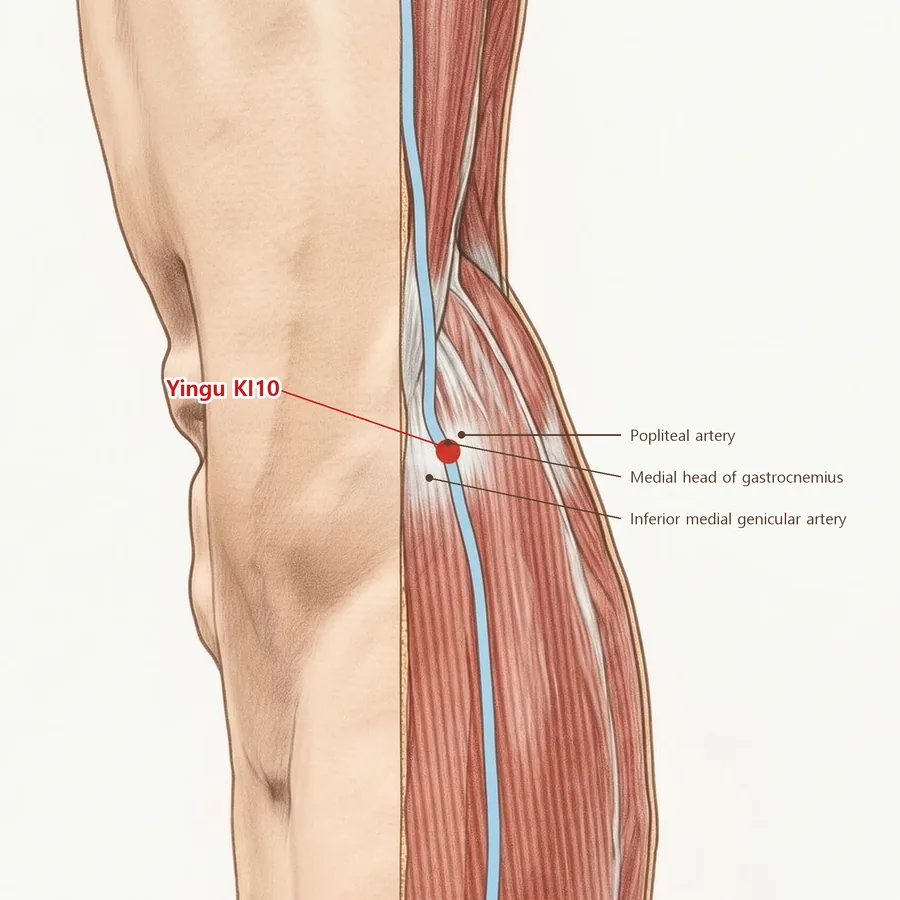
Location and structures come from our 3D model; only the drawing style was refined with AI. Labels are added by us.
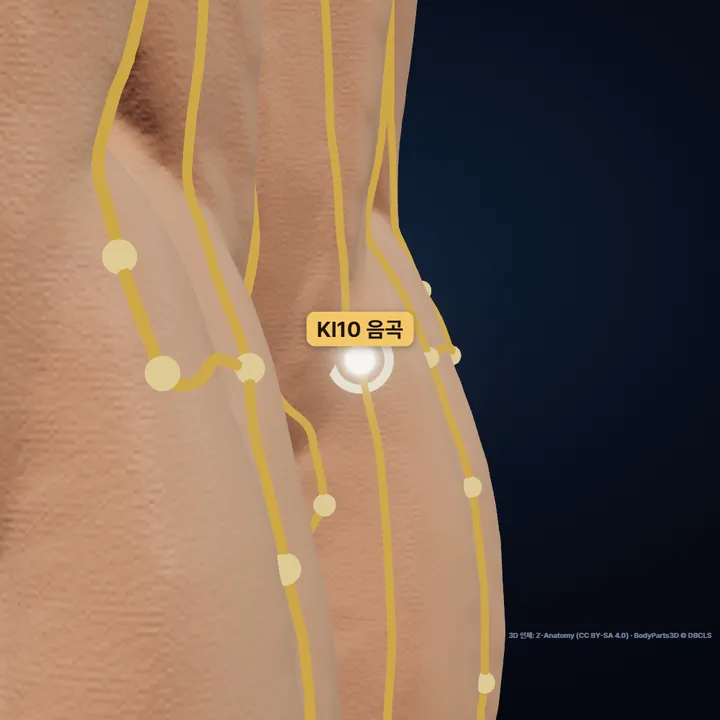

Medial head of gastrocnemius · Inferior medial genicular artery · Popliteal artery
Rendered straight from the 3D model at the computed location. The glowing ring marks Yingu.
On this page
1Where is Yingu?
Back-inner side of the knee, on the knee crease, just to the outer side of the semitendinosus tendon.
Medial head of gastrocnemius · Inferior medial genicular artery · Popliteal artery
2How do I find it on my body?
- Bend the knee slightly so the crease behind it shows.
- Hook a finger into the inner side of the knee hollow — you can feel two tendons.
- The thin, cord-like one nearer the middle is the semitendinosus.
- Press on the crease just to the outer side of that tendon.
- medial head of gastrocnemius
- The inner of the two heads of gastrocnemius. It is bigger and reaches lower than the outer head.
- inferior medial genicular artery
- A thin branch of the popliteal artery that wraps around the lower inner knee.
- semitendinosus
- A muscle on the inner back of the thigh. Its lower half is a long tendon, hence its name; bend the knee and the thin tendon stands out like a cord on the inner side of the back of the knee.
- popliteal artery
- The artery deep in the back of the knee, continuing from the femoral artery. Bend the knee slightly and press deep in the middle of the back of the knee to feel its pulse.
- tibial nerve
- A branch of the sciatic nerve that runs through the middle of the back of the knee and deep in the calf, then behind the inner ankle to the sole. It handles the back calf muscles and feeling in the sole.
3The classical posture
- Sit and bend the knee (the classical "found with the knee bent").
- At the inner edge of the knee hollow, feel between the two tendons — the old texts say below the large sinew and above the small one.
- The old texts add that a pulse meets the finger here; do not push deep toward the centre.
- Our 3D model keeps the knee straight, so this hollow hardly shows; the bent-knee method lands at roughly the same spot as "How to find" above (on the crease, just outside the semitendinosus tendon).
4Before you press
- The popliteal artery and tibial nerve run through the middle of the knee hollow — do not push into the centre; press only beside the tendon.
- Avoid broken or swollen skin and press only to a comfortable level.
- Acupressure is not a substitute for medical care.
5How has it been used traditionally?
- Classified as the He-sea (Water) point of the Kidney meridian — a historical classification, not a claim of effect.
- The name is usually translated as 'Yin Valley': the hollow on the inner (yin) side behind the knee, between two tendons.
- Classical texts say to find it with the knee bent.
From traditional texts — not a claim of effect.
6Classical text
Donguibogam (Heo Jun, 1613), Acupuncture and Moxibustion, "Yingu"
在膝內輔骨後大筋下小筋上《銅人》
在輔骨之後大筋之下小筋之上有動脈按之應手屈膝而得之《靈樞》
足少陰脈之所入爲合 …《銅人》
- ①On the inner knee, behind the "assisting bone", below the large sinew and above the small one. Tongren Shuxue Zhenjiu Tujing
- ②Behind the assisting bone, below the large sinew and above the small one; a pulse meets the finger when pressed, and it is found with the knee bent. Lingshu
- ③Where the Foot Shaoyin channel enters, which makes it the He-sea point. Tongren Shuxue Zhenjiu Tujing
- Source tags as given in the Donguibogam: Tongren = Tongren Shuxue Zhenjiu Tujing, Lingshu = the Yellow Emperor's Inner Classic: Spiritual Pivot.
- Lingshu ch.
- 2 has the same wording without "there is a pulse".
- "Assisting bone" (fugu) is an old name for the bone beside a joint.
- Which modern tendons the "large" and "small" sinews correspond to has not been confirmed.
- "…" marks the needling depth and moxa count, left out because they are for licensed practitioners.
Original text as written · translation is ours.
?FAQ
Where exactly is Yingu?
Back-inner side of the knee, on the knee crease, just to the outer side of the semitendinosus tendon.
How do I find Yingu?
Bend the knee slightly so the crease behind it shows. Hook a finger into the inner side of the knee hollow — you can feel two tendons. The thin, cord-like one nearer the middle is the semitendinosus. Press on the crease just to the outer side of that tendon. it is level with BL40.
What should I watch out for?
The popliteal artery and tibial nerve run through the middle of the knee hollow — do not push into the centre; press only beside the tendon. Avoid broken or swollen skin and press only to a comfortable level. Acupressure is not a substitute for medical care.
Sources
- Location: WHO Standard Acupuncture Point Locations in the Western Pacific Region (2008), p. 140
- Standard comparison: Chinese national standard GB/T 12346-2021 (Nomenclature and location of meridian points)
- Korean anatomical terms and point names: KMCRIC Standard Acupoint DB (Korea)
- Classification source: Lingshu ch. 2 (Ben Shu) for the five transport points; Zhenjiu Jiayi Jing vol. 3 for the phases
- Posture and traditional use: Hyeoljari Seodang (Bookdramang, 2015; Korean), ch. 8 "Yingu" and appendix (Yixue Rumen indications)
- Classical text: Donguibogam, Acupuncture and Moxibustion, "Yingu" — Wikisource public edition (no glyph corrections needed)
- Indications: Yixue Rumen vol. 1 (Wikisource)
- Traditional use cross-check: AcuAtlas dataset (CC BY 4.0)
- 3D: computed on Z-Anatomy (CC BY-SA 4.0) · BodyParts3D © DBCLS
Positions computed from the WHO standard locations (2008) on Z-Anatomy (CC BY-SA 4.0) · BodyParts3D © DBCLS. For reference only — not a substitute for diagnosis or treatment. See a clinician if you are unwell.