Lingxu 靈墟
Front of the chest, 2 B-cun out from the front midline, in the third intercostal space.
Open the 3D Acupoint Map →
🖼See it in pictures

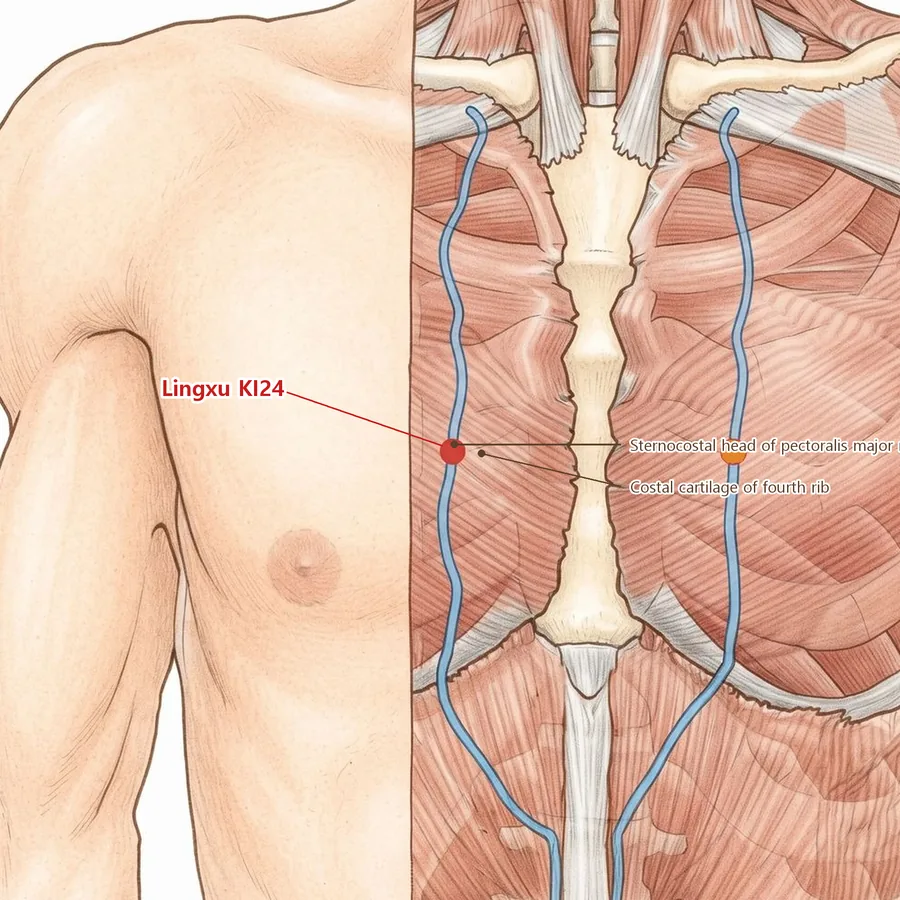
Location and structures come from our 3D model; only the drawing style was refined with AI. Labels are added by us.
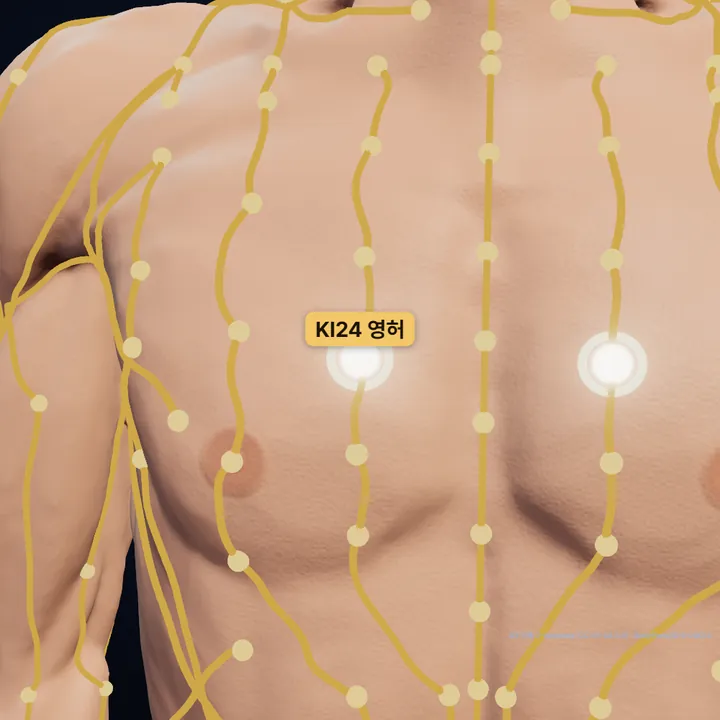

Sternocostal head of pectoralis major muscle · Costal cartilage of fourth rib
Rendered straight from the 3D model at the computed location. The glowing ring marks Lingxu.
On this page
1Where is Lingxu?
Front of the chest, 2 B-cun out from the front midline, in the third intercostal space.
Sternocostal head of pectoralis major muscle · Costal cartilage of fourth rib
2How do I find it on my body?
- Width scale: nipple to nipple is 8 B-cun, so midline to nipple is 4 B-cun and 2 B-cun is halfway.
- Find the ridge across the upper breastbone (sternal angle) — the 2nd rib sits beside it.
- The gap just below that rib is the 2nd intercostal space; count down from there to the 3rd.
- Press where the 2 B-cun line meets that space.

A cun is a body-scaled unit of length. The precise way is to divide a bone length into equal parts (proportional bone cun); finger widths are a quick estimate.
- sternocostal head of pectoralis major
- The large middle part of pectoralis major, starting from the breastbone and upper rib cartilages. It pulls the arm in toward the body.
- intercostal space
- The gap between two ribs, felt with a fingertip as a slight groove between bone and bone. It is named after the rib above it (the gap below the first rib is the first intercostal space).
- costal cartilage
- The firm cartilage that joins the front end of a rib to the breastbone. It is a little softer and more bendy than bone, so the chest can expand when we breathe.
- sternal angle
- The slight horizontal ridge where the manubrium meets the body of the breastbone; slide a finger down from the notch at the base of the neck and it catches on it. The second rib attaches right beside it, so it is the starting mark for counting ribs.
3Before you press
- The pleura and lung lie close beneath the rib spaces — do not dig a fingertip in deeply.
- Avoid broken or swollen skin and press only to a comfortable level.
- Acupressure is not a substitute for medical care.
- For crushing chest pain or sudden breathlessness, call emergency services at once; do not try acupressure.
4How has it been used traditionally?
- A Kidney meridian point on the chest; the Zhenjiu Jiayi Jing lists it among the spots where Kidney-channel qi surfaces — a historical description, not a claim of effect.
- The name is usually translated as 'Spirit Ruins'.
From traditional texts — not a claim of effect.
?FAQ
Where exactly is Lingxu?
Front of the chest, 2 B-cun out from the front midline, in the third intercostal space.
How do I find Lingxu?
Width scale: nipple to nipple is 8 B-cun, so midline to nipple is 4 B-cun and 2 B-cun is halfway. Find the ridge across the upper breastbone (sternal angle) — the 2nd rib sits beside it. The gap just below that rib is the 2nd intercostal space; count down from there to the 3rd. Press where the 2 B-cun line meets that space. it is about halfway between CV18 and ST16.
What should I watch out for?
The pleura and lung lie close beneath the rib spaces — do not dig a fingertip in deeply. Avoid broken or swollen skin and press only to a comfortable level. Acupressure is not a substitute for medical care. For crushing chest pain or sudden breathlessness, call emergency services at once; do not try acupressure.
Sources
- Location: WHO Standard Acupuncture Point Locations in the Western Pacific Region (2008), p. 147
- Standard comparison: Chinese national standard GB/T 12346-2021 (Nomenclature and location of meridian points)
- Korean anatomical terms and point names: KMCRIC Standard Acupoint DB (Korea)
- Classical description: Zhenjiu Jiayi Jing vol. 3 ('where Foot Shaoyin qi emerges')
- Traditional use cross-check: AcuAtlas dataset (CC BY 4.0)
- 3D: computed on Z-Anatomy (CC BY-SA 4.0) · BodyParts3D © DBCLS
Positions computed from the WHO standard locations (2008) on Z-Anatomy (CC BY-SA 4.0) · BodyParts3D © DBCLS. For reference only — not a substitute for diagnosis or treatment. See a clinician if you are unwell.