Pianli 偏歷
Back-and-thumb side of the forearm, 3 cun above the back wrist crease.
Open the 3D Acupoint Map →
🖼See it in pictures
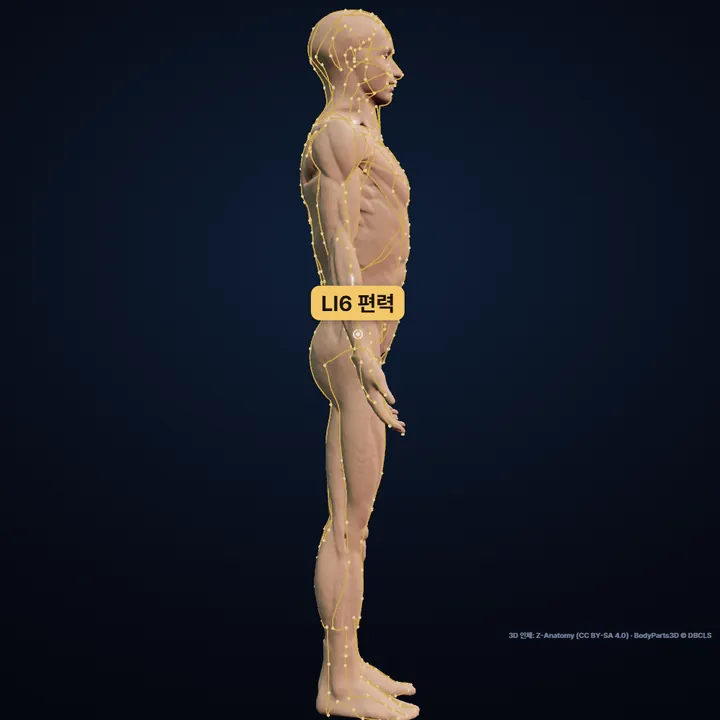
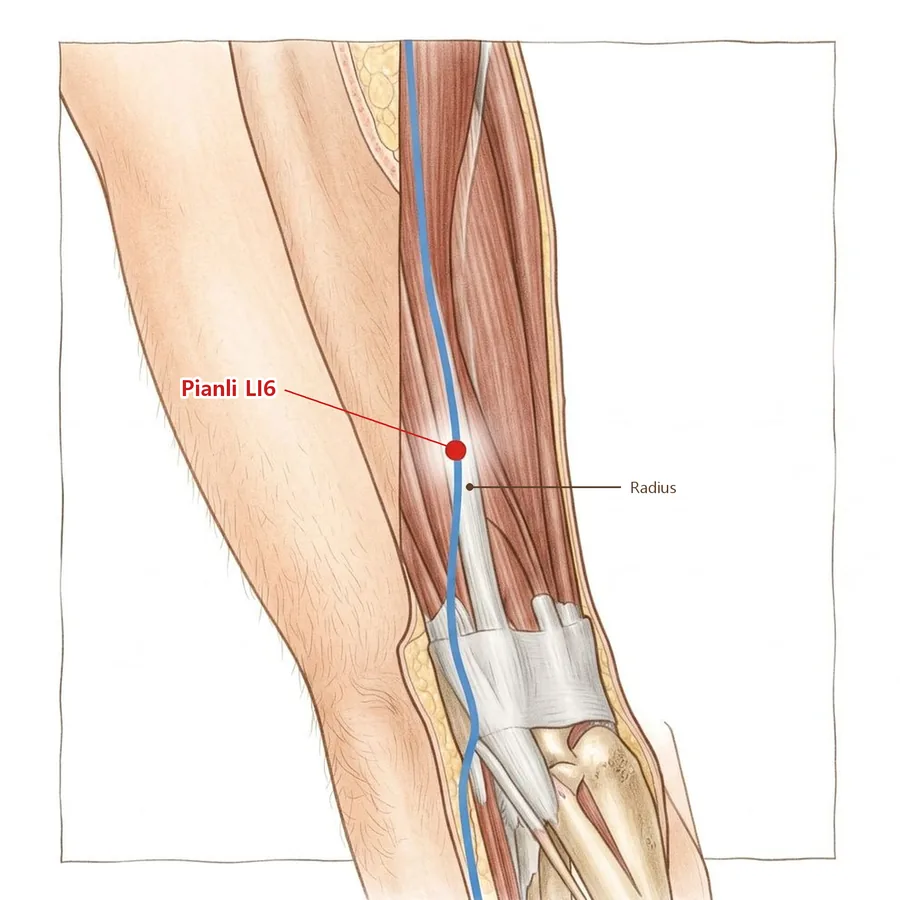
Location and structures come from our 3D model; only the drawing style was refined with AI. Labels are added by us.
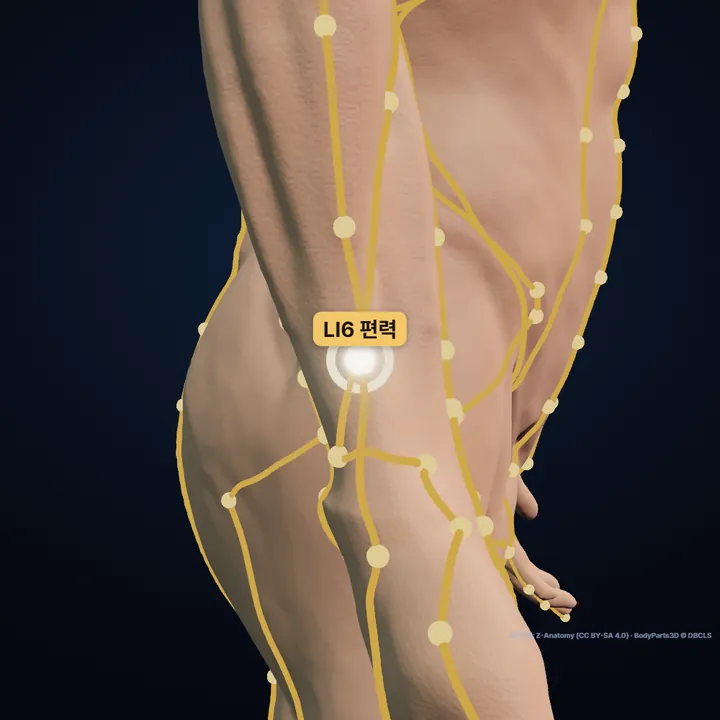
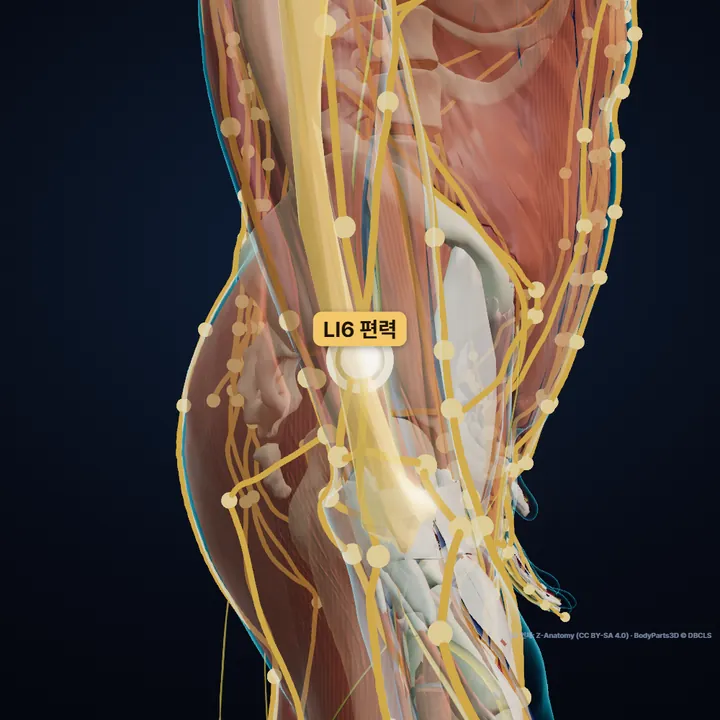
Radius
Rendered straight from the 3D model at the computed location. The glowing ring marks Pianli.
On this page
1Where is Pianli?
Back-and-thumb side of the forearm, 3 cun above the back wrist crease.
It lies on the line joining LI5 at the wrist and LI11 at the elbow.
Radius
2How do I find it on my body?
- Find LI5 in the anatomical snuffbox at the wrist and LI11 at the elbow (with the elbow fully bent, the hollow at the outer end of the elbow crease).
- Divide the distance between them into 12 equal parts: halve, halve again, then split each part into thirds.
- Count 3 parts up from LI5.
- anatomical snuffbox
- The small hollow on the thumb side of the wrist when the thumb is pulled back hard, bordered in front by the abductor pollicis longus and extensor pollicis brevis tendons and behind by the extensor pollicis longus tendon. The scaphoid and the radial pulse can be felt at its floor, and the name comes from people once placing snuff here.
- wrist crease
- The horizontal crease that forms at the wrist when it is slightly bent. There is one on the palm side and one on the back, and they are starting lines for measuring arm points.
3Before you press
- Avoid broken, bruised or swollen skin and press only to a comfortable level.
- Acupressure is not a substitute for medical care.
4How has it been used traditionally?
- In classical theory this is the Luo-connecting point, where a branch leaves the Large Intestine channel to join its paired Lung channel (Lingshu, ch. 10).
From traditional texts — not a claim of effect.
?FAQ
Where exactly is Pianli?
Back-and-thumb side of the forearm, 3 cun above the back wrist crease. It lies on the line joining LI5 at the wrist and LI11 at the elbow.
How do I find Pianli?
Find LI5 in the anatomical snuffbox at the wrist and LI11 at the elbow (with the elbow fully bent, the hollow at the outer end of the elbow crease). Divide the distance between them into 12 equal parts: halve, halve again, then split each part into thirds. Count 3 parts up from LI5. this is a quarter of the way up from the wrist.
What should I watch out for?
Avoid broken, bruised or swollen skin and press only to a comfortable level. Acupressure is not a substitute for medical care.
Sources
- Location: WHO Standard Acupuncture Point Locations in the Western Pacific Region (2008), p. 36
- Korean anatomical terms: KMCRIC standard acupoint database · KMLE medical dictionary
- Luo-connecting: Lingshu, chapter 10 (Jing Mai)
- Classification cross-check: AcuAtlas dataset (CC BY 4.0)
- 3D: computed on Z-Anatomy (CC BY-SA 4.0) · BodyParts3D © DBCLS
Positions computed from the WHO standard locations (2008) on Z-Anatomy (CC BY-SA 4.0) · BodyParts3D © DBCLS. For reference only — not a substitute for diagnosis or treatment. See a clinician if you are unwell.