Zhongfeng 中封
On the front-inner ankle, in the hollow in front of the medial malleolus.
Open the 3D Acupoint Map →
🖼See it in pictures
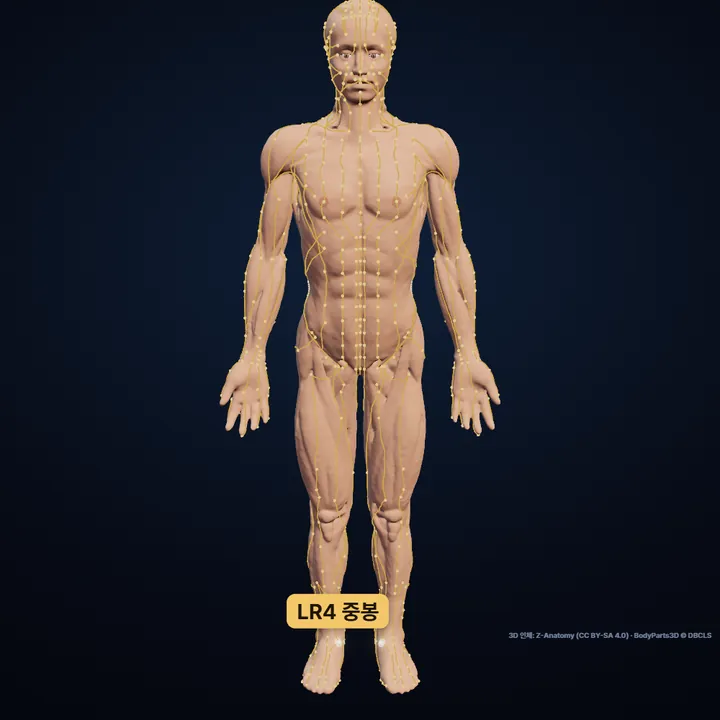

Location and structures come from our 3D model; only the drawing style was refined with AI. Labels are added by us.
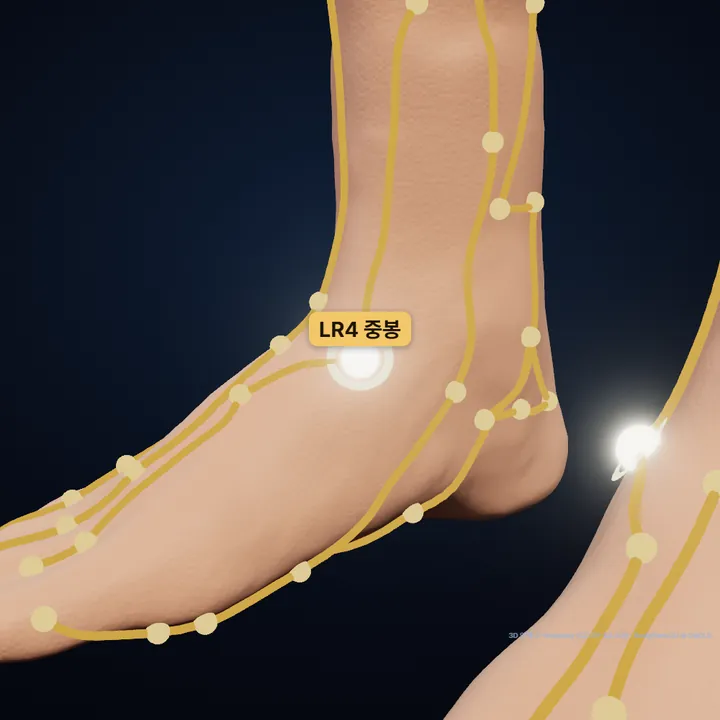
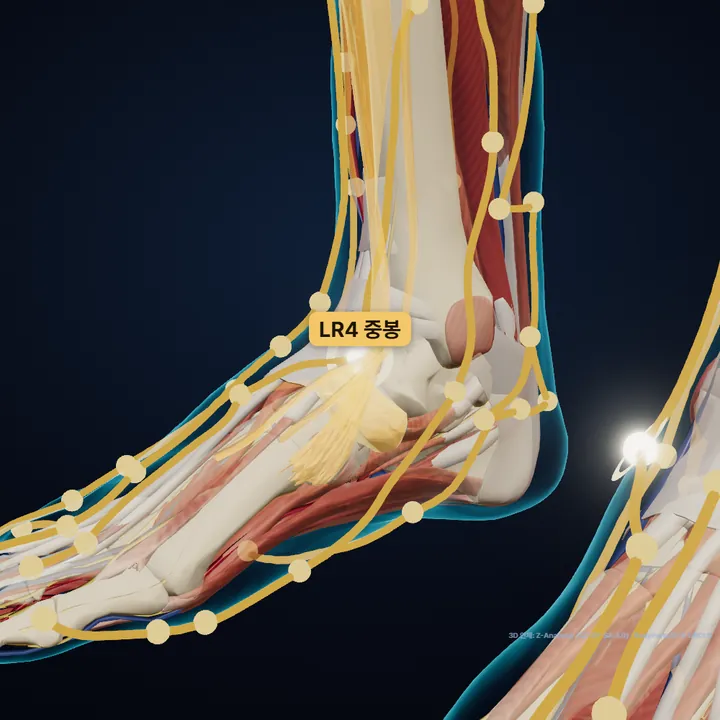
Great saphenous vein · Tibialis anterior muscle · Navicular bone · Dorsalis pedis artery
Rendered straight from the 3D model at the computed location. The glowing ring marks Zhongfeng.
On this page
1Where is Zhongfeng?
On the front-inner ankle, in the hollow in front of the medial malleolus.
It lies on the inner side of the tibialis anterior tendon.
It is halfway between SP5 (Shangqiu) and ST41 (Jiexi).
Great saphenous vein · Tibialis anterior muscle · Navicular bone · Dorsalis pedis artery
2How do I find it on my body?
- Pull the toes up toward the shin. The thick tibialis anterior tendon stands out at the front of the ankle.
- Find its inner (big-toe side) edge.
- Press the hollow between the tendon and the medial malleolus.
- great saphenous vein
- A vein under the skin that starts on the inner top of the foot, passes in front of the inner ankle and climbs the inner leg to the groin. It is the longest vein in the body.
- dorsalis pedis artery
- The artery that runs from the front of the ankle onto the top of the foot. You can feel its pulse at the highest point of the foot, just outside the big-toe tendon.
- medial malleolus
- The bump on the inner side of the ankle, the lower end of the tibia. Its highest point is a starting mark for measuring lower-leg points.
- tibialis anterior
- The thick muscle running down the front of the shin, just outside the tibia. Lift the top of your foot and it hardens on the front of the shin, with a thick tendon standing out at the inner front of the ankle.
3The classical posture
- Sit and pull the toes up toward the shin (the classical "take it with the foot turned up").
- When the tibialis anterior tendon stands out, press the hollow between its inner edge and the medial malleolus.
- The Lingshu says it is found by moving the foot, and that turning the foot up makes the hollow show.
4Before you press
- Avoid broken or swollen skin and press only to a comfortable level.
- Acupressure is not a substitute for medical care.
5How has it been used traditionally?
- Classified as the Jing-river (Metal) point of the Liver meridian — a historical classification, not a claim of effect.
- The name joins zhong (middle) and feng (an earthen boundary mound). Another name is Xuanquan (懸泉).
- The Lingshu (ch. 2) says it is found by moving the foot; the Zhenjiu Jiayi Jing and the Yixue Rumen say to take it with the foot turned up.
From traditional texts — not a claim of effect.
6Classical text
Donguibogam (Heo Jun, 1613), Acupuncture and Moxibustion, "Zhongfeng"
一名懸泉在足內踝前一寸陷中《銅人》
在內踝前一寸斜行小脈上《資生》
足厥陰脈之所行爲經仰足取之《靈樞》
…《銅人》
在內踝之前一寸半陷者之中使逆則宛使和則通搖足而得之其穴使足逆仰則穴有宛陷可定鍼使手足和其穴有巷道可通故曰使逆則宛使和則通也《靈樞》
- ①Also called Xuanquan. In the hollow 1 cun in front of the inner ankle bone. Tongren Shuxue Zhenjiu Tujing
- ②1 cun in front of the inner ankle bone, on a small vessel that runs at a slant. Zhenjiu Zisheng Jing
- ③Where the Foot Jueyin channel moves on, which makes it the Jing-river point; take it with the foot turned up. Lingshu
- ④In the hollow 1.5 cun in front of the inner ankle bone. Turned against its rest, the foot shows a hollow; at ease, the way is open; it is found by moving the foot. A foot turned up gives a hollow where the needle can be placed, and relaxed hands and feet open a passage at the point, hence the saying. Lingshu
- Source tags as given in the Donguibogam: Tongren = Tongren Shuxue Zhenjiu Tujing (1026), Zisheng = Zhenjiu Zisheng Jing (Song dynasty), Lingshu = the Yellow Emperor's Inner Classic: Spiritual Pivot.
- The words 'take it with the foot turned up' on line ③ come from the Zhenjiu Jiayi Jing (vol.
- 3), not from Lingshu ch.
- 2, whose text ends at 'found by moving the foot … the Jing-river point'; the part from 其穴 on line ④ reads as a commentary.
- Lines ① and ④ give 1 and 1.5 cun (WHO 2008 uses the midpoint of SP5 and ST41 instead).
- 仰足 is read here as turning the foot up (still to be confirmed).
- The garbled glyph 嚹 in the Wikisource text has been corrected to 踝 (ankle bone) in three places.
- The segment marked "○ …" held only the needling depth and moxa count and was left out.
Original text as written · translation is ours.
?FAQ
Where exactly is Zhongfeng?
On the front-inner ankle, in the hollow in front of the medial malleolus. It lies on the inner side of the tibialis anterior tendon. It is halfway between SP5 (Shangqiu) and ST41 (Jiexi).
How do I find Zhongfeng?
Pull the toes up toward the shin. The thick tibialis anterior tendon stands out at the front of the ankle. Find its inner (big-toe side) edge. Press the hollow between the tendon and the medial malleolus. it is halfway between SP5 (below and in front of the inner ankle bone) and ST41 (middle of the front of the ankle).
What should I watch out for?
Avoid broken or swollen skin and press only to a comfortable level. Acupressure is not a substitute for medical care.
Sources
- Location: WHO Standard Acupuncture Point Locations in the Western Pacific Region (2008), p. 197
- Standard comparison: Chinese national standard GB/T 12346-2021 (Nomenclature and location of meridian points)
- Posture and traditional use: Hyeoljari Seodang (Bookdramang, 2015; Korean), ch. 12 "Zhongfeng" and appendix (Yixue Rumen indications)
- Classical text: Donguibogam, Acupuncture and Moxibustion, "Zhongfeng" — Wikisource public edition (garbled glyph 嚹 corrected to 踝)
- Indications: Yixue Rumen vol. 1 (Wikisource)
- Classification source: Lingshu ch. 2 (Ben Shu); Zhenjiu Jiayi Jing vol. 3; Nanjing ch. 64
- 3D: computed on Z-Anatomy (CC BY-SA 4.0) · BodyParts3D © DBCLS
Positions computed from the WHO standard locations (2008) on Z-Anatomy (CC BY-SA 4.0) · BodyParts3D © DBCLS. For reference only — not a substitute for diagnosis or treatment. See a clinician if you are unwell.