Huaroumen 滑肉門
1 B-cun above the centre of the navel, 2 B-cun out from the front midline.
Open the 3D Acupoint Map →
🖼See it in pictures
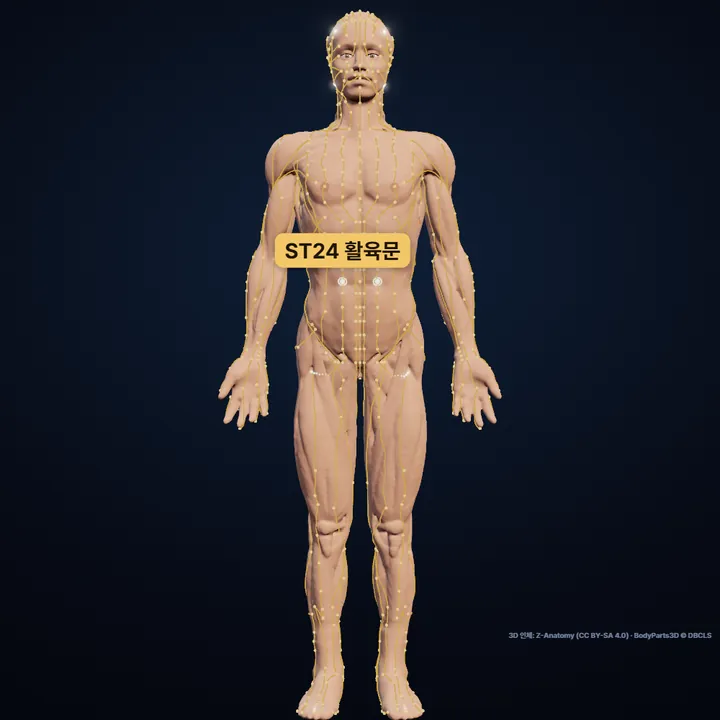
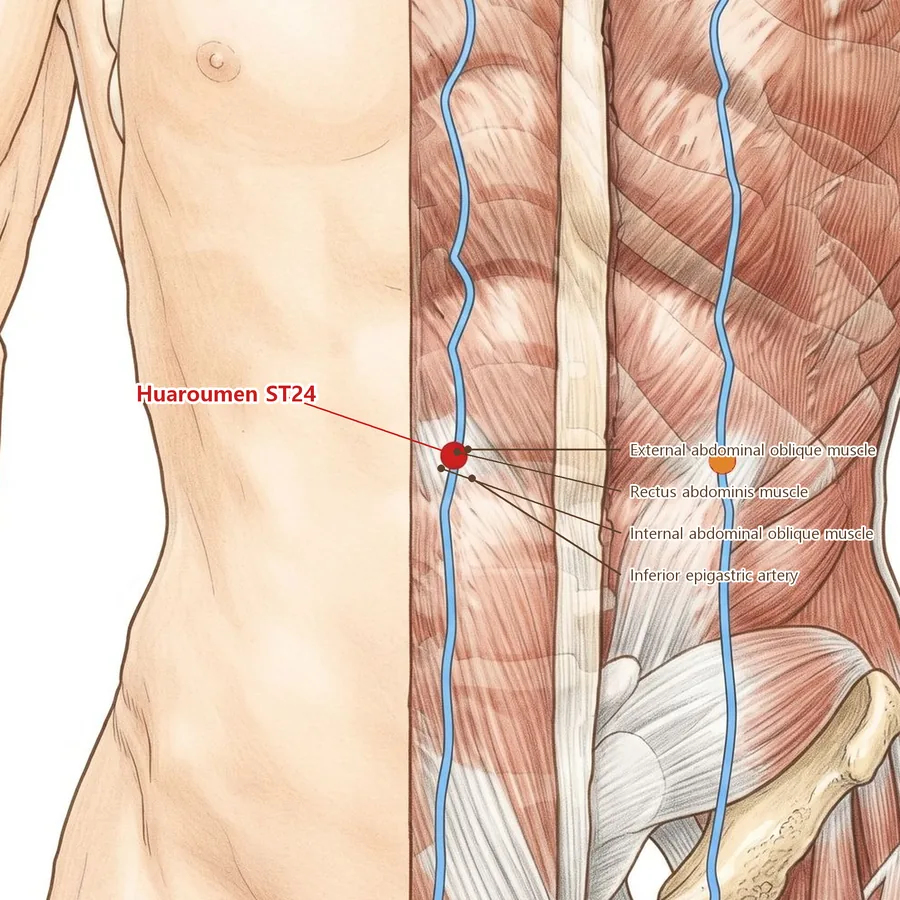
Location and structures come from our 3D model; only the drawing style was refined with AI. Labels are added by us.


External abdominal oblique muscle · Internal abdominal oblique muscle · Rectus abdominis muscle · Inferior epigastric artery
Rendered straight from the 3D model at the computed location. The glowing ring marks Huaroumen.
On this page
1Where is Huaroumen?
1 B-cun above the centre of the navel, 2 B-cun out from the front midline.
It lies beside CV9, on the upper abdomen.
External abdominal oblique muscle · Internal abdominal oblique muscle · Rectus abdominis muscle · Inferior epigastric artery
2How do I find it on my body?
- Divide the distance from the centre of the navel to the xiphisternal junction into 8 B-cun.
- Count up 1 from the navel.
- Move out to the 2 B-cun line, halfway between the midline and the nipple line (4 B-cun).

A cun is a body-scaled unit of length. The precise way is to divide a bone length into equal parts (proportional bone cun); finger widths are a quick estimate.
- inferior epigastric artery
- An artery that comes up near the groin and runs behind rectus abdominis toward the navel, where it links with the superior epigastric artery.
- external abdominal oblique
- The widest, outermost muscle on the side of the belly. Its fibers slant like hands slipped into front pockets (from upper outside to lower inside), and it twists and bends the trunk.
- xiphisternal junction
- Where the body of the breastbone meets the xiphoid process, just above the pit of the stomach. From here to the center of the navel is taken as 8 cun.
- rectus abdominis
- The long vertical muscle on each side of the middle of the belly, from the pubic bone to the rib cartilages, that bends the trunk forward. It makes the 'six-pack' blocks when tightened.
- internal abdominal oblique
- The second layer of side-belly muscle, just under the external oblique. Its fibers run roughly crosswise to the external oblique, and it helps twist the trunk.
3Before you press
- Press the abdomen only gently, with several fingers or the palm.
- Do not press the abdomen during pregnancy.
- Sudden severe abdominal pain, especially with fever or vomiting, needs urgent care — call emergency services if needed instead of using acupressure.
- Avoid broken or swollen skin and press only to a comfortable level.
- Acupressure is not a substitute for medical care.
4How has it been used traditionally?
- The name joins hua (slippery), rou (flesh) and men (gate).
From traditional texts — not a claim of effect.
5Alternative location
Chinese standard (2021) differs · China's 2021 standard measures the 8 B-cun above the navel from the tip of the xiphoid process instead of the xiphisternal junction (WHO). The cun count is the same, but each cun can come out slightly shorter, moving the point a little toward the navel.
?FAQ
Where exactly is Huaroumen?
1 B-cun above the centre of the navel, 2 B-cun out from the front midline. It lies beside CV9, on the upper abdomen.
How do I find Huaroumen?
Divide the distance from the centre of the navel to the xiphisternal junction into 8 B-cun. Count up 1 from the navel. Move out to the 2 B-cun line, halfway between the midline and the nipple line (4 B-cun). CV9 lies on the midline at the same level.
Can I press it during pregnancy?
Do not press the abdomen during pregnancy.
What should I watch out for?
Press the abdomen only gently, with several fingers or the palm. Do not press the abdomen during pregnancy. Sudden severe abdominal pain, especially with fever or vomiting, needs urgent care — call emergency services if needed instead of using acupressure. Avoid broken or swollen skin and press only to a comfortable level. Acupressure is not a substitute for medical care.
Sources
- Location: WHO Standard Acupuncture Point Locations in the Western Pacific Region (2008), p. 57
- Standard comparison: Chinese national standard GB/T 12346-2021 (Nomenclature and location of meridian points)
- Korean anatomical terms and locating tips: KMCRIC Standard Acupoint DB (Korea)
- Classification cross-check: AcuAtlas dataset (CC BY 4.0)
- Safety: Chinese Medicine Council of New Zealand, Safety in Clinical Practice Guidance (2023)
- 3D: computed on Z-Anatomy (CC BY-SA 4.0) · BodyParts3D © DBCLS
Positions computed from the WHO standard locations (2008) on Z-Anatomy (CC BY-SA 4.0) · BodyParts3D © DBCLS. For reference only — not a substitute for diagnosis or treatment. See a clinician if you are unwell.