Biguan 髀關
On the front of the thigh, in the hollow framed by three muscles: the upper rectus femoris, the sartorius and the tensor fasciae latae.
Open the 3D Acupoint Map →
🖼See it in pictures
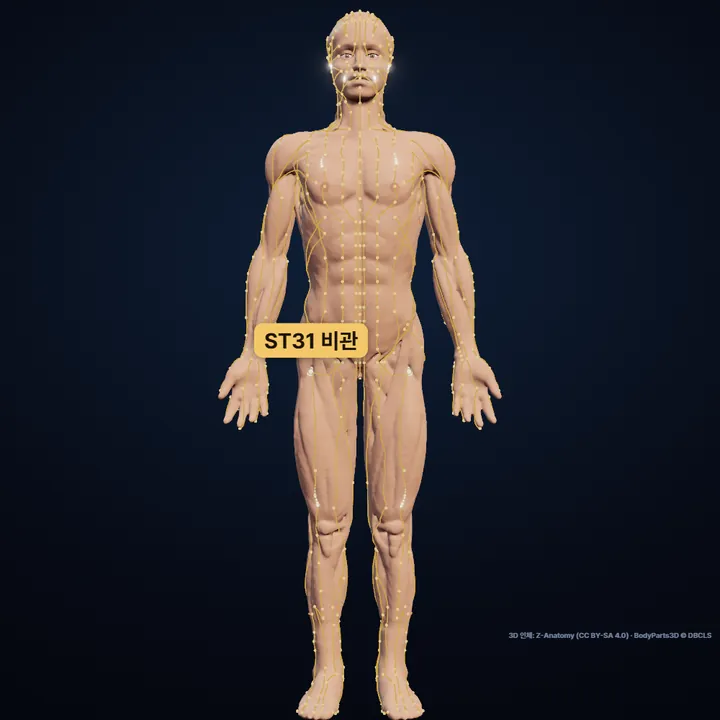

Location and structures come from our 3D model; only the drawing style was refined with AI. Labels are added by us.
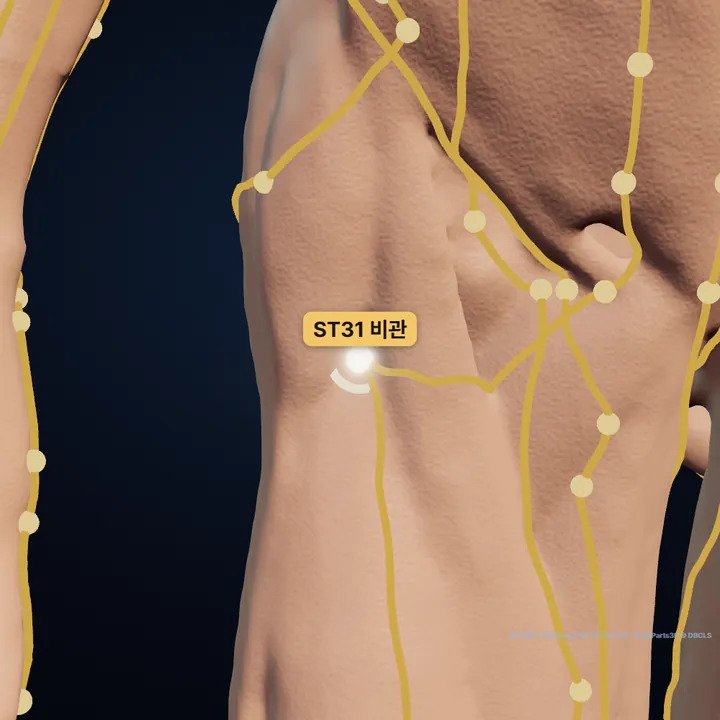
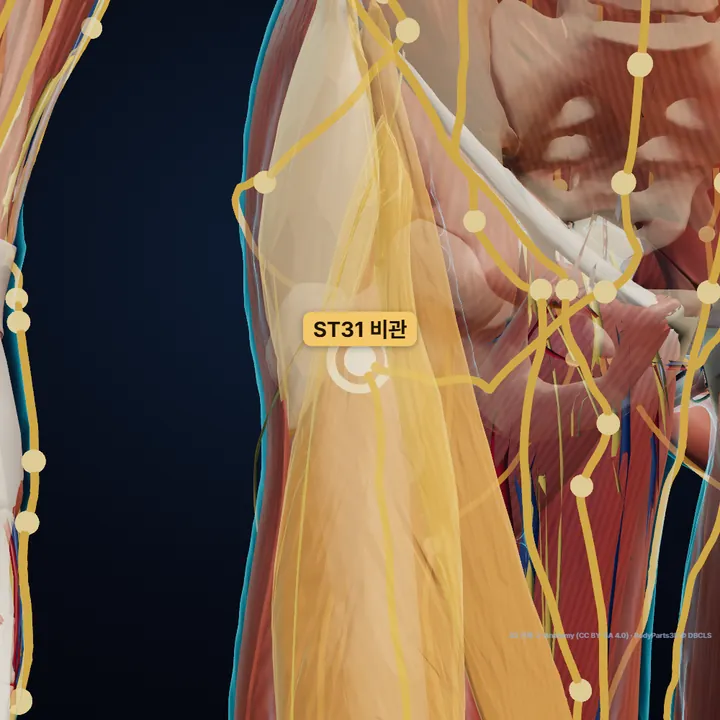
Rectus femoris muscle · Sartorius muscle · Tensor fasciae latae
Rendered straight from the 3D model at the computed location. The glowing ring marks Biguan.
On this page
1Where is Biguan?
On the front of the thigh, in the hollow framed by three muscles: the upper rectus femoris, the sartorius and the tensor fasciae latae.
Reference: where the line from the anterior superior iliac spine to the lateral end of the patellar base crosses the level of the lower border of the pubic symphysis.
Rectus femoris muscle · Sartorius muscle · Tensor fasciae latae
2How do I find it on my body?
- Bend the hip and knee slightly.
- Open the thigh a little and push its inner front against resistance; a triangular hollow appears.
- See the rectus femoris running down between the sartorius (inside) and the tensor fasciae latae (outside).
- Press the deepest dip just below the triangle's apex.
- tensor fasciae latae
- A short muscle on the outer front of the pelvis. It pulls tight the tough band on the outer thigh (iliotibial tract).
- rectus femoris
- The muscle running straight down the middle of the front of the thigh. It starts on the pelvis, joins the kneecap tendon, straightens the knee and lifts the leg.
- pubic symphysis
- Where the two pubic bones join with cartilage at the bottom middle of the belly; going straight down from the navel you meet it as a hard bony edge. The center of the navel to its upper edge is taken as 5 cun.
3Before you press
- Avoid broken or swollen skin and press only to a comfortable level.
- Acupressure is not a substitute for medical care.
4How has it been used traditionally?
- The name joins bi (thigh) and guan (gate): the gateway into the thigh. Found by touch in the triangle formed by three thigh muscles.
From traditional texts — not a claim of effect.
?FAQ
Where exactly is Biguan?
On the front of the thigh, in the hollow framed by three muscles: the upper rectus femoris, the sartorius and the tensor fasciae latae. Reference: where the line from the anterior superior iliac spine to the lateral end of the patellar base crosses the level of the lower border of the pubic symphysis.
How do I find Biguan?
Bend the hip and knee slightly. Open the thigh a little and push its inner front against resistance; a triangular hollow appears. See the rectus femoris running down between the sartorius (inside) and the tensor fasciae latae (outside). Press the deepest dip just below the triangle's apex. it matches where the ASIS–patellar-base line crosses the level of the pubic symphysis's lower border.
What should I watch out for?
Avoid broken or swollen skin and press only to a comfortable level. Acupressure is not a substitute for medical care.
Sources
- Location: WHO Standard Acupuncture Point Locations in the Western Pacific Region (2008), p. 61
- Standard comparison: Chinese national standard GB/T 12346-2021 (Nomenclature and location of meridian points)
- Korean anatomical terms and locating tips: KMCRIC Standard Acupoint DB (Korea)
- Classification cross-check: AcuAtlas dataset (CC BY 4.0)
- 3D: computed on Z-Anatomy (CC BY-SA 4.0) · BodyParts3D © DBCLS
Positions computed from the WHO standard locations (2008) on Z-Anatomy (CC BY-SA 4.0) · BodyParts3D © DBCLS. For reference only — not a substitute for diagnosis or treatment. See a clinician if you are unwell.