Xiaguan 下關
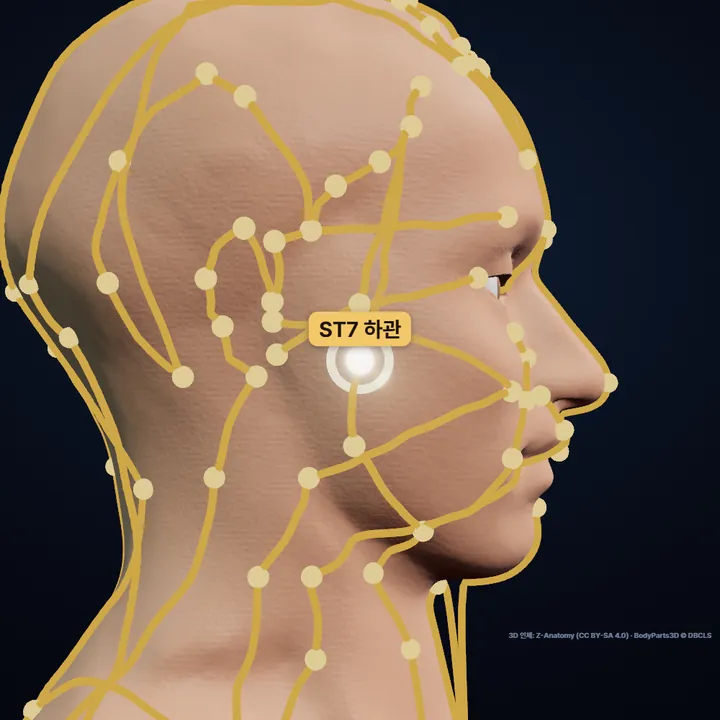
In the hollow between the middle of the zygomatic arch's lower border and the mandibular notch.
Open the 3D Acupoint Map →
🖼See it in pictures
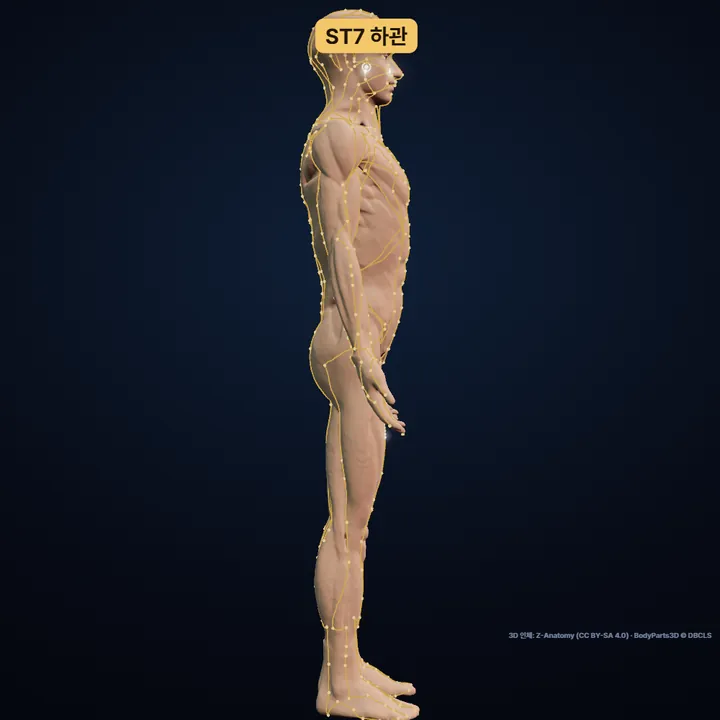

Location and structures come from our 3D model; only the drawing style was refined with AI. Labels are added by us.
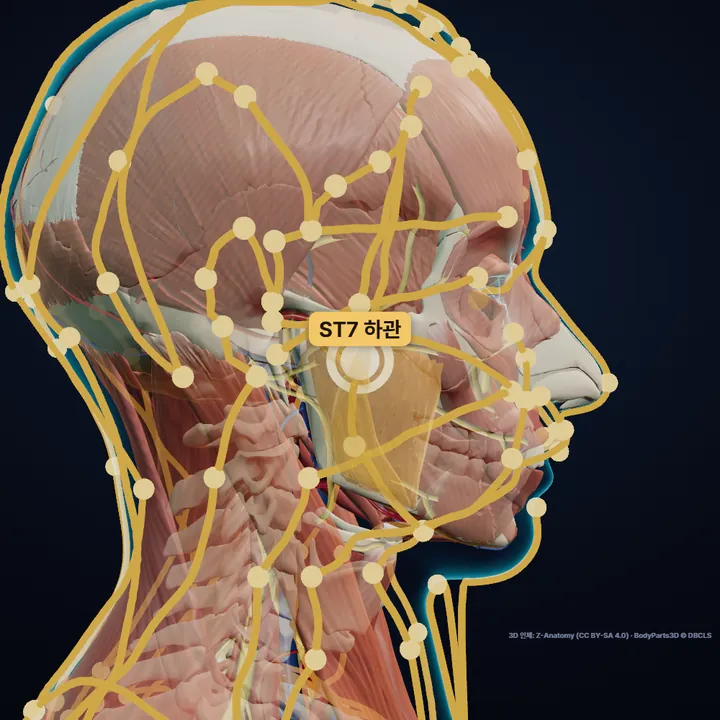
Superficial part of masseter · Deep part of masseter · Inferior head of lateral pterygoid muscle
Rendered straight from the 3D model at the computed location. The glowing ring marks Xiaguan.
On this page
1Where is Xiaguan?
In the hollow between the middle of the zygomatic arch's lower border and the mandibular notch.
With the mouth closed, it lies straight below GB3.
It is on the face.
Superficial part of masseter · Deep part of masseter · Inferior head of lateral pterygoid muscle
2How do I find it on my body?
- Close your mouth.
- In front of the ear, find the lower edge of the zygomatic arch, the bony bar running from the cheekbone toward the ear.
- Press the hollow just under the middle of that edge.
- inferior head of lateral pterygoid
- The larger, lower of the two heads of lateral pterygoid. It pulls the condyle of the jaw forward to open the mouth.
- deep part of masseter
- The smaller part under the superficial masseter. It runs almost straight down from the back of the zygomatic arch to the upper ramus of the jaw.
- superficial part of masseter
- The larger outer part of masseter. It slants down and back from the front of the zygomatic arch to the angle of the lower jaw.
- zygomatic arch
- The bony bridge running sideways from the cheekbone to just in front of the ear, shaped like an arch. You feel it as a horizontal bar on the side of the face.
3Before you press
- Facial skin is thin, so press lightly with a fingertip only.
- If the jaw joint hurts or clicks, do not press hard.
- Avoid broken or swollen skin and press only to a comfortable level.
- Acupressure is not a substitute for medical care.
4How has it been used traditionally?
- The Zhenjiu Jiayi Jing records it as a meeting place of the Stomach and Gallbladder channels — a historical classification, not a claim of effect.
- The same text gives the classic locating cue: a hollow opens with the mouth shut and closes when the mouth opens.
From traditional texts — not a claim of effect.
?FAQ
Where exactly is Xiaguan?
In the hollow between the middle of the zygomatic arch's lower border and the mandibular notch. With the mouth closed, it lies straight below GB3. It is on the face.
How do I find Xiaguan?
Close your mouth. In front of the ear, find the lower edge of the zygomatic arch, the bony bar running from the cheekbone toward the ear. Press the hollow just under the middle of that edge. opening wide makes the jaw's condyle slide forward and fill the hollow.
What should I watch out for?
Facial skin is thin, so press lightly with a fingertip only. If the jaw joint hurts or clicks, do not press hard. Avoid broken or swollen skin and press only to a comfortable level. Acupressure is not a substitute for medical care.
Sources
- Location: WHO Standard Acupuncture Point Locations in the Western Pacific Region (2008), p. 49
- Standard comparison: Chinese national standard GB/T 12346-2021 (Nomenclature and location of meridian points)
- Korean anatomical terms and locating tips: KMCRIC Standard Acupoint DB (Korea)
- Classification source: Zhenjiu Jiayi Jing vol. 3 (Siku Quanshu edition)
- Classification cross-check: AcuAtlas dataset (CC BY 4.0)
- 3D: computed on Z-Anatomy (CC BY-SA 4.0) · BodyParts3D © DBCLS
Positions computed from the WHO standard locations (2008) on Z-Anatomy (CC BY-SA 4.0) · BodyParts3D © DBCLS. For reference only — not a substitute for diagnosis or treatment. See a clinician if you are unwell.