Zhongzhu 中渚
Back of the hand, in the dip just on the wrist side of the ring finger's knuckle joint, in the gap of the fourth and fifth metacarpals.
Open the 3D Acupoint Map →
🖼See it in pictures

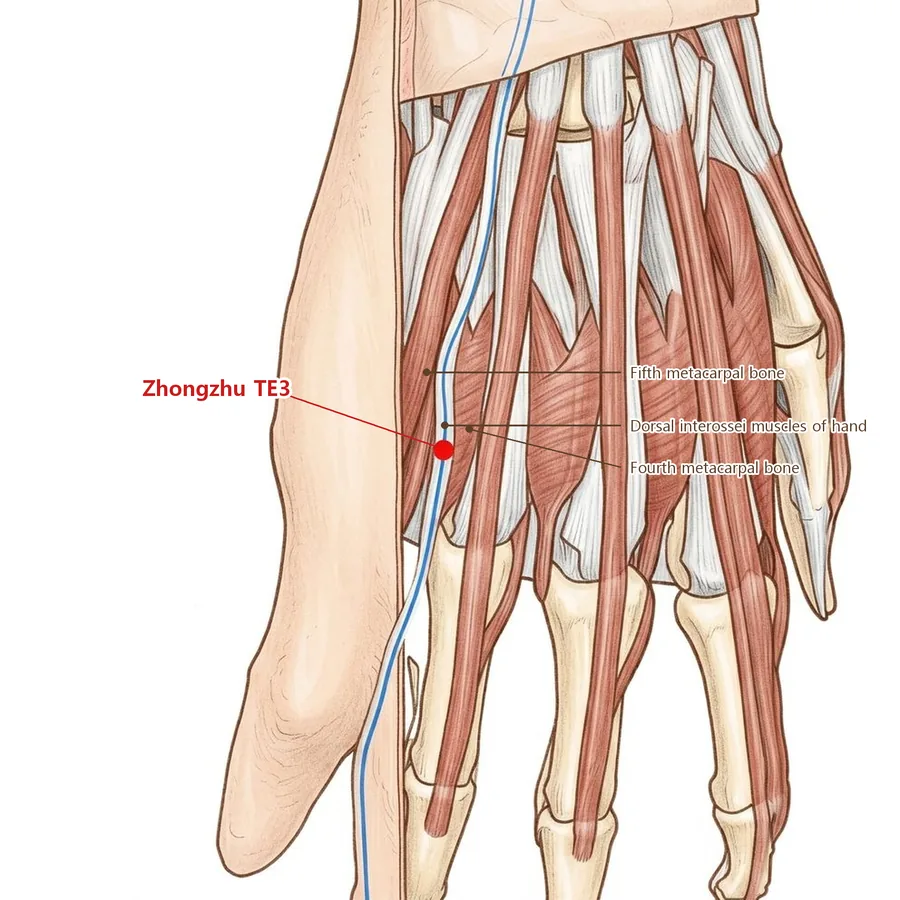
Location and structures come from our 3D model; only the drawing style was refined with AI. Labels are added by us.


Fourth metacarpal bone · Fifth metacarpal bone · Dorsal interossei muscles of hand
Rendered straight from the 3D model at the computed location. The glowing ring marks Zhongzhu.
On this page
1Where is Zhongzhu?
Back of the hand, in the dip just on the wrist side of the ring finger's knuckle joint, in the gap of the fourth and fifth metacarpals.
Fourth metacarpal bone · Fifth metacarpal bone · Dorsal interossei muscles of hand
2How do I find it on my body?
- Make a loose fist so the knuckles stand out on the back of the hand.
- Move from the ring-finger knuckle toward the wrist.
- Press the dip between the fourth and fifth metacarpals.

A cun is a body-scaled unit of length. The precise way is to divide a bone length into equal parts (proportional bone cun); finger widths are a quick estimate.
3The classical posture
- Make a fist (the classical "closed hand").
- From the ring-finger knuckle on the back of the hand, move toward the wrist.
- Press the hollow between the fourth and fifth metacarpals.
4Before you press
- Avoid broken or swollen skin and press only to a comfortable level.
- Acupressure is not a substitute for medical care.
5How has it been used traditionally?
- Classified as the Shu-stream (Wood) point of the Triple Energizer meridian — a historical classification, not a claim of effect.
- The name means 'middle islet' (a sandbar in a stream).
- The Donguibogam, quoting the Song-dynasty Tongren, locates it with the hand closed into a fist.
From traditional texts — not a claim of effect.
6Classical text
Donguibogam (Heo Jun, 1613), Acupuncture and Moxibustion, "Zhongzhu"
在手小指次指本節後間陷中液門下一寸握掌取之手少陽脈之所注爲腧 …《銅人》
① Behind the base joint (benjie) of the ring finger, in the hollow between the bones, 1 cun below Yemen (TE2); take it with a closed fist. Where the Hand Shaoyang channel pours in, which makes it the Shu-stream point (Tongren Shuxue Zhenjiu Tujing).
- Source tags as given in the Donguibogam: Tongren = Tongren Shuxue Zhenjiu Tujing (1026).
- The garbled glyph 杮 in the Wikisource text has been corrected to 腧.
- Benjie ("base joint") is the old name for the knuckle (metacarpophalangeal) joint.
- "…" marks the needling depth and moxa count, left out because they are for licensed practitioners.
Original text as written · translation is ours.
?FAQ
Where exactly is Zhongzhu?
Back of the hand, in the dip just on the wrist side of the ring finger's knuckle joint, in the gap of the fourth and fifth metacarpals.
How do I find Zhongzhu?
Make a loose fist so the knuckles stand out on the back of the hand. Move from the ring-finger knuckle toward the wrist. Press the dip between the fourth and fifth metacarpals.
What should I watch out for?
Avoid broken or swollen skin and press only to a comfortable level. Acupressure is not a substitute for medical care.
Sources
- Location: WHO Standard Acupuncture Point Locations in the Western Pacific Region (2008), p. 159
- Standard comparison: Chinese national standard GB/T 12346-2021 (Nomenclature and location of meridian points), p. 22
- Korean anatomical terms: KMLE medical dictionary (Korean Medical Association terms)
- Classification source: Lingshu ch. 2 (Ben Shu) for the five transport points; Nanjing ch. 64 for the phases
- Posture and traditional use: Hyeoljari Seodang (Bookdramang, 2015; Korean), ch. 10 "Zhongzhu" and appendix (Yixue Rumen indications)
- Classical text: Donguibogam, Acupuncture and Moxibustion, "Zhongzhu" — Wikisource public edition (garbled glyph 杮 corrected to 腧)
- Indications: Yixue Rumen vol. 1 (Wikisource)
- Classification and traditional-use cross-check: AcuAtlas dataset (CC BY 4.0)
- 3D: computed on Z-Anatomy (CC BY-SA 4.0) · BodyParts3D © DBCLS
Positions computed from the WHO standard locations (2008) on Z-Anatomy (CC BY-SA 4.0) · BodyParts3D © DBCLS. For reference only — not a substitute for diagnosis or treatment. See a clinician if you are unwell.