Jinmen 金門
Outer top of the foot, in the dip behind the tuberosity of the fifth metatarsal and below the cuboid bone.
Open the 3D Acupoint Map →
🖼See it in pictures
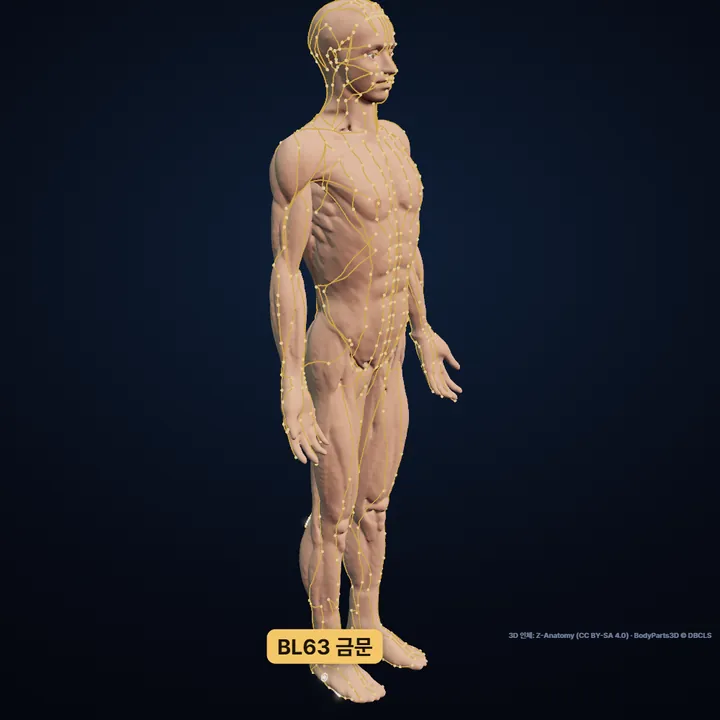

Location and structures come from our 3D model; only the drawing style was refined with AI. Labels are added by us.


Cuboid bone · Fifth metatarsal bone · Fibularis brevis muscle · Inferior fibular retinaculum
Rendered straight from the 3D model at the computed location. The glowing ring marks Jinmen.
On this page
1Where is Jinmen?
Outer top of the foot, in the dip behind the tuberosity of the fifth metatarsal and below the cuboid bone.
It is distal to the front edge of the outer ankle bone.
Cuboid bone · Fifth metatarsal bone · Fibularis brevis muscle · Inferior fibular retinaculum
2How do I find it on my body?
- Find the bony bump halfway along the outer edge of the foot (tuberosity of the fifth metatarsal).
- Come straight down from the front edge of the outer ankle bone.
- Press the dip just behind that bump, below the cuboid bone.
- inferior fibular retinaculum
- A band on the outer side of the heel bone that holds down the fibularis tendons.
3Before you press
- Avoid broken or swollen skin and press only to a comfortable level.
- Acupressure is not a substitute for medical care.
4How has it been used traditionally?
- The Zhenjiu Jiayi Jing and Qianjin Yaofang record it as the Xi-cleft point of the Foot Taiyang — a historical classification, not a claim of effect.
- The name means 'golden gate'; an alternative name is Guanliang.
From traditional texts — not a claim of effect.
?FAQ
Where exactly is Jinmen?
Outer top of the foot, in the dip behind the tuberosity of the fifth metatarsal and below the cuboid bone. It is distal to the front edge of the outer ankle bone.
How do I find Jinmen?
Find the bony bump halfway along the outer edge of the foot (tuberosity of the fifth metatarsal). Come straight down from the front edge of the outer ankle bone. Press the dip just behind that bump, below the cuboid bone.
What should I watch out for?
Avoid broken or swollen skin and press only to a comfortable level. Acupressure is not a substitute for medical care.
Sources
- Location: WHO Standard Acupuncture Point Locations in the Western Pacific Region (2008), p. 131
- Standard comparison: Chinese national standard GB/T 12346-2021 (Nomenclature and location of meridian points), p. 20 — same location
- Korean anatomical terms: KMLE medical dictionary
- Traditional-use cross-check: AcuAtlas dataset (CC BY 4.0)
- Classification source: Zhenjiu Jiayi Jing vol. 3, sec. 35; Qianjin Yaofang, Mingtang Sanren Tu (Siku Quanshu edition, vol. 87)
- 3D: computed on Z-Anatomy (CC BY-SA 4.0) · BodyParts3D © DBCLS
Positions computed from the WHO standard locations (2008) on Z-Anatomy (CC BY-SA 4.0) · BodyParts3D © DBCLS. For reference only — not a substitute for diagnosis or treatment. See a clinician if you are unwell.