Tiantu 天突
On the front of the neck, on the midline, at the centre of the suprasternal fossa.
Open the 3D Acupoint Map →
🖼See it in pictures
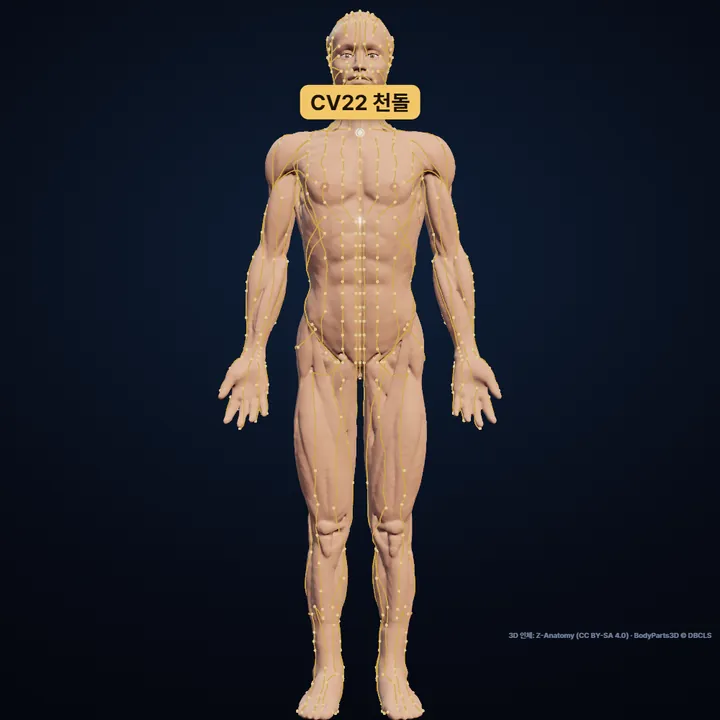
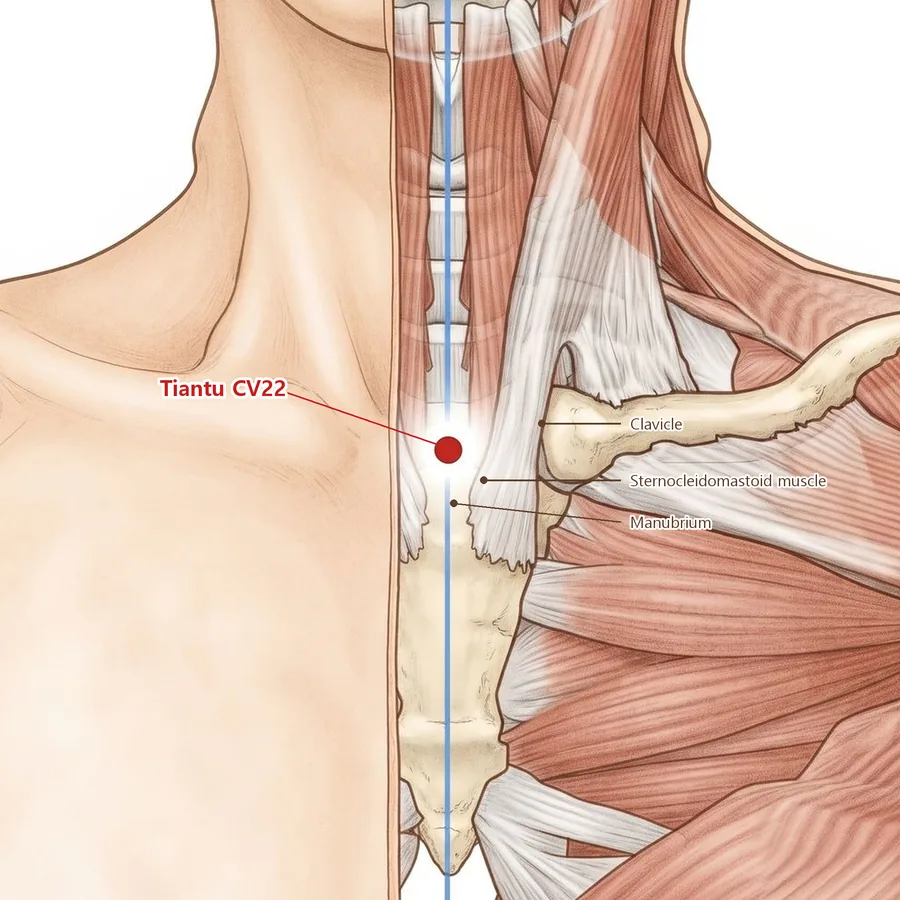
Location and structures come from our 3D model; only the drawing style was refined with AI. Labels are added by us.

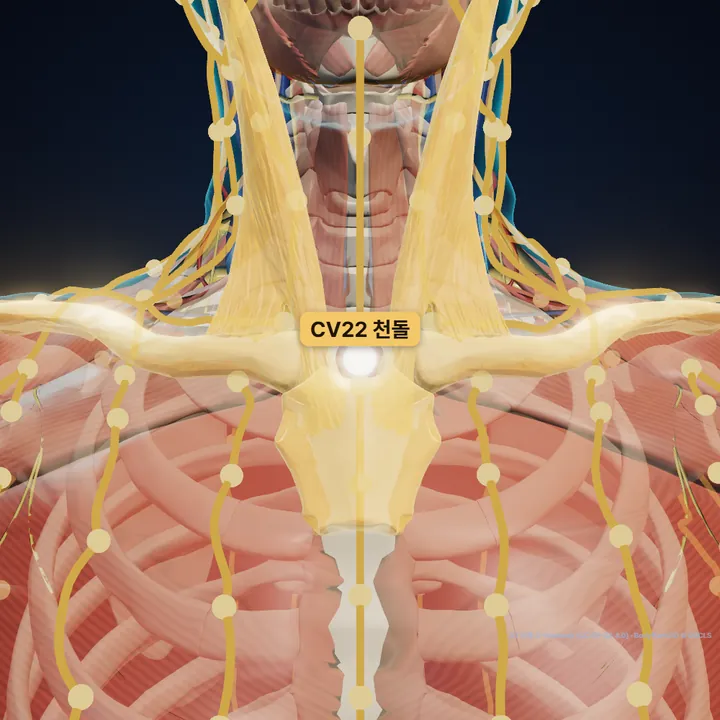
Manubrium · Clavicle · Sternocleidomastoid muscle · Clavicle · Sternocleidomastoid muscle
Rendered straight from the 3D model at the computed location. The glowing ring marks Tiantu.
On this page
1Where is Tiantu?
On the front of the neck, on the midline, at the centre of the suprasternal fossa.
This is the hollow between the inner ends of the two collarbones.
Manubrium · Clavicle · Sternocleidomastoid muscle · Clavicle · Sternocleidomastoid muscle
2How do I find it on my body?
- Find the dip at the base of the neck, above the breastbone (suprasternal fossa).
- The point is its centre, between the inner ends of the two collarbones.
- sternocleidomastoid
- The thick muscle slanting across the side of the neck. It runs from the mastoid process behind the ear down to the breastbone and collarbone, and stands out as a thick cord when you turn your head to the other side.
3Before you press
- The trachea lies right behind it.
- WHO's safety guidelines (1999) name this as a potentially dangerous point.
- Do not press inward or downward.
- Stop at once if breathing feels blocked.
- Avoid broken or swollen skin and press only to a comfortable level.
- Acupressure is not a substitute for medical care.
4How has it been used traditionally?
- The Zhenjiu Jiayi Jing (vol. 3) classifies it as a meeting point of the Yin Linking Vessel and the Conception Vessel — a historical classification, not a claim of effect.
From traditional texts — not a claim of effect.
?FAQ
Where exactly is Tiantu?
On the front of the neck, on the midline, at the centre of the suprasternal fossa. This is the hollow between the inner ends of the two collarbones.
How do I find Tiantu?
Find the dip at the base of the neck, above the breastbone (suprasternal fossa). The point is its centre, between the inner ends of the two collarbones.
What should I watch out for?
The trachea lies right behind it. WHO's safety guidelines (1999) name this as a potentially dangerous point. Do not press inward or downward. Stop at once if breathing feels blocked. Avoid broken or swollen skin and press only to a comfortable level. Acupressure is not a substitute for medical care.
Sources
- Location: WHO Standard Acupuncture Point Locations in the Western Pacific Region (2008), p. 230
- Standard comparison: Chinese national standard GB/T 12346-2021 (Nomenclature and location of meridian points)
- Korean point names: KMCRIC standard acupoint database
- Traditional-use cross-check: AcuAtlas dataset (CC BY 4.0)
- Classification source: Zhenjiu Jiayi Jing vols. 3 and 12
- Safety: WHO Guidelines on Basic Training and Safety in Acupuncture (1999), p. 25
- Safety: CCAOM Clean Needle Technique Manual, 7th ed. (rev. 2024), p. 12
- 3D: computed on Z-Anatomy (CC BY-SA 4.0) · BodyParts3D © DBCLS
Positions computed from the WHO standard locations (2008) on Z-Anatomy (CC BY-SA 4.0) · BodyParts3D © DBCLS. For reference only — not a substitute for diagnosis or treatment. See a clinician if you are unwell.