Daimai 帶脈
Side of the abdomen, where a line dropped from the free tip of the 11th rib meets the level of the navel centre.
Open the 3D Acupoint Map →
🖼See it in pictures

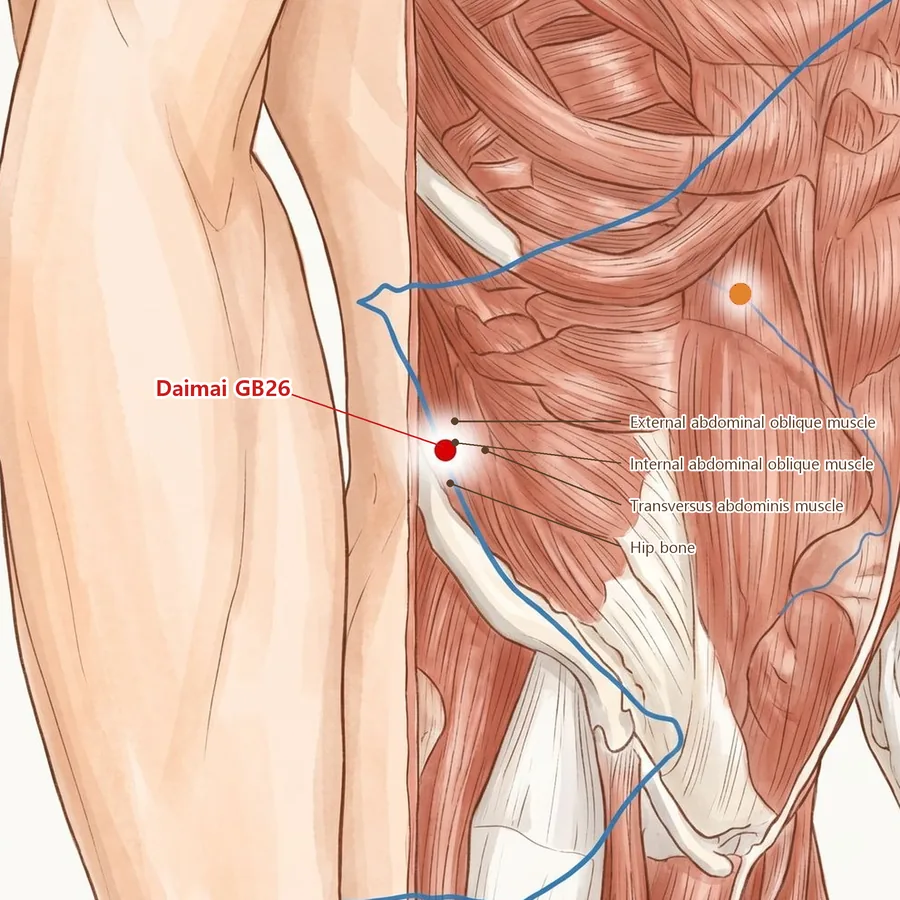
Location and structures come from our 3D model; only the drawing style was refined with AI. Labels are added by us.


External abdominal oblique muscle · Internal abdominal oblique muscle · Transversus abdominis muscle · Hip bone
Rendered straight from the 3D model at the computed location. The glowing ring marks Daimai.
On this page
1Where is Daimai?
Side of the abdomen, where a line dropped from the free tip of the 11th rib meets the level of the navel centre.
It is below Zhangmen (LR13) and level with Shenque (CV8).
External abdominal oblique muscle · Internal abdominal oblique muscle · Transversus abdominis muscle · Hip bone
2How do I find it on my body?
- Follow the lower edge of the rib cage to the 10th rib.
- Just below it, find the short tip of the 11th rib (Zhangmen).
- Go straight down from that tip and press at the level of the navel centre.
- external abdominal oblique
- The widest, outermost muscle on the side of the belly. Its fibers slant like hands slipped into front pockets (from upper outside to lower inside), and it twists and bends the trunk.
- transversus abdominis
- The deepest of the three side-belly muscle layers. Its fibers run sideways like a belt and squeeze the belly in.
- internal abdominal oblique
- The second layer of side-belly muscle, just under the external oblique. Its fibers run roughly crosswise to the external oblique, and it helps twist the trunk.
- hip bone
- The large, wide bone on each side of the pelvis, formed when the ilium, ischium and pubis grow together. The ridge you feel at belt level (iliac crest) is its top edge.
3Before you press
- Do not press hard or deep into the side of the abdomen.
- Do not press abdominal points during pregnancy (a traditional caution).
- Avoid broken or swollen skin and press only to a comfortable level.
- Acupressure is not a substitute for medical care.
4How has it been used traditionally?
- Shares its name with the Dai (Girdling) vessel, the extraordinary vessel said to circle the waist like a belt — a historical description, not a claim of effect.
- The name means 'girdle vessel'.
From traditional texts — not a claim of effect.
?FAQ
Where exactly is Daimai?
Side of the abdomen, where a line dropped from the free tip of the 11th rib meets the level of the navel centre. It is below Zhangmen (LR13) and level with Shenque (CV8).
How do I find Daimai?
Follow the lower edge of the rib cage to the 10th rib. Just below it, find the short tip of the 11th rib (Zhangmen). Go straight down from that tip and press at the level of the navel centre.
Can I press it during pregnancy?
Do not press abdominal points during pregnancy (a traditional caution).
What should I watch out for?
Do not press hard or deep into the side of the abdomen. Do not press abdominal points during pregnancy (a traditional caution). Avoid broken or swollen skin and press only to a comfortable level. Acupressure is not a substitute for medical care.
Sources
- Location: WHO Standard Acupuncture Point Locations in the Western Pacific Region (2008), p. 184
- Standard comparison: Chinese national standard GB/T 12346-2021 (Nomenclature and location of meridian points)
- Korean anatomical terms and point names: KMCRIC Standard Acupoint DB (Korea)
- Traditional use cross-check: AcuAtlas dataset (CC BY 4.0)
- 3D: computed on Z-Anatomy (CC BY-SA 4.0) · BodyParts3D © DBCLS
Positions computed from the WHO standard locations (2008) on Z-Anatomy (CC BY-SA 4.0) · BodyParts3D © DBCLS. For reference only — not a substitute for diagnosis or treatment. See a clinician if you are unwell.