Yanglingquan 陽陵泉
Outer (fibular) side of the lower leg, in the hollow in front of and below the head of the fibula.
Open the 3D Acupoint Map →
🖼See it in pictures

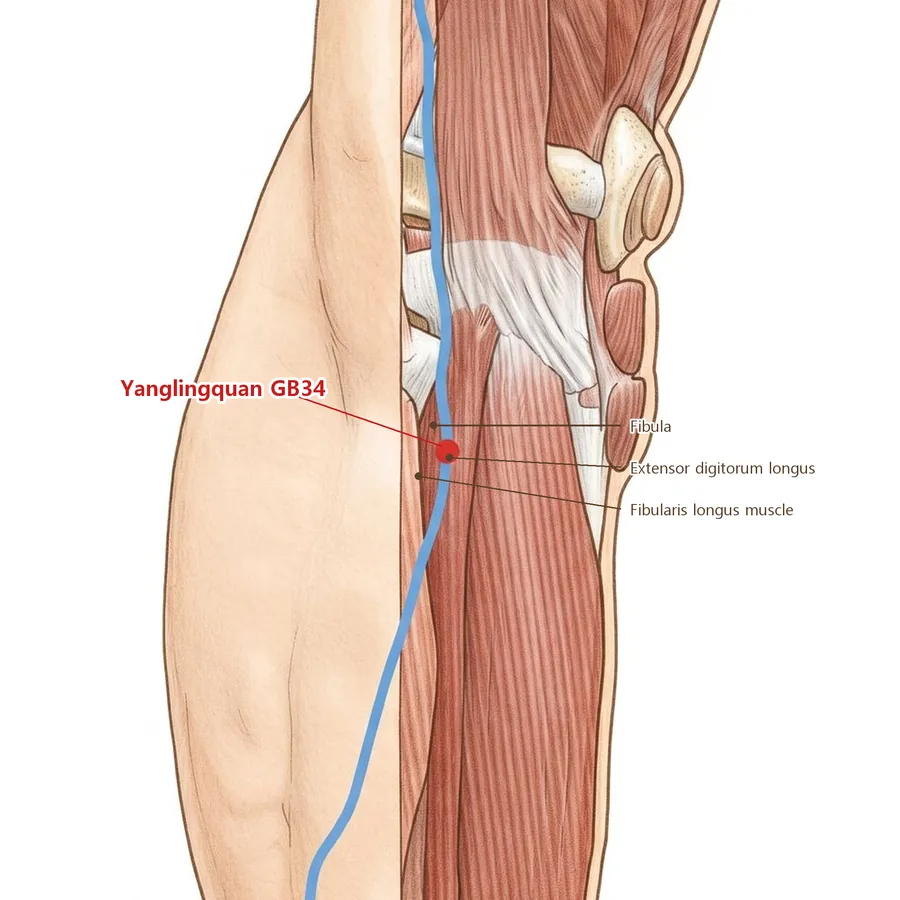
Location and structures come from our 3D model; only the drawing style was refined with AI. Labels are added by us.

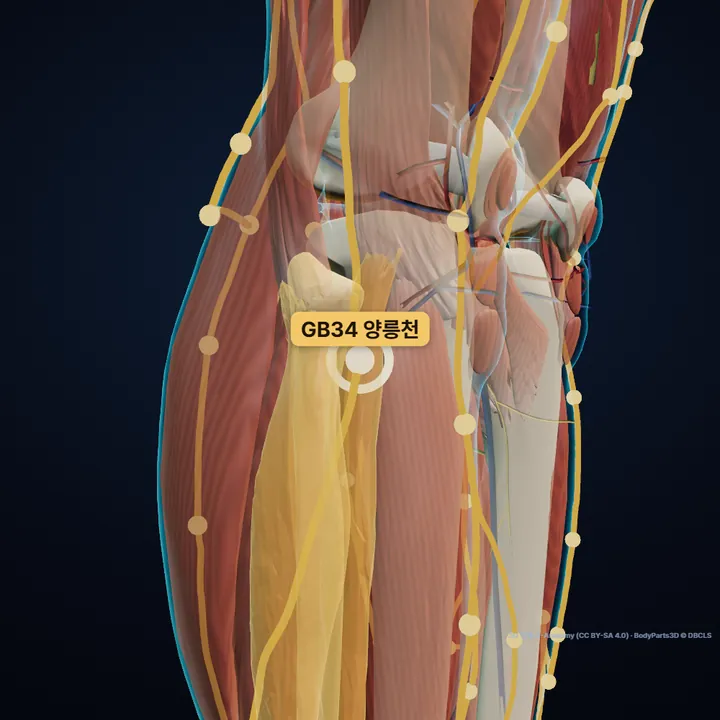
Fibula · Extensor digitorum longus · Fibularis longus muscle
Rendered straight from the 3D model at the computed location. The glowing ring marks Yanglingquan.
On this page
1Where is Yanglingquan?
Outer (fibular) side of the lower leg, in the hollow in front of and below the head of the fibula.
Fibula · Extensor digitorum longus · Fibularis longus muscle
2How do I find it on my body?
- Find the round bony head on the outer side just below the knee (head of the fibula).
- Slide a fingertip forward and down off it.
- Press the hollow where the finger sinks in.
- extensor digitorum longus
- A muscle running from the outer front of the shin across the top of the foot to the 2nd–5th toes. Lift your toes and four tendons fan out on the top of the foot.
- common fibular nerve
- A branch of the sciatic nerve that passes the outer back of the knee and wraps around just below the head of the fibula. It lies right under the skin over bone there, so pressure easily makes the outer leg tingle.
3The classical posture
- The old texts give two postures: with the leg straightened, or squatting.
- In either, first find the head of the fibula below the outer knee.
- Press the hollow in front of and below it, where the fingertip sinks in.
- Our 3D model keeps the leg straight, which matches the "leg straightened" posture (Lingshu; Tongren).
4Before you press
- The common fibular nerve winds just under the skin behind and below the fibular head — do not press hard or for long, and stop if tingling runs into the top of the foot.
- Avoid broken or swollen skin and press only to a comfortable level.
- Acupressure is not a substitute for medical care.
- Sudden face drooping, weakness on one side or slurred speech can mean a stroke — call emergency services at once; do not try acupressure.
5How has it been used traditionally?
- Classified as the He-sea (Earth) point, the lower He-sea point of the Gallbladder (Lingshu ch. 4) and the Influential point of the sinews (Nanjing ch. 45) — historical classifications, not claims of effect.
- In the name, ling ('mound') refers to the fibular head, with the 'spring' in the hollow below it on the outer (yang) side.
- Classical texts give two postures for finding it: with the leg straightened, or squatting.
From traditional texts — not a claim of effect.
6Classical text
Donguibogam (Heo Jun, 1613), Acupuncture and Moxibustion, "Yanglingquan"
在膝下一寸外廉陷中伸而得之《銅人》
在膝下外尖骨前《資生》
在膝品骨下一寸外廉兩骨陷中蹲坐取之足少陽脈之所入爲合 …《銅人》
- ①1 cun below the knee, in the hollow on the outer edge; it is found with the leg straightened. Tongren Shuxue Zhenjiu Tujing
- ②Below the knee on the outer side, in front of the pointed bone. Zhenjiu Zisheng Jing
- ③1 cun below the "pingu" (品骨) of the knee, in the hollow between two bones on the outer edge; take it squatting. Where the Foot Shaoyang channel enters, which makes it the He-sea point. Tongren Shuxue Zhenjiu Tujing
- Source tags as given in the Donguibogam: Tongren = Tongren Shuxue Zhenjiu Tujing, Zisheng = Zhenjiu Zisheng Jing.
- The phrase "found with the leg straightened" in line ① also appears in Lingshu ch.
- 2.
- The first part of line ③ is almost identical to the Yixue Rumen (vol.
- 1), although the Donguibogam tags it Tongren.
- The garbled glyph 猦 in the Wikisource text has been corrected to 蹲 (squat).
- "Pingu" (品骨) is the same in the Wikisource Yixue Rumen and is left as written; which knee bone it names has not been confirmed.
- "…" marks the needling depth, moxa count and needling technique, left out because they are for licensed practitioners.
Original text as written · translation is ours.
?FAQ
Where exactly is Yanglingquan?
Outer (fibular) side of the lower leg, in the hollow in front of and below the head of the fibula.
How do I find Yanglingquan?
Find the round bony head on the outer side just below the knee (head of the fibula). Slide a fingertip forward and down off it. Press the hollow where the finger sinks in.
What should I watch out for?
The common fibular nerve winds just under the skin behind and below the fibular head — do not press hard or for long, and stop if tingling runs into the top of the foot. Avoid broken or swollen skin and press only to a comfortable level. Acupressure is not a substitute for medical care. Sudden face drooping, weakness on one side or slurred speech can mean a stroke — call emergency services at once; do not try acupressure.
Sources
- Location: WHO Standard Acupuncture Point Locations in the Western Pacific Region (2008), p. 188
- Standard comparison: Chinese national standard GB/T 12346-2021 (Nomenclature and location of meridian points)
- Korean anatomical terms and point names: KMCRIC Standard Acupoint DB (Korea)
- Classification source: Lingshu ch. 2 (He-sea) and ch. 4 (lower He-sea); Nanjing ch. 45 (sinew meeting point); Zhenjiu Jiayi Jing vol. 3 (phase)
- Posture and traditional use: Hyeoljari Seodang (Bookdramang, 2015; Korean), ch. 11 "Yanglingquan" and appendix (Yixue Rumen indications)
- Classical text: Donguibogam, Acupuncture and Moxibustion, "Yanglingquan" — Wikisource public edition (garbled glyph 猦 corrected to 蹲)
- Indications: Yixue Rumen vol. 1 (Wikisource)
- Traditional use cross-check: AcuAtlas dataset (CC BY 4.0)
- 3D: computed on Z-Anatomy (CC BY-SA 4.0) · BodyParts3D © DBCLS
Positions computed from the WHO standard locations (2008) on Z-Anatomy (CC BY-SA 4.0) · BodyParts3D © DBCLS. For reference only — not a substitute for diagnosis or treatment. See a clinician if you are unwell.