Yongquan 湧泉
On the sole, in the deepest hollow that appears when the toes curl.
Open the 3D Acupoint Map →
🖼See it in pictures

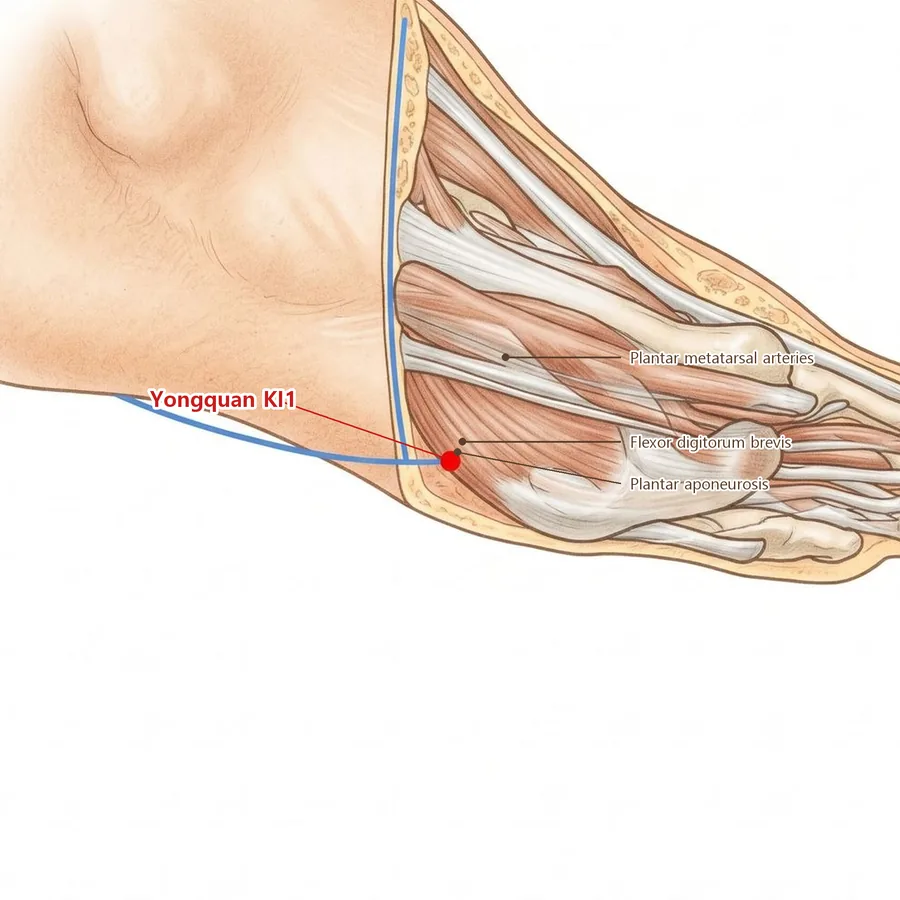
Location and structures come from our 3D model; only the drawing style was refined with AI. Labels are added by us.

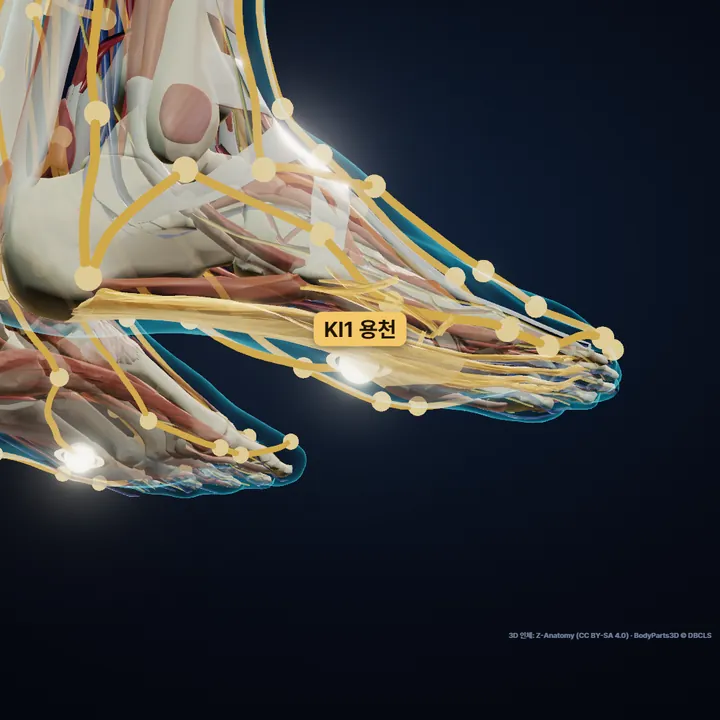
Plantar aponeurosis · Flexor digitorum brevis · Plantar metatarsal arteries
Rendered straight from the 3D model at the computed location. The glowing ring marks Yongquan.
On this page
1Where is Yongquan?
On the sole, in the deepest hollow that appears when the toes curl.
It lies roughly a third of the way back along a line from the web between the 2nd and 3rd toes to the back of the heel.
Plantar aponeurosis · Flexor digitorum brevis · Plantar metatarsal arteries
2How do I find it on my body?
- Lie down, or sit with the leg straight, so the sole faces you.
- Draw a line from the web between the 2nd and 3rd toes to the back of the heel.
- Split it into thirds and take the first mark from the toes.
- plantar metatarsal arteries
- Arteries running deep in the sole between the metatarsals toward the toes.
- flexor digitorum brevis
- The muscle in the middle of the sole, just under the plantar aponeurosis. It runs from the heel to the 2nd–5th toes and bends them.
3The classical posture
- The older texts quoted in the Donguibogam give two postures: bending the foot with the toes curled, and kneeling.
- Kneel, or sit so the sole faces you, then curl the toes.
- Press the deepest hollow that forms in the front part of the sole; WHO 2008 also defines the point by this hollow with the toes flexed.
- Our 3D model keeps the toes straight, so the hollow does not show; it roughly matches the one-third mark in "How to find" above.
4Before you press
- The Donguibogam, citing the Zhenjiu Zisheng Jing, forbids moxibustion here — do not use moxa or hot packs on this point.
- Avoid broken or swollen skin and press only to a comfortable level.
- Acupressure is not a substitute for medical care.
- If someone collapses or is unresponsive, call emergency services at once; do not rely on acupressure.
5How has it been used traditionally?
- Classified as the Jing-well (Wood) point where the Kidney meridian begins — a historical classification, not a claim of effect.
- The name joins yong (to gush) and quan (spring) — usually translated as 'Gushing Spring'.
- Classical texts locate it with the foot bent and the toes curled; one line quoted in the Donguibogam says to take it kneeling.
From traditional texts — not a claim of effect.
6Classical text
Donguibogam (Heo Jun, 1613), Acupuncture and Moxibustion, "Yongquan"
在足陷中屈足卷指宛宛中《銅人》
涌泉者足心也跪而取之《靈樞》
在脚心底宛中白肉際《資生》
在脚掌中心《入門》
足少陰脈之所出爲井 … 禁不可灸若灸廢人行動《資生》
- ①In the hollow of the foot: bend the foot and curl the toes, and it is the centre of the dip. Tongren Shuxue Zhenjiu Tujing
- ②Yongquan is the centre of the sole; take it kneeling. Lingshu
- ③In the hollow centre of the underside of the foot, at the edge of the pale skin. Zhenjiu Zisheng Jing
- ④In the middle of the sole. Yixue Rumen
- ⑤Where the Foot Shaoyin channel emerges, which makes it the Jing-well point. Moxibustion is forbidden here — it can leave a person unable to walk. Zhenjiu Zisheng Jing
- Source tags as given in the Donguibogam: Tongren = Tongren Shuxue Zhenjiu Tujing, Lingshu = the Yellow Emperor's Inner Classic: Spiritual Pivot, Zisheng = Zhenjiu Zisheng Jing, Rumen = Yixue Rumen (1575).
- The received Lingshu ch.
- 2 reads only "Yongquan is the centre of the sole, the Jing-well (Wood) point", without the kneeling phrase.
- The Zhenjiu Jiayi Jing (vol.
- 3) words line ① as "in the hollow at the centre of the sole"; the Wikisource text lacks "centre" (心), to be checked against a facsimile.
- The garbled glyph 墦 in the Wikisource text has been corrected to 跪 (kneel).
- "…" marks the needling depth, left out because it is for licensed practitioners; the moxibustion prohibition is kept as safety information.
Original text as written · translation is ours.
?FAQ
Where exactly is Yongquan?
On the sole, in the deepest hollow that appears when the toes curl. It lies roughly a third of the way back along a line from the web between the 2nd and 3rd toes to the back of the heel.
How do I find Yongquan?
Lie down, or sit with the leg straight, so the sole faces you. Draw a line from the web between the 2nd and 3rd toes to the back of the heel. Split it into thirds and take the first mark from the toes. curl the toes — the deepest hollow forms near that mark; press it.
What should I watch out for?
The Donguibogam, citing the Zhenjiu Zisheng Jing, forbids moxibustion here — do not use moxa or hot packs on this point. Avoid broken or swollen skin and press only to a comfortable level. Acupressure is not a substitute for medical care. If someone collapses or is unresponsive, call emergency services at once; do not rely on acupressure.
Sources
- Location: WHO Standard Acupuncture Point Locations in the Western Pacific Region (2008), p. 136
- Standard comparison: Chinese national standard GB/T 12346-2021 (Nomenclature and location of meridian points)
- Korean anatomical terms and point names: KMCRIC Standard Acupoint DB (Korea)
- Classification source: Lingshu ch. 2 (Ben Shu) for the five transport points; Zhenjiu Jiayi Jing vol. 3 for the phases
- Posture and traditional use: Hyeoljari Seodang (Bookdramang, 2015; Korean), ch. 8 "Yongquan" and appendix (Yixue Rumen indications)
- Classical text: Donguibogam, Acupuncture and Moxibustion, "Yongquan" — Wikisource public edition (garbled glyph 墦 corrected to 跪)
- Indications: Yixue Rumen vol. 1 (Wikisource)
- Traditional use cross-check: AcuAtlas dataset (CC BY 4.0)
- 3D: computed on Z-Anatomy (CC BY-SA 4.0) · BodyParts3D © DBCLS
Positions computed from the WHO standard locations (2008) on Z-Anatomy (CC BY-SA 4.0) · BodyParts3D © DBCLS. For reference only — not a substitute for diagnosis or treatment. See a clinician if you are unwell.