Rangu 然谷
Inner edge of the foot, just below the navicular tuberosity.
Open the 3D Acupoint Map →
🖼See it in pictures


Location and structures come from our 3D model; only the drawing style was refined with AI. Labels are added by us.
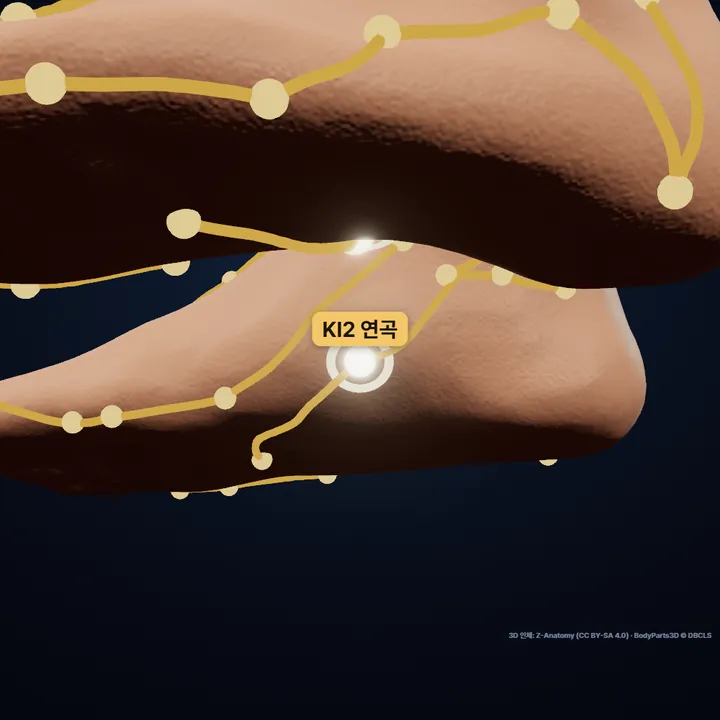

Abductor hallucis · Medial plantar artery · Flexor hallucis longus · Tibialis posterior muscle
Rendered straight from the 3D model at the computed location. The glowing ring marks Rangu.
On this page
1Where is Rangu?
Inner edge of the foot, just below the navicular tuberosity.
It sits on the border where the thick sole skin meets the thinner skin of the side of the foot.
Abductor hallucis · Medial plantar artery · Flexor hallucis longus · Tibialis posterior muscle
2How do I find it on my body?
- Slide a finger forward and down from the inner ankle bone.
- When it meets a bony bump (the navicular tuberosity), move just below it.
- Press the hollow on the line where sole skin changes to side-of-foot skin.
- medial plantar artery
- A branch of the posterior tibial artery that runs along the inner sole toward the big toe.
- flexor hallucis longus
- A muscle that starts deep in the back of the calf, curves behind the inner ankle and attaches to the tip bone of the big toe. It bends the big toe to push off the ground.
- abductor hallucis
- A muscle along the inner edge of the sole from the heel to the big toe. It spreads the big toe and supports the inner arch.
- tibialis posterior
- The deepest muscle in the back of the calf. It curves behind the inner ankle to the bones of the inner sole and holds up the inner arch.
- bloodletting
- A procedure that pricks the skin to let out a little blood. It is done by professionals and must not be done on yourself.
3Before you press
- The Donguibogam advises against drawing blood at this point — do not use bloodletting here.
- Avoid broken or swollen skin and press only to a comfortable level.
- Acupressure is not a substitute for medical care.
4How has it been used traditionally?
- Classified as the Ying-spring (Fire) point of the Kidney meridian — a historical classification, not a claim of effect.
- Ran comes from 'rangu' (然骨), an old name for the navicular prominence just above the point (Lingshu ch. 2).
- An alternative name, Longyuan (龍淵), means 'dragon's pool'.
From traditional texts — not a claim of effect.
5Classical text
Donguibogam (Heo Jun, 1613), Acupuncture and Moxibustion, "Rangu"
一名龍淵在足內踝前起大骨下陷中《銅人》
然谷者然骨之下者《靈樞》
在內踝前直下一寸《資生》
足少陰脈之所流爲滎 … 不宜見血刺之多見血使人立飢欲食 …《靈樞》
- ①Also called Longyuan. On the inner side of the foot, in front of the inner ankle bone, in the hollow below the large raised bone. Tongren Shuxue Zhenjiu Tujing
- ②Rangu lies below the "ran bone". Lingshu
- ③Directly 1 cun below the front of the inner ankle bone. Zhenjiu Zisheng Jing
- ④Where the Foot Shaoyin channel flows, which makes it the Ying-spring point. It is better not to draw blood here — heavy bleeding from needling makes a person suddenly hungry. Lingshu
- Source tags as given in the Donguibogam: Tongren = Tongren Shuxue Zhenjiu Tujing, Lingshu = the Yellow Emperor's Inner Classic: Spiritual Pivot, Zisheng = Zhenjiu Zisheng Jing.
- The bleeding warning in line ④ is found in the Zhenjiu Jiayi Jing (vol.
- 3); Lingshu ch.
- 2 reads only "Rangu is below the ran bone, the Ying-spring point".
- The garbled glyph 嚹 in the Wikisource text has been corrected to 踝 (ankle).
- The "ran bone" (然骨) is an old name for the navicular prominence.
- "…" marks the needling depth and moxa count, left out because they are for licensed practitioners; the warning against drawing blood is kept as safety information.
Original text as written · translation is ours.
?FAQ
Where exactly is Rangu?
Inner edge of the foot, just below the navicular tuberosity. It sits on the border where the thick sole skin meets the thinner skin of the side of the foot.
How do I find Rangu?
Slide a finger forward and down from the inner ankle bone. When it meets a bony bump (the navicular tuberosity), move just below it. Press the hollow on the line where sole skin changes to side-of-foot skin.
What should I watch out for?
The Donguibogam advises against drawing blood at this point — do not use bloodletting here. Avoid broken or swollen skin and press only to a comfortable level. Acupressure is not a substitute for medical care.
Sources
- Location: WHO Standard Acupuncture Point Locations in the Western Pacific Region (2008), p. 136
- Standard comparison: Chinese national standard GB/T 12346-2021 (Nomenclature and location of meridian points)
- Korean anatomical terms and point names: KMCRIC Standard Acupoint DB (Korea)
- Classification source: Lingshu ch. 2 (Ben Shu) for the five transport points; Zhenjiu Jiayi Jing vol. 3 for the phases
- Traditional use: Hyeoljari Seodang (Bookdramang, 2015; Korean), ch. 8 "Rangu" and appendix (Yixue Rumen indications)
- Classical text: Donguibogam, Acupuncture and Moxibustion, "Rangu" — Wikisource public edition (garbled glyph 嚹 corrected to 踝)
- Indications: Yixue Rumen vol. 1 (Wikisource)
- Traditional use cross-check: AcuAtlas dataset (CC BY 4.0)
- 3D: computed on Z-Anatomy (CC BY-SA 4.0) · BodyParts3D © DBCLS
Positions computed from the WHO standard locations (2008) on Z-Anatomy (CC BY-SA 4.0) · BodyParts3D © DBCLS. For reference only — not a substitute for diagnosis or treatment. See a clinician if you are unwell.