Shangyang 商陽
Thumb side of the index fingertip, 0.1 finger-cun from the nail corner.
Open the 3D Acupoint Map →
🖼See it in pictures
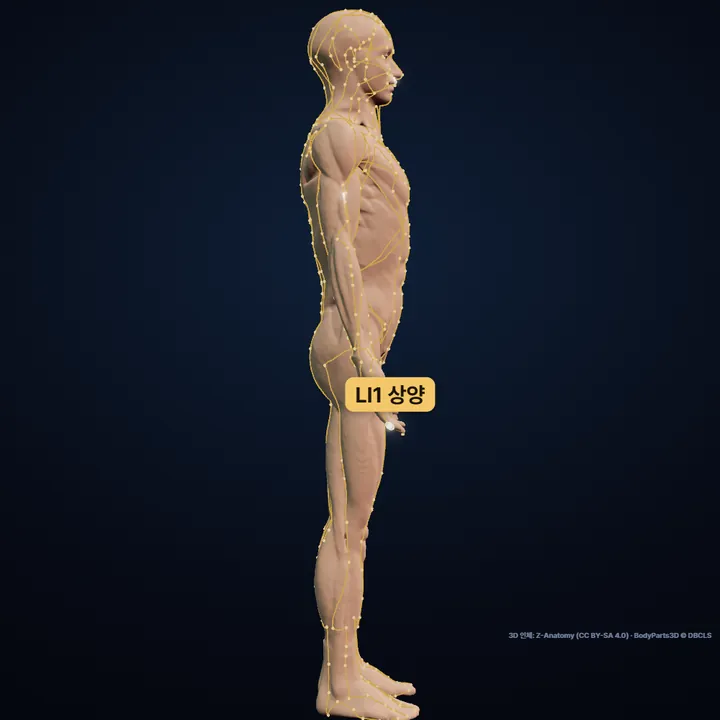

Location and structures come from our 3D model; only the drawing style was refined with AI. Labels are added by us.


Distal phalanx of index finger
Rendered straight from the 3D model at the computed location. The glowing ring marks Shangyang.
On this page
1Where is Shangyang?
Thumb side of the index fingertip, 0.1 finger-cun from the nail corner.
It is where a line down the thumb-side edge of the nail crosses a line along the nail base.
Distal phalanx of index finger
2How do I find it on my body?
- Look at the index fingernail with the back of the hand up.
- Picture one line continuing the thumb-side edge of the nail toward the wrist, and a second line along the nail base.
- Press where the two lines cross.

A cun is a body-scaled unit of length. The precise way is to divide a bone length into equal parts (proportional bone cun); finger widths are a quick estimate.
- distal phalanx of index finger
- The last bone at the tip of the index finger. The fingernail lies on it.
3Before you press
- Skip this point if the skin around the nail is infected or injured.
- There is little tissue here and pressing can hurt, so press gently.
- Avoid broken, bruised or swollen skin and press only to a comfortable level.
- Acupressure is not a substitute for medical care.
4How has it been used traditionally?
- Classified as the Jing-well (Metal) point of the channel. Because its channel, organ and five-phase category are all Metal, classical theory regards it as the point where Metal is strongest.
- An alternative name is Jueyang (絶陽).
From traditional texts — not a claim of effect.
5Classical text
Donguibogam (Heo Jun, 1613), Acupuncture and Moxibustion, "Shangyang"
一名絶陽在手大指次指內側去爪甲角如韭葉手陽明脈之所出也爲井 …《銅人》
① Also called Jueyang. On the inner side of the index finger (the 'finger next to the thumb'), a chive leaf's width from the corner of the nail. Where the Hand Yangming channel emerges, which makes it the Jing-well point (Tongren Shuxue Zhenjiu Tujing).
- Source tag as given in the Donguibogam: Tongren = Tongren Shuxue Zhenjiu Tujing.
- 'The finger next to the thumb' is the index finger, and 'inner' here means its thumb (radial) side.
- The garbled glyph 堛 in the Wikisource text has been corrected to 韭 (chive), as in the Zhenjiu Jiayi Jing (vol.
- 3).
- Lingshu ch.
- 2 reads 'Shangyang, the tip of the index finger … the Jing-well point'.
- "…" marks the needling depth and moxa count, left out because they are for licensed practitioners.
Original text as written · translation is ours.
?FAQ
Where exactly is Shangyang?
Thumb side of the index fingertip, 0.1 finger-cun from the nail corner. It is where a line down the thumb-side edge of the nail crosses a line along the nail base.
How do I find Shangyang?
Look at the index fingernail with the back of the hand up. Picture one line continuing the thumb-side edge of the nail toward the wrist, and a second line along the nail base. Press where the two lines cross. it sits just outside and behind the nail corner (0.1 finger-cun).
What should I watch out for?
Skip this point if the skin around the nail is infected or injured. There is little tissue here and pressing can hurt, so press gently. Avoid broken, bruised or swollen skin and press only to a comfortable level. Acupressure is not a substitute for medical care.
Sources
- Location: WHO Standard Acupuncture Point Locations in the Western Pacific Region (2008), p. 34
- Korean anatomical terms: KMCRIC standard acupoint database · KMLE medical dictionary
- Traditional use: Hyeoljari Seodang (Bookdramang, 2015; Korean), ch. 2 "Shangyang" and appendix (Yixue Rumen indications)
- Classical text: Donguibogam, Acupuncture and Moxibustion, "Shangyang" — Wikisource public edition (garbled glyph 堛 corrected to 韭)
- Indications: Yixue Rumen vol. 1 (Wikisource)
- Classification source: Lingshu ch. 2 (Ben Shu) for the five transport points; Nanjing ch. 64 for the phases
- 3D: computed on Z-Anatomy (CC BY-SA 4.0) · BodyParts3D © DBCLS
Positions computed from the WHO standard locations (2008) on Z-Anatomy (CC BY-SA 4.0) · BodyParts3D © DBCLS. For reference only — not a substitute for diagnosis or treatment. See a clinician if you are unwell.