Shaoshang 少商
Thumb side of the thumb's end segment (distal phalanx), about 0.1 finger-cun (roughly 2 mm) from the nail corner.
Open the 3D Acupoint Map →
🖼See it in pictures
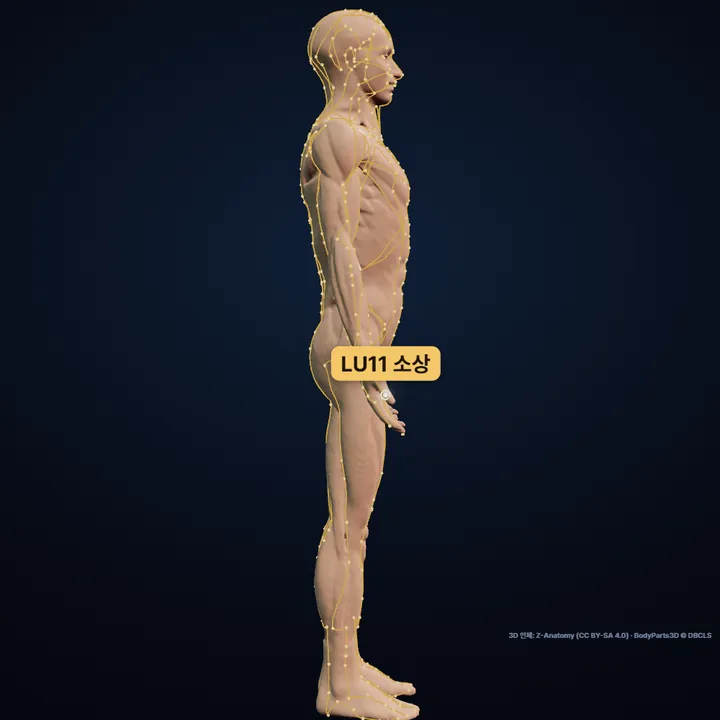

Location and structures come from our 3D model; only the drawing style was refined with AI. Labels are added by us.
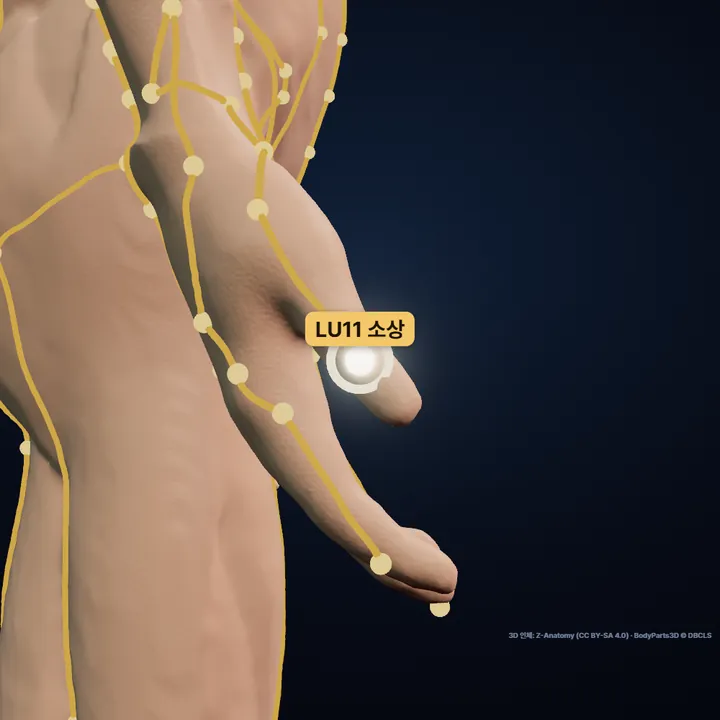
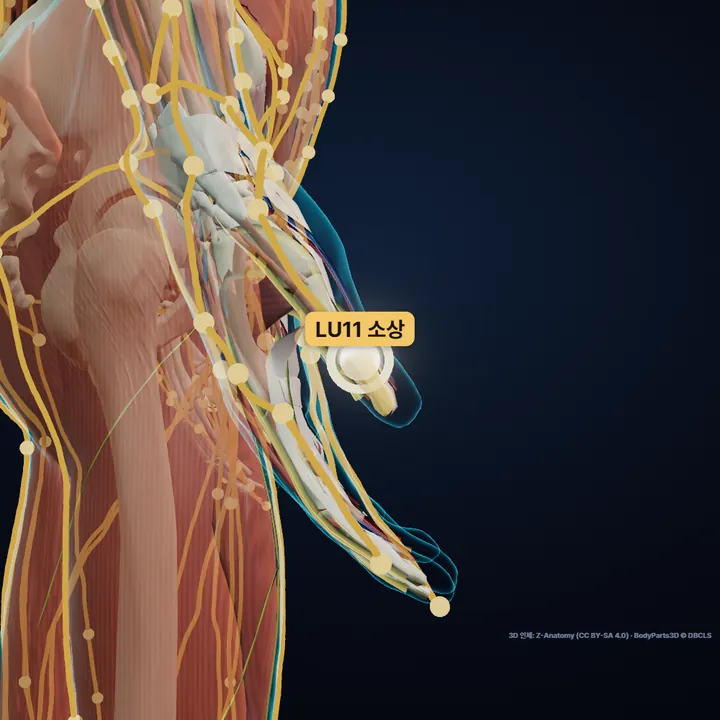
Distal phalanx of thumb
Rendered straight from the 3D model at the computed location. The glowing ring marks Shaoshang.
On this page
1Where is Shaoshang?
Thumb side of the thumb's end segment (distal phalanx), about 0.1 finger-cun (roughly 2 mm) from the nail corner.
It is where a line along the nail's thumb-side edge crosses a line along the nail base.
Distal phalanx of thumb
2How do I find it on my body?
- Extend a line along the thumb-side edge of the thumbnail (the edge away from the index finger) toward the wrist.
- Extend a second line along the base of the nail.
- Press where the two lines cross.
- distal phalanx of thumb
- The last bone at the tip of the thumb. The fingernail lies on it.
- bloodletting
- A procedure that pricks the skin to let out a little blood. It is done by professionals and must not be done on yourself.
3Before you press
- Bloodletting is a professional procedure — do not prick this point yourself.
- There is very little tissue here, so press gently.
- The Donguibogam says moxibustion should not be used here.
- If the throat suddenly swells and breathing or swallowing becomes hard, or someone collapses or becomes confused, call emergency services at once; do not try acupressure.
- Avoid broken or swollen skin and press only to a comfortable level.
- Acupressure is not a substitute for medical care.
4How has it been used traditionally?
- In TCM theory it is the Jing-well (Wood) point where the Lung meridian ends — a historical classification, not a claim of effect.
- Sun Simiao's Qianjin Yaofang lists a spot 'below the thumbnail', Guixin (鬼信), as the second of the classical "13 ghost points"; it is commonly read as this point.
From traditional texts — not a claim of effect.
5Classical text
Donguibogam (Heo Jun, 1613), Acupuncture and Moxibustion, "Shaoshang"
在手大指端內側去爪甲角如韭葉手太陰脈之所出爲井 … 禁不可灸《銅人》
出血以瀉諸藏之熱《靈樞》
以三稜鍼刺之微出血泄諸藏熱湊
咽中腫塞水粒不下鍼之立愈《資生》
- ①On the side of the thumb tip that old texts call 'inner' (the radial side, away from the index finger), a chive leaf's width from the corner of the nail. Where the Hand Taiyin channel emerges, which makes it the Jing-well point. … Moxibustion is forbidden here. Tongren Shuxue Zhenjiu Tujing
- ②–④ The remaining lines describe letting a little blood here with a three-edged needle and record a historical case; they are not translated in English. Bloodletting is a procedure for licensed practitioners only.
- Source tags as given in the Donguibogam: Tongren = Tongren Shuxue Zhenjiu Tujing, Lingshu = the Yellow Emperor's Inner Classic: Spiritual Pivot, Zisheng = Zhenjiu Zisheng Jing (line ③ carries no tag).
- Lingshu ch.
- 2 places Shaoshang 'at the inner side of the thumb tip … the Jing-well point'.
- Garbled glyphs in the Wikisource text have been corrected: 堛 to 韭 (chive) and 溱 to 湊, checked against the Zhenjiu Jiayi Jing (vol.
- 3) and the Zhenjiu Dacheng (vol.
- 8).
- 'Inner' in old texts is measured from the trunk; here it means the radial side of the thumb.
- 'A chive leaf's width' is an old way of saying 'just off the corner' (WHO: 0.1 finger-cun).
- "…" marks the needling depth, left out because it is for licensed practitioners.
- The moxibustion warning is kept and carried into the Caution section.
Original text as written · translation is ours.
?FAQ
Where exactly is Shaoshang?
Thumb side of the thumb's end segment (distal phalanx), about 0.1 finger-cun (roughly 2 mm) from the nail corner. It is where a line along the nail's thumb-side edge crosses a line along the nail base.
How do I find Shaoshang?
Extend a line along the thumb-side edge of the thumbnail (the edge away from the index finger) toward the wrist. Extend a second line along the base of the nail. Press where the two lines cross. it is about 2 mm from the nail corner, along the line that splits the corner angle in half.
What should I watch out for?
Bloodletting is a professional procedure — do not prick this point yourself. There is very little tissue here, so press gently. The Donguibogam says moxibustion should not be used here. If the throat suddenly swells and breathing or swallowing becomes hard, or someone collapses or becomes confused, call emergency services at once; do not try acupressure. Avoid broken or swollen skin and press only to a comfortable level. Acupressure is not a substitute for medical care.
Sources
- Location: WHO Standard Acupuncture Point Locations in the Western Pacific Region (2008), p. 31
- Standard comparison: Chinese national standard GB/T 12346-2021 (Nomenclature and location of meridian points)
- Locating tips: KMCRIC Standard Acupoint DB (Korea)
- Traditional use: Hyeoljari Seodang (Bookdramang, 2015; Korean), ch. 1 "Shaoshang" and appendix (Yixue Rumen indications)
- Classical text: Donguibogam, Acupuncture and Moxibustion, "Shaoshang" — Wikisource public edition (garbled glyphs 堛 corrected to 韭, 溱 corrected to 湊)
- Indications: Yixue Rumen vol. 1 (Wikisource) · 13 ghost points: Beiji Qianjin Yaofang vol. 14 (Wikisource)
- Classification source: Lingshu ch. 2 (Ben Shu) for the five transport points; Nanjing ch. 64 for the phases
- 3D: computed on Z-Anatomy (CC BY-SA 4.0) · BodyParts3D © DBCLS
Positions computed from the WHO standard locations (2008) on Z-Anatomy (CC BY-SA 4.0) · BodyParts3D © DBCLS. For reference only — not a substitute for diagnosis or treatment. See a clinician if you are unwell.