Yuji 魚際
On the palm, halfway along the first metacarpal on its thumb (radial) side.
Open the 3D Acupoint Map →
🖼See it in pictures
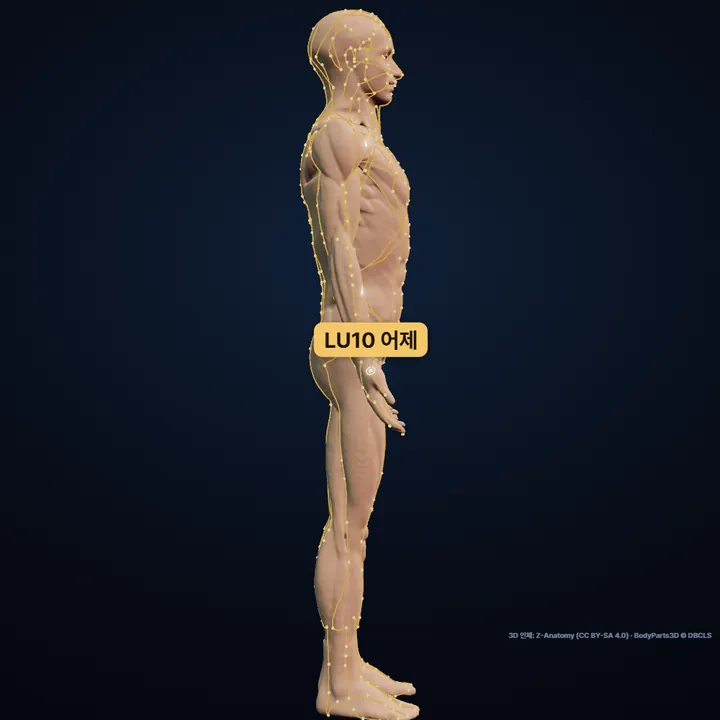

Location and structures come from our 3D model; only the drawing style was refined with AI. Labels are added by us.
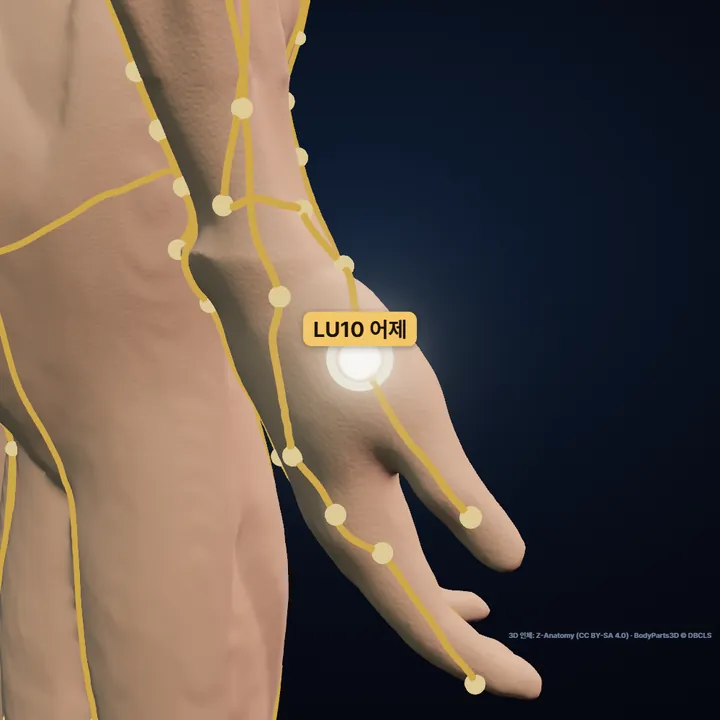
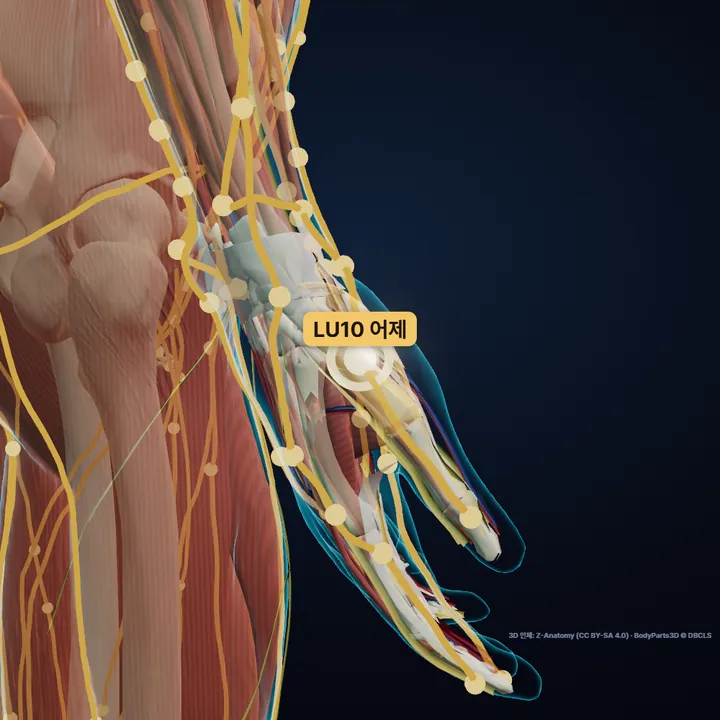
First metacarpal bone · Abductor pollicis brevis
Rendered straight from the 3D model at the computed location. The glowing ring marks Yuji.
On this page
1Where is Yuji?
On the palm, halfway along the first metacarpal on its thumb (radial) side.
It lies on the line where palm skin meets back-of-hand skin, the middle of the edge of the thenar eminence.
First metacarpal bone · Abductor pollicis brevis
2How do I find it on my body?
- Trace the first metacarpal from its head at the thumb's knuckle (first metacarpophalangeal joint) back to its base near the wrist.
- Mark the halfway level.
- At that level, stroke the edge of the thenar eminence from the palm toward the back of the hand. Press on the line where skin texture and colour change.
- metacarpophalangeal joint
- The joint where a metacarpal meets the first bone of a finger, the root joint of the finger. It is the knuckle that rises on the back of the hand when you make a fist.
- abductor pollicis brevis
- The surface muscle of the thenar eminence (the fleshy pad at the base of the thumb). It moves the thumb forward away from the palm.
- thenar eminence
- The fleshy bulge on the palm at the base of the thumb. It holds the short muscles that move the thumb.
- Yixue Rumen
- An introductory medical book published by Li Chan in Ming China in 1575, widely read in Joseon Korea as well.
3Before you press
- The Donguibogam and Yixue Rumen say moxibustion should not be used here.
- Avoid broken or swollen skin and press only to a comfortable level.
- Acupressure is not a substitute for medical care.
4How has it been used traditionally?
- In TCM theory it is the Ying-spring (Fire) point of the Lung meridian — a historical classification, not a claim of effect.
- The name joins yu (fish) and ji (edge): the border of the fish-shaped thenar eminence, where the palm meets the back of the hand.
- Old diagnostic texts describe looking at the colour of this area; this is a historical practice, not a validated test.
From traditional texts — not a claim of effect.
5Classical text
Donguibogam (Heo Jun, 1613), Acupuncture and Moxibustion, "Yuji"
在手大指本節後內側散脈中手太陰脈之所流爲滎 … 禁不可灸《入門》
① Behind the base joint of the thumb on its inner side, among the scattered small vessels. Where the Hand Taiyin channel flows, which makes it the Ying-spring point. … Moxibustion is forbidden here (Yixue Rumen).
- Source tag as given in the Donguibogam: Rumen = Yixue Rumen (1575).
- The 'base joint' is the metacarpophalangeal joint.
- 'Inner side' in old texts is measured from the trunk and may not match modern anatomical directions.
- The Wikisource Yixue Rumen writes 'second joint' where the Donguibogam has 'base joint'.
- Lingshu ch.
- 2 reads 'Yuji, the fish of the hand … the Ying-spring point'.
- "…" marks the needling depth, left out because it is for licensed practitioners.
- The moxibustion warning is kept and carried into the Caution section.
- No glyphs needed correcting in this entry.
Original text as written · translation is ours.
?FAQ
Where exactly is Yuji?
On the palm, halfway along the first metacarpal on its thumb (radial) side. It lies on the line where palm skin meets back-of-hand skin, the middle of the edge of the thenar eminence.
How do I find Yuji?
Trace the first metacarpal from its head at the thumb's knuckle (first metacarpophalangeal joint) back to its base near the wrist. Mark the halfway level. At that level, stroke the edge of the thenar eminence from the palm toward the back of the hand. Press on the line where skin texture and colour change.
What should I watch out for?
The Donguibogam and Yixue Rumen say moxibustion should not be used here. Avoid broken or swollen skin and press only to a comfortable level. Acupressure is not a substitute for medical care.
Sources
- Location: WHO Standard Acupuncture Point Locations in the Western Pacific Region (2008), p. 30
- Standard comparison: Chinese national standard GB/T 12346-2021 (Nomenclature and location of meridian points)
- Locating tips: KMCRIC Standard Acupoint DB (Korea)
- Traditional use: Hyeoljari Seodang (Bookdramang, 2015; Korean), ch. 1 "Yuji" and appendix (Yixue Rumen indications)
- Classical text: Donguibogam, Acupuncture and Moxibustion, "Yuji" — Wikisource public edition
- Indications: Yixue Rumen vol. 1 (Wikisource)
- Classification source: Lingshu ch. 2 (Ben Shu) for the five transport points; Nanjing ch. 64 for the phases
- 3D: computed on Z-Anatomy (CC BY-SA 4.0) · BodyParts3D © DBCLS
Positions computed from the WHO standard locations (2008) on Z-Anatomy (CC BY-SA 4.0) · BodyParts3D © DBCLS. For reference only — not a substitute for diagnosis or treatment. See a clinician if you are unwell.