Taiyuan 太淵
Thumb end of the palmar wrist crease, right over the radial artery where the pulse is felt.
Open the 3D Acupoint Map →
🖼See it in pictures


Location and structures come from our 3D model; only the drawing style was refined with AI. Labels are added by us.

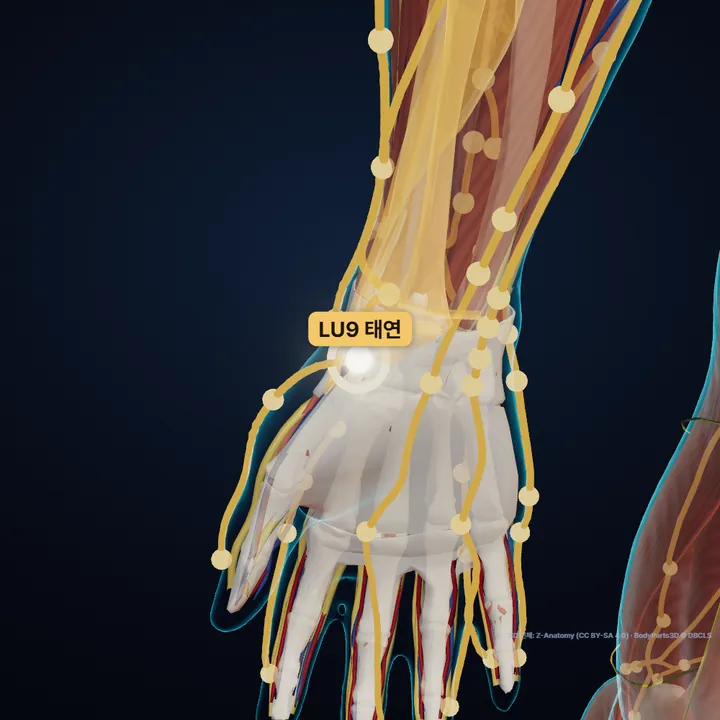
Radius · Scaphoid · Abductor pollicis longus · Radial artery
Rendered straight from the 3D model at the computed location. The glowing ring marks Taiyuan.
On this page
1Where is Taiyuan?
Thumb end of the palmar wrist crease, right over the radial artery where the pulse is felt.
It lies in the dip between the scaphoid and the radial styloid process, on the little-finger (ulnar) side of the abductor pollicis longus tendon.
Radius · Scaphoid · Abductor pollicis longus · Radial artery
2How do I find it on my body?
- Palm up, flex the wrist slightly and pick the crease closest to the hand.
- Feel the bony end on the thumb side of the wrist (radial styloid process) and check that the crease passes at its level.
- Find the pulse at the thumb end of the crease.
- radial styloid process
- The bony tip sticking out on the thumb side of the wrist, the lower end of the radius, right beside the pulse spot on the thumb side.
- wrist crease
- The horizontal crease that forms at the wrist when it is slightly bent. There is one on the palm side and one on the back, and they are starting lines for measuring arm points.
- radial artery
- The artery running down the thumb side of the forearm to the wrist. It is the pulse you feel when you place fingers on the thumb side of the wrist crease.
3Before you press
- This point lies directly over the radial artery.
- Do not press hard or for long where you feel the pulse.
- Avoid broken or swollen skin and press only to a comfortable level.
- Acupressure is not a substitute for medical care.
4How has it been used traditionally?
- Classified as the Yuan-source point of the Lung meridian — a historical classification, not a claim of effect.
- The Nanjing (Classic of Difficulties) names it the meeting point of the vessels; it is also where the wrist pulse is traditionally read.
- The name joins tai (very great) and yuan (deep pool); its alternative name Taiquan (太泉) means 'great spring'.
- Sun Simiao's Qianjin Yaofang names this spot Guixin (鬼心), the fourth of the classical "13 ghost points".
From traditional texts — not a claim of effect.
5Classical text
Donguibogam (Heo Jun, 1613), Acupuncture and Moxibustion, "Taiyuan"
一名太泉在手掌後橫文頭陷中一云在魚後一寸陷者中手太陰脈之所注爲腧 …《銅人》
① Also called Taiquan. In the hollow at the end of the crease behind the palm; also given as the hollow 1 cun behind the 'fish' (the thenar eminence). Where the Hand Taiyin channel pours in, which makes it the Shu-stream point (Tongren Shuxue Zhenjiu Tujing).
- Source tag as given in the Donguibogam: Tongren = Tongren Shuxue Zhenjiu Tujing.
- The garbled glyph 杮 in the Wikisource text has been corrected to 腧 (Lingshu ch.
- 2 and the Zhenjiu Jiayi Jing write 俞).
- Lingshu ch.
- 2 also places Taiyuan 'in the hollow 1 cun behind the fish'.
- 'Fish' is an old name for the thenar eminence.
- "…" marks the needling depth and moxa count, left out because they are for licensed practitioners.
Original text as written · translation is ours.
?FAQ
Where exactly is Taiyuan?
Thumb end of the palmar wrist crease, right over the radial artery where the pulse is felt. It lies in the dip between the scaphoid and the radial styloid process, on the little-finger (ulnar) side of the abductor pollicis longus tendon.
How do I find Taiyuan?
Palm up, flex the wrist slightly and pick the crease closest to the hand. Feel the bony end on the thumb side of the wrist (radial styloid process) and check that the crease passes at its level. Find the pulse at the thumb end of the crease. it is the hollow just on the little-finger side of the abductor pollicis longus tendon, which stands out when you spread the thumb.
What should I watch out for?
This point lies directly over the radial artery. Do not press hard or for long where you feel the pulse. Avoid broken or swollen skin and press only to a comfortable level. Acupressure is not a substitute for medical care.
Sources
- Location: WHO Standard Acupuncture Point Locations in the Western Pacific Region (2008), p. 30
- Standard comparison: Chinese national standard GB/T 12346-2021 (Nomenclature and location of meridian points)
- Locating tips: KMCRIC Standard Acupoint DB (Korea)
- Traditional use: Hyeoljari Seodang (Bookdramang, 2015; Korean), ch. 1 "Taiyuan" and appendix (Yixue Rumen indications)
- Classical text: Donguibogam, Acupuncture and Moxibustion, "Taiyuan" — Wikisource public edition (garbled glyph 杮 corrected to 腧)
- Indications: Yixue Rumen vol. 1 (Wikisource) · 13 ghost points: Beiji Qianjin Yaofang vol. 14 (Wikisource)
- Classification source: Lingshu ch. 1 (Jiu Zhen Shi Er Yuan, source point) and ch. 2 (Ben Shu); Nanjing ch. 45 and 64
- Safety: CCAOM Clean Needle Technique Manual, 7th ed. (rev. 2024) — points over major vessels
- 3D: computed on Z-Anatomy (CC BY-SA 4.0) · BodyParts3D © DBCLS
Positions computed from the WHO standard locations (2008) on Z-Anatomy (CC BY-SA 4.0) · BodyParts3D © DBCLS. For reference only — not a substitute for diagnosis or treatment. See a clinician if you are unwell.