Ximen 郄門
Front of the forearm, 5 cun above the palm-side wrist crease, between the palmaris longus and flexor carpi radialis tendons.
Open the 3D Acupoint Map →
🖼See it in pictures

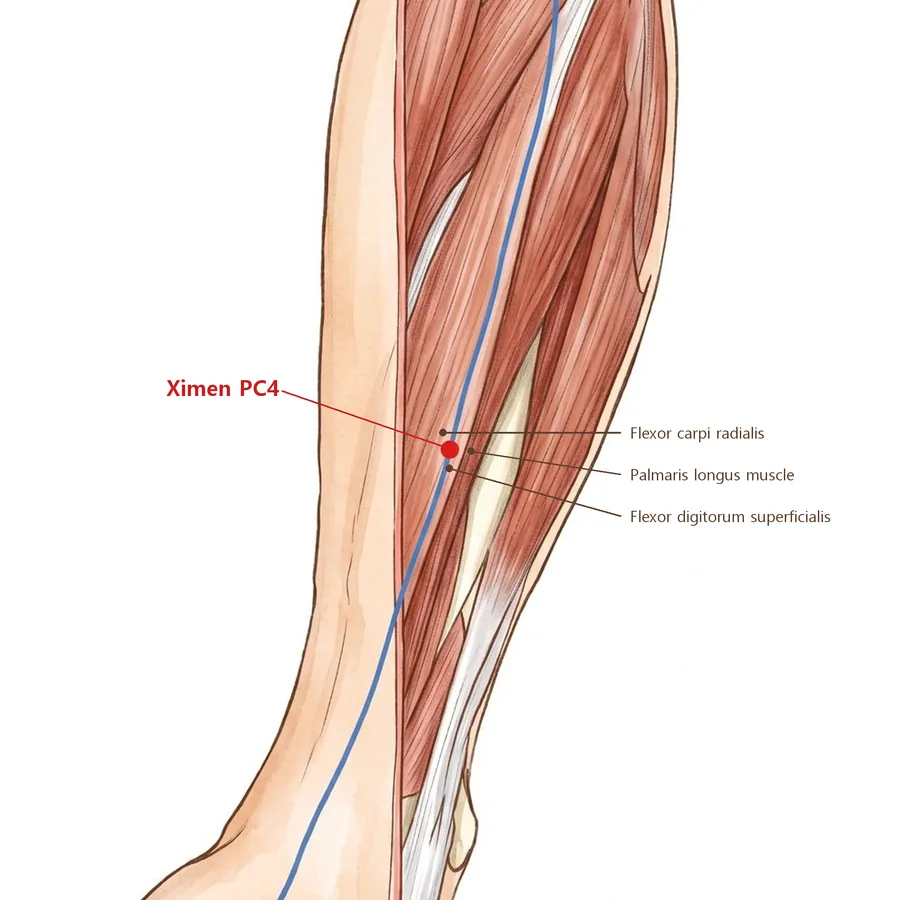
Location and structures come from our 3D model; only the drawing style was refined with AI. Labels are added by us.

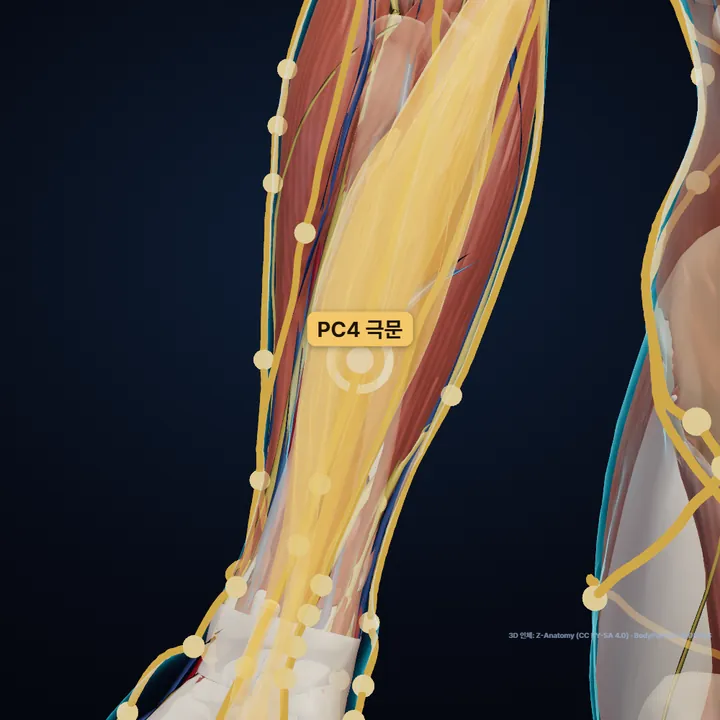
Palmaris longus muscle · Flexor carpi radialis · Flexor digitorum superficialis
Rendered straight from the 3D model at the computed location. The glowing ring marks Ximen.
On this page
1Where is Ximen?
Front of the forearm, 5 cun above the palm-side wrist crease, between the palmaris longus and flexor carpi radialis tendons.
Palmaris longus muscle · Flexor carpi radialis · Flexor digitorum superficialis
2How do I find it on my body?
- Make a fist, turn the palm up and bend the elbow a little.
- Find the two tendons standing out in the middle of the wrist (palmaris longus and flexor carpi radialis).
- Find the midpoint of the line from PC3 to PC7 (6 cun) and move 1 cun toward the wrist.
- Press between the two tendons.
- No palmaris longus tendon (not rare)? Use the spot just on the little-finger side of the flexor carpi radialis tendon.

A cun is a body-scaled unit of length. The precise way is to divide a bone length into equal parts (proportional bone cun); finger widths are a quick estimate.
- flexor digitorum superficialis
- A wide muscle in the middle layer of the palm side of the forearm. It bends the middle joints of the four fingers.
- flexor carpi radialis
- A forearm muscle running from the inner elbow to the second metacarpal that bends the wrist and tilts it toward the thumb. Flex the wrist and its tendon stands out like a cord a little to the thumb side of the middle of the wrist crease.
- palmaris longus
- A thin muscle down the middle of the palm side of the forearm, missing in quite a few people. Touch thumb and little fingertips together and bend the wrist slightly: the thin tendon standing out most in the middle of the wrist is this one.
- wrist crease
- The horizontal crease that forms at the wrist when it is slightly bent. There is one on the palm side and one on the back, and they are starting lines for measuring arm points.
- median nerve
- The nerve running down the middle of the arm, through the center of the palm side of the wrist into the palm. It handles feeling on the thumb-side palm and movement of the thumb muscles.
3Before you press
- The median nerve runs deep between the two tendons.
- Ease off if the fingers tingle.
- Avoid broken or swollen skin and press only to a comfortable level.
- Acupressure is not a substitute for medical care.
- Crushing chest pain, breathlessness or a cold sweat can signal a heart emergency — call emergency services at once; do not try acupressure.
4How has it been used traditionally?
- Classified as the Xi-cleft point of the Pericardium meridian — a historical classification, not a claim of effect.
From traditional texts — not a claim of effect.
?FAQ
Where exactly is Ximen?
Front of the forearm, 5 cun above the palm-side wrist crease, between the palmaris longus and flexor carpi radialis tendons.
How do I find Ximen?
Make a fist, turn the palm up and bend the elbow a little. Find the two tendons standing out in the middle of the wrist (palmaris longus and flexor carpi radialis). Find the midpoint of the line from PC3 to PC7 (6 cun) and move 1 cun toward the wrist. Press between the two tendons. No palmaris longus tendon (not rare)? Use the spot just on the little-finger side of the flexor carpi radialis tendon.
What should I watch out for?
The median nerve runs deep between the two tendons. Ease off if the fingers tingle. Avoid broken or swollen skin and press only to a comfortable level. Acupressure is not a substitute for medical care. Crushing chest pain, breathlessness or a cold sweat can signal a heart emergency — call emergency services at once; do not try acupressure.
Sources
- Location: WHO Standard Acupuncture Point Locations in the Western Pacific Region (2008), p. 153
- Standard comparison: Chinese national standard GB/T 12346-2021 (Nomenclature and location of meridian points), p. 22
- Korean anatomical terms: KMLE medical dictionary (Korean Medical Association terms)
- Xi-cleft source: Zhenjiu Jiayi Jing vol. 3 (Wikisource edition)
- Classification and traditional-use cross-check: AcuAtlas dataset (CC BY 4.0)
- 3D: computed on Z-Anatomy (CC BY-SA 4.0) · BodyParts3D © DBCLS
Positions computed from the WHO standard locations (2008) on Z-Anatomy (CC BY-SA 4.0) · BodyParts3D © DBCLS. For reference only — not a substitute for diagnosis or treatment. See a clinician if you are unwell.