Yinbai 隱白
0.1 F-cun back and in from the inner corner of the big toenail.
Open the 3D Acupoint Map →
🖼See it in pictures
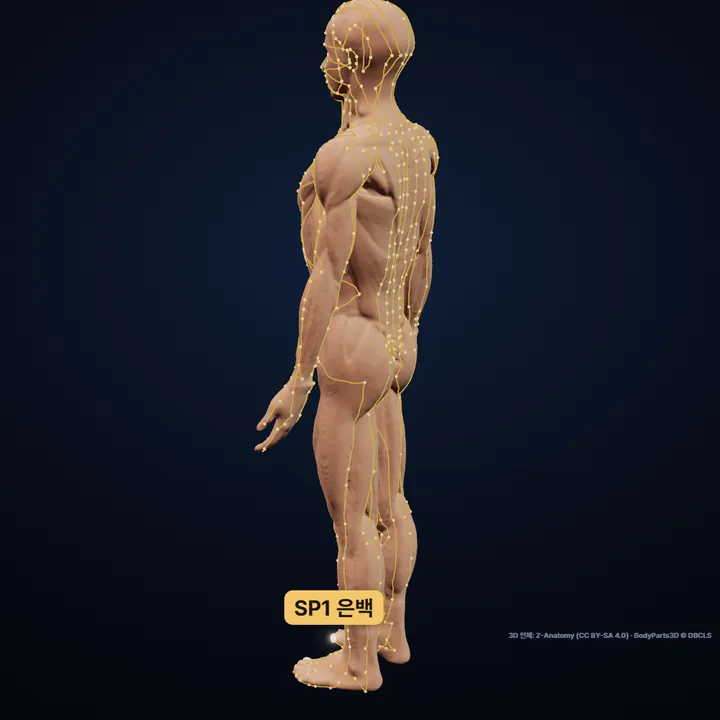

Location and structures come from our 3D model; only the drawing style was refined with AI. Labels are added by us.
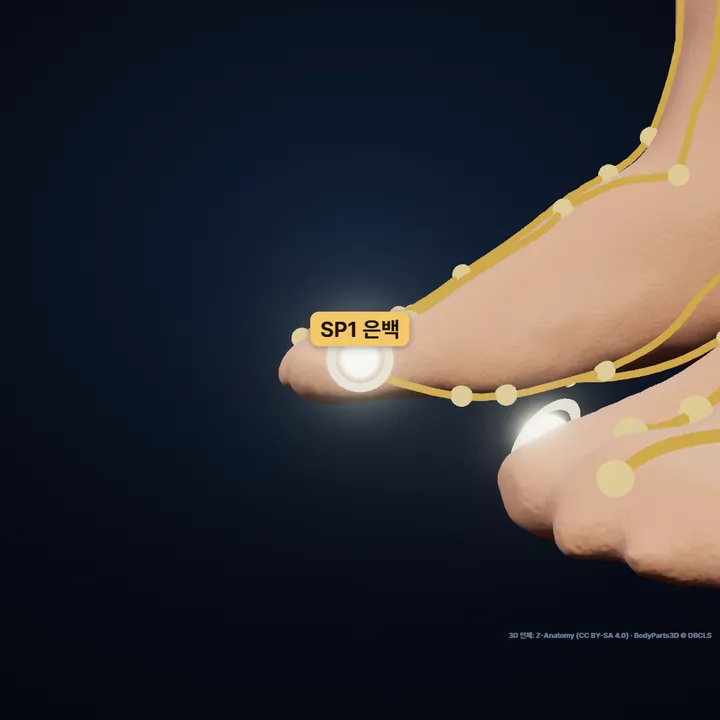
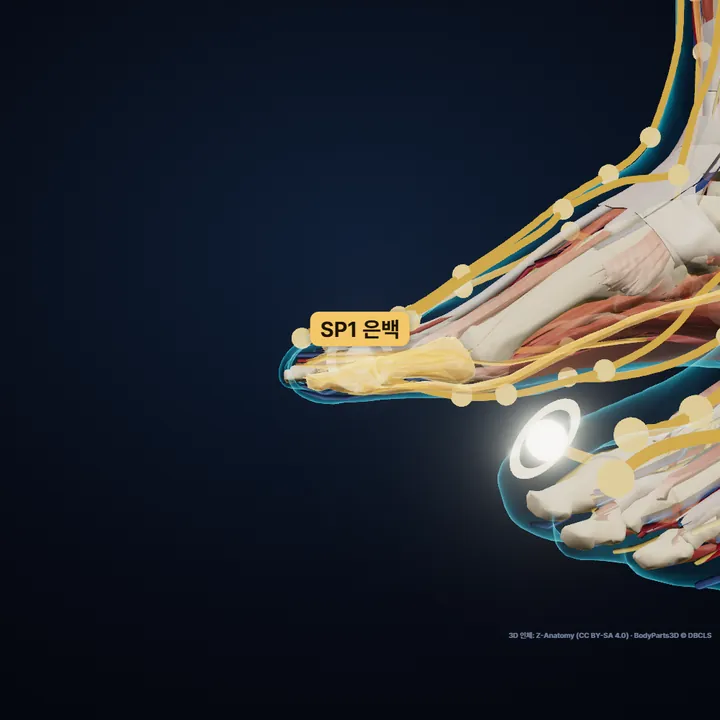
Proximal phalanx of first finger of foot · Distal phalanx of first finger of foot · Flexor hallucis longus · Proper plantar digital arteries
Rendered straight from the 3D model at the computed location. The glowing ring marks Yinbai.
On this page
1Where is Yinbai?
0.1 F-cun back and in from the inner corner of the big toenail.
On the inner side of the end bone, it is where a line along the nail's inner edge meets a line across the nail's base.
Proximal phalanx of first finger of foot · Distal phalanx of first finger of foot · Flexor hallucis longus · Proper plantar digital arteries
2How do I find it on my body?
- Picture a line along the inner edge of the big toenail (the side away from the second toe).
- Picture a line across the base of the nail, where it emerges from the skin.
- Press where the two lines cross.

A cun is a body-scaled unit of length. The precise way is to divide a bone length into equal parts (proportional bone cun); finger widths are a quick estimate.
- proper plantar digital arteries
- The thin arteries running along both sides of the underside of each toe to its tip.
- flexor hallucis longus
- A muscle that starts deep in the back of the calf, curves behind the inner ankle and attaches to the tip bone of the big toe. It bends the big toe to push off the ground.
- distal phalanx
- The last bone at the tip of a finger or toe. The nail lies on top of it.
- Yixue Rumen
- An introductory medical book published by Li Chan in Ming China in 1575, widely read in Joseon Korea as well.
- proximal phalanx
- The first bone of a finger or toe, at the root end. It forms a joint with the metacarpal or metatarsal bone.
3Before you press
- Skip this point if the skin around the toenail is infected or injured.
- Classical texts (Donguibogam; Yixue Rumen) forbid moxibustion at this point.
- Do not apply moxa at home.
- Avoid broken or swollen skin and press only to a comfortable level.
- Acupressure is not a substitute for medical care.
4How has it been used traditionally?
- Classified as the Jing-well (Wood) point of the Spleen channel, where the channel begins — a historical classification, not a claim of effect.
- The name joins yin (hidden) and bai (white): tucked at the pale edge of the big toe.
- Sun Simiao's Qianjin Yaofang lists Guilei (鬼壘), "under the big-toe nail", as the third of the classical "13 ghost points"; Hyeoljari Seodang gives Guilei as another name for this point.
From traditional texts — not a claim of effect.
5Classical text
Donguibogam (Heo Jun, 1613), Acupuncture and Moxibustion, "Yinbai"
在足大指端內側去爪甲角如韭葉足太陰脈之所出爲井 … 禁不可灸《銅人》
① On the inner side of the tip of the big toe, a leek leaf's width from the corner of the nail. Where the Foot Taiyin channel emerges, which makes it the Jing-well point. Moxibustion is forbidden here (Tongren).
- Source tags as given in the Donguibogam: Tongren = Tongren Shuxue Zhenjiu Tujing (1026).
- The garbled glyph 堛 has been corrected to 韭 (leek), checked against the Zhenjiu Jiayi Jing vol.
- 3.
- The prohibition line is kept and translated; the Yixue Rumen also forbids moxa here, while the Jiayi Jing lists a moxa count, so the texts differ.
- Our card does not recommend moxa.
- "…" marks the needling depth and moxa count, left out because they are for licensed practitioners.
Original text as written · translation is ours.
?FAQ
Where exactly is Yinbai?
0.1 F-cun back and in from the inner corner of the big toenail. On the inner side of the end bone, it is where a line along the nail's inner edge meets a line across the nail's base.
How do I find Yinbai?
Picture a line along the inner edge of the big toenail (the side away from the second toe). Picture a line across the base of the nail, where it emerges from the skin. Press where the two lines cross. about 0.1 F-cun diagonally from the nail corner.
What should I watch out for?
Skip this point if the skin around the toenail is infected or injured. Classical texts (Donguibogam; Yixue Rumen) forbid moxibustion at this point. Do not apply moxa at home. Avoid broken or swollen skin and press only to a comfortable level. Acupressure is not a substitute for medical care.
Sources
- Location: WHO Standard Acupuncture Point Locations in the Western Pacific Region (2008), p. 70
- Standard comparison: Chinese national standard GB/T 12346-2021 (Nomenclature and location of meridian points)
- Korean anatomical terms and locating tips: KMCRIC Standard Acupoint DB (Korea)
- Classification source: Lingshu ch. 2 (Ben Shu) for the five transport points; Nanjing ch. 64 for the phases; Zhenjiu Jiayi Jing vol. 3 (Siku Quanshu edition)
- Traditional use: Hyeoljari Seodang (Bookdramang, 2015; Korean), ch. 4 "Yinbai" and appendix (Yixue Rumen indications)
- Classical text: Donguibogam, Acupuncture and Moxibustion, "Yinbai" — Wikisource public edition (garbled glyph 堛 corrected to 韭)
- Indications: Yixue Rumen vol. 1 (Wikisource)
- 13 ghost points: Beiji Qianjin Yaofang vol. 14 (Wikisource)
- 3D: computed on Z-Anatomy (CC BY-SA 4.0) · BodyParts3D © DBCLS
Positions computed from the WHO standard locations (2008) on Z-Anatomy (CC BY-SA 4.0) · BodyParts3D © DBCLS. For reference only — not a substitute for diagnosis or treatment. See a clinician if you are unwell.