Yinlingquan 陰陵泉
In the hollow where the lower edge of the tibia's medial condyle meets the medial border of the tibia.
Open the 3D Acupoint Map →
🖼See it in pictures
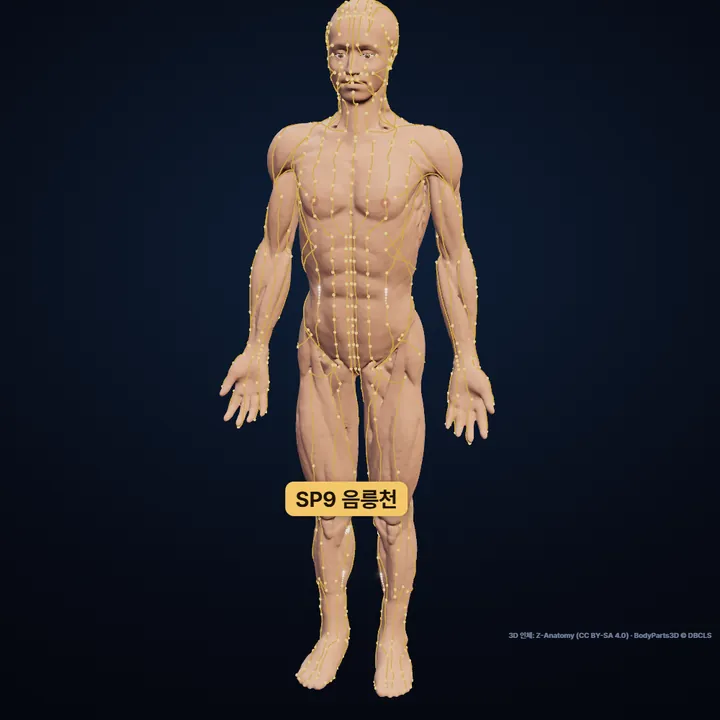
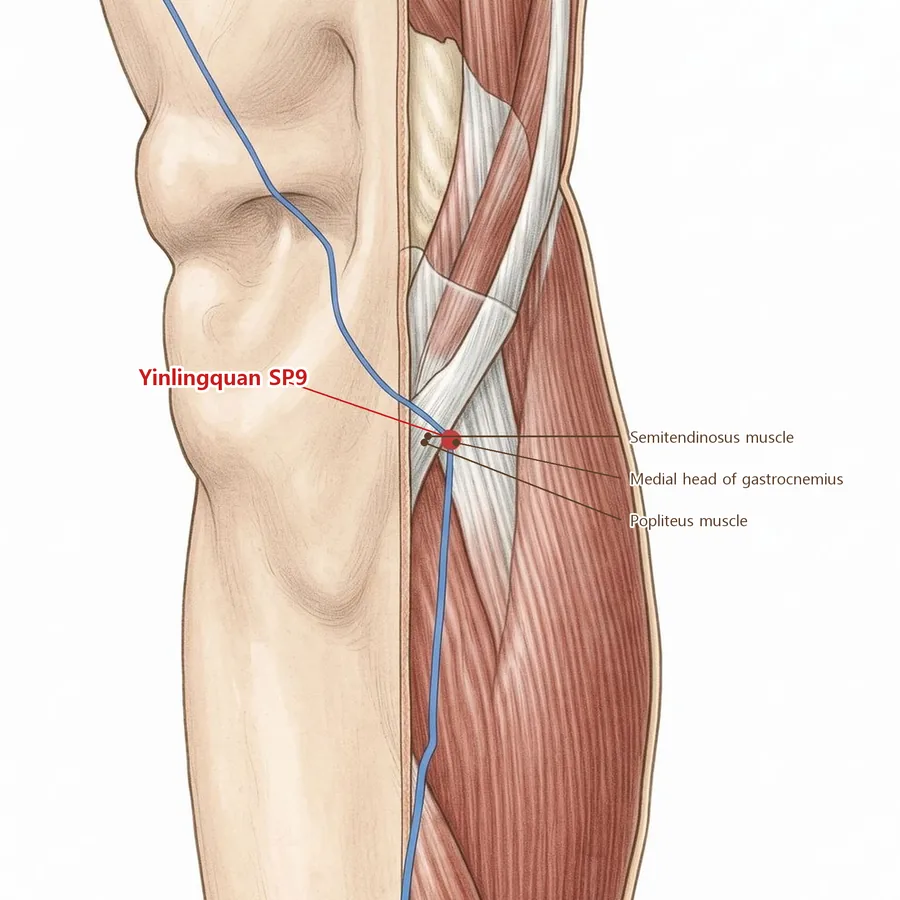
Location and structures come from our 3D model; only the drawing style was refined with AI. Labels are added by us.
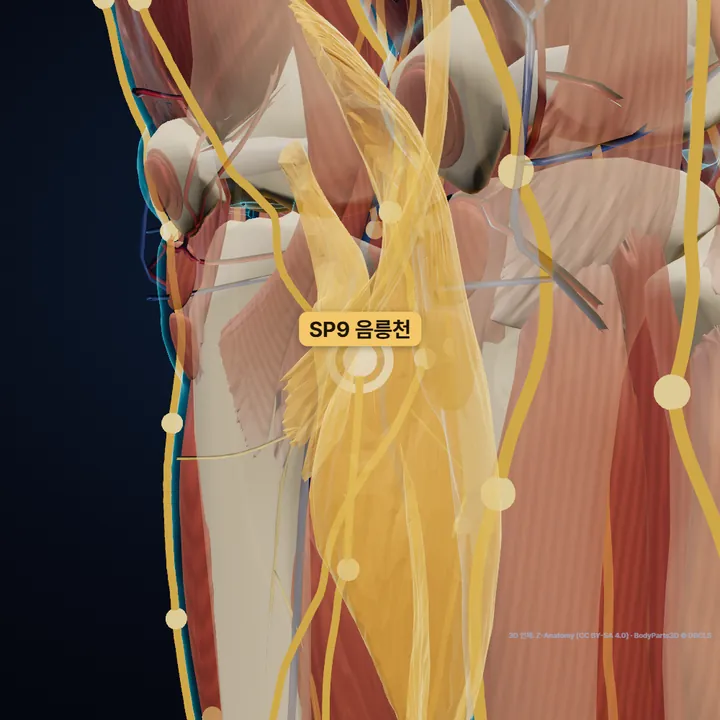
Medial head of gastrocnemius · Semitendinosus muscle · Popliteus muscle
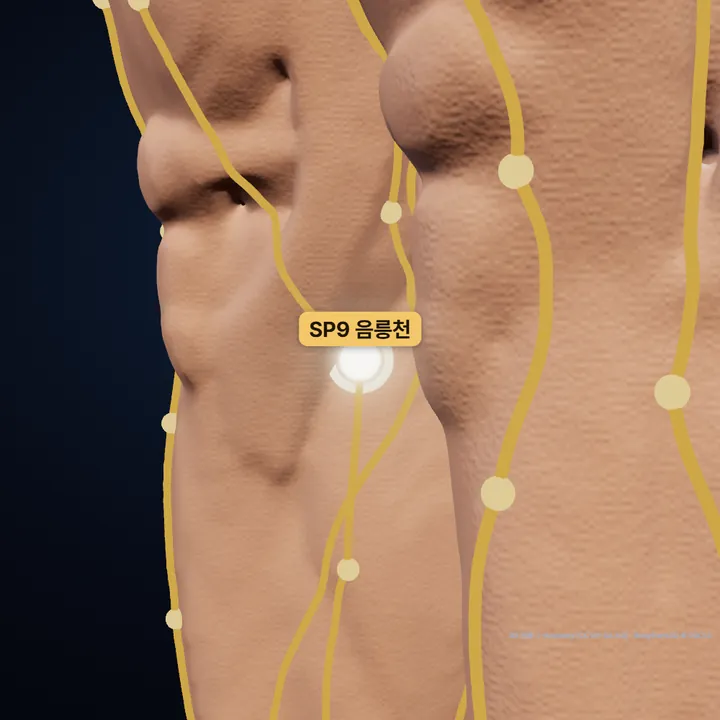
Rendered straight from the 3D model at the computed location. The glowing ring marks Yinlingquan.
On this page
1Where is Yinlingquan?
In the hollow where the lower edge of the tibia's medial condyle meets the medial border of the tibia.
It is on the inner leg, just below the knee.
Medial head of gastrocnemius · Semitendinosus muscle · Popliteus muscle
2How do I find it on my body?
- On the inside of the lower leg, place a finger on the inner edge of the shinbone.
- Slide it up along that edge toward the knee.
- Just below the knee, the finger stops against the lower edge of the medial condyle.
- medial head of gastrocnemius
- The inner of the two heads of gastrocnemius. It is bigger and reaches lower than the outer head.
- medial condyle
- The inner rounded knob at the lower end of the femur or the upper end of the tibia. Below the inner knee, the lower edge of the tibia's medial condyle catches under your fingertip.
- medial border
- The edge of a bone or structure nearer the middle of the body.
- semitendinosus
- A muscle on the inner back of the thigh. Its lower half is a long tendon, hence its name; bend the knee and the thin tendon stands out like a cord on the inner side of the back of the knee.
- Yixue Rumen
- An introductory medical book published by Li Chan in Ming China in 1575, widely read in Joseon Korea as well.
3The classical posture
- Take it with the leg stretched out, as the Tongren (quoted in the Donguibogam) and Lingshu ch. 2 both say.
- The Yixue Rumen instead takes it with the knee bent.
4Before you press
- If the knee is swollen, hot or freshly injured, see a clinician before pressing.
- Classical texts (Donguibogam; Yixue Rumen) forbid moxibustion at this point.
- Do not apply moxa at home.
- Avoid broken or swollen skin and press only to a comfortable level.
- Acupressure is not a substitute for medical care.
5How has it been used traditionally?
- Classified as the He-sea (Water) point of the Spleen channel — a historical classification, not a claim of effect.
- The name joins yin (inner side), ling (mound) and quan (spring): a spring below the bony mound of the inner knee. Its outer-side counterpart is GB34, Yanglingquan.
- It also marks the top of the 13 B-cun span used to measure the inner lower leg.
From traditional texts — not a claim of effect.
6Classical text
Donguibogam (Heo Jun, 1613), Acupuncture and Moxibustion, "Yinlingquan"
在膝下內側輔骨下陷中伸足乃得之《銅人》
在膝內側輔骨下陷中《資生》
曲膝取之《入門》
足太陰脈之所合 … 禁不可灸《入門》
- ①Below the knee on the inner side, in the hollow under the "assisting bone"; it is found with the leg stretched out. Tongren
- ②On the inner side of the knee, in the hollow under the assisting bone. Zisheng
- ③Take it with the knee bent. Rumen
- ④The He-sea point where the Foot Taiyin channel gathers; moxibustion is forbidden. Rumen
- Source tags as given in the Donguibogam: Tongren = Tongren Shuxue Zhenjiu Tujing (1026); Zisheng = Zhenjiu Zisheng Jing (early 13th century); Rumen = Yixue Rumen (1575).
- This entry has no garbled glyphs.
- The prohibition line is kept and translated; the Yixue Rumen also forbids moxa here, while the Jiayi Jing lists a moxa count.
- Our card does not recommend moxa.
- The "assisting bone" (fugu) is an old name for the bone beside a joint, here the medial condyle of the tibia.
- "…" marks the needling depth and moxa count, left out because they are for licensed practitioners.
Original text as written · translation is ours.
?FAQ
Where exactly is Yinlingquan?
In the hollow where the lower edge of the tibia's medial condyle meets the medial border of the tibia. It is on the inner leg, just below the knee.
How do I find Yinlingquan?
On the inside of the lower leg, place a finger on the inner edge of the shinbone. Slide it up along that edge toward the knee. Just below the knee, the finger stops against the lower edge of the medial condyle. the hollow where it stops is the point.
What should I watch out for?
If the knee is swollen, hot or freshly injured, see a clinician before pressing. Classical texts (Donguibogam; Yixue Rumen) forbid moxibustion at this point. Do not apply moxa at home. Avoid broken or swollen skin and press only to a comfortable level. Acupressure is not a substitute for medical care.
Sources
- Location: WHO Standard Acupuncture Point Locations in the Western Pacific Region (2008), p. 74
- Standard comparison: Chinese national standard GB/T 12346-2021 (Nomenclature and location of meridian points)
- Korean anatomical terms and locating tips: KMCRIC Standard Acupoint DB (Korea)
- Classification source: Lingshu ch. 2 (Ben Shu) for the five transport points; Nanjing ch. 64 for the phases; Zhenjiu Jiayi Jing vol. 3 (Siku Quanshu edition)
- Posture and traditional use: Hyeoljari Seodang (Bookdramang, 2015; Korean), ch. 4 "Yinlingquan" and appendix (Yixue Rumen indications)
- Classical text: Donguibogam, Acupuncture and Moxibustion, "Yinlingquan" — Wikisource public edition (no garbled glyphs in this entry)
- Indications: Yixue Rumen vol. 1 (Wikisource)
- Posture: Lingshu ch. 2 (leg stretched) · Yixue Rumen vol. 1 (knee bent)
- 3D: computed on Z-Anatomy (CC BY-SA 4.0) · BodyParts3D © DBCLS
Positions computed from the WHO standard locations (2008) on Z-Anatomy (CC BY-SA 4.0) · BodyParts3D © DBCLS. For reference only — not a substitute for diagnosis or treatment. See a clinician if you are unwell.