Fenglong 豊隆
8 B-cun above the prominence of the lateral malleolus, at the outer edge of the tibialis anterior.
Open the 3D Acupoint Map →
🖼See it in pictures
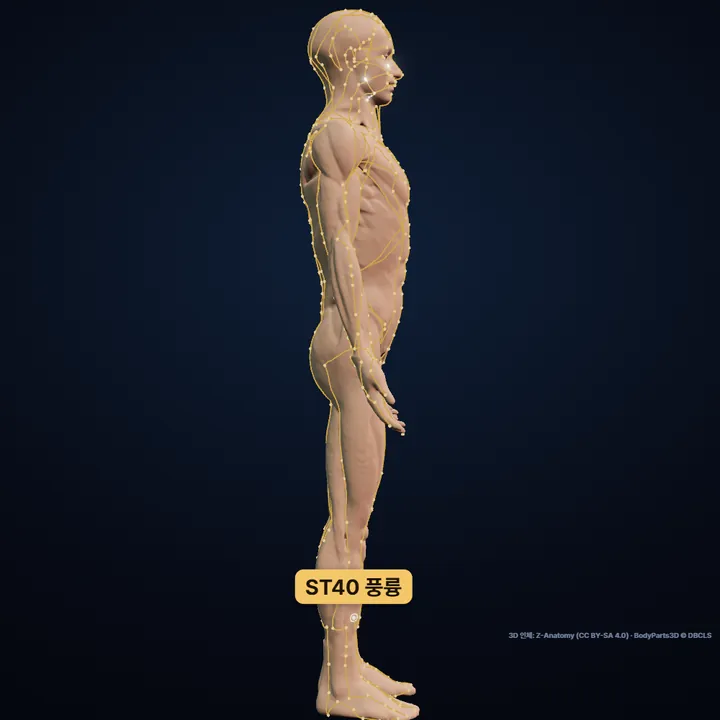
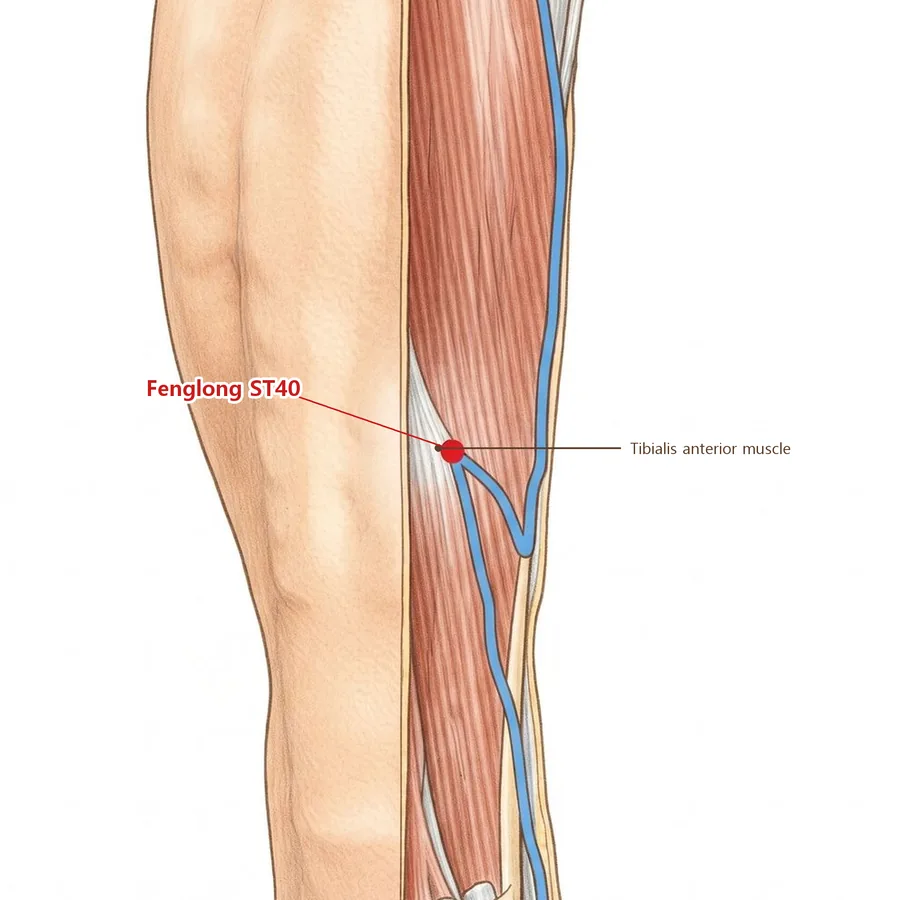
Location and structures come from our 3D model; only the drawing style was refined with AI. Labels are added by us.

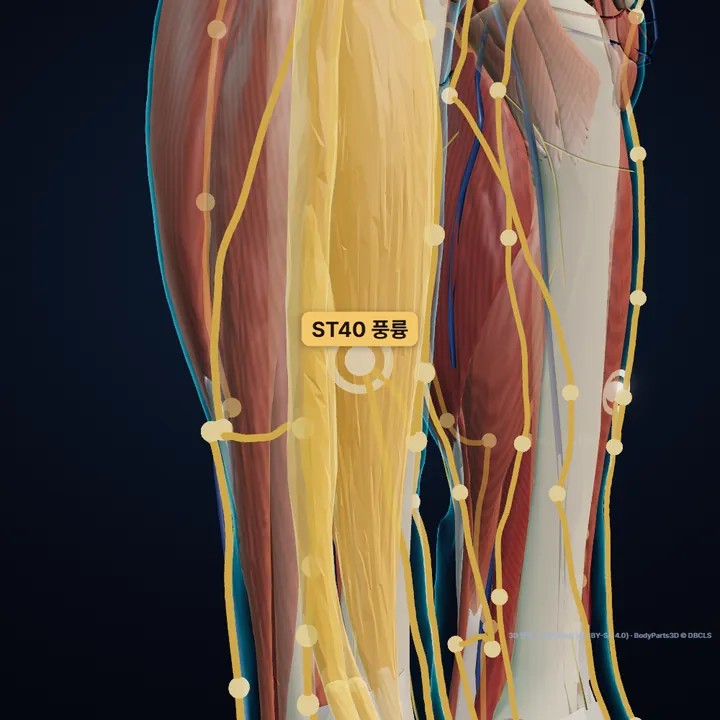
Tibialis anterior muscle · Extensor digitorum longus · Extensor hallucis longus
Rendered straight from the 3D model at the computed location. The glowing ring marks Fenglong.
On this page
1Where is Fenglong?
8 B-cun above the prominence of the lateral malleolus, at the outer edge of the tibialis anterior.
It is one middle-finger breadth outside ST38.
It is on the front-outer lower leg.
Tibialis anterior muscle · Extensor digitorum longus · Extensor hallucis longus
2How do I find it on my body?
- Take the popliteal crease (level with the kneecap's lower tip) to the lateral malleolus as 16 B-cun.
- Mark 8 B-cun above the malleolus, the halfway level.
- At that height, lift the foot to raise the tibialis anterior and press its outer edge.

A cun is a body-scaled unit of length. The precise way is to divide a bone length into equal parts (proportional bone cun); finger widths are a quick estimate.
- extensor digitorum longus
- A muscle running from the outer front of the shin across the top of the foot to the 2nd–5th toes. Lift your toes and four tendons fan out on the top of the foot.
- lateral malleolus
- The bump on the outer side of the ankle, the lower end of the fibula. It sits a little lower and farther back than the inner ankle bone.
- tibialis anterior
- The thick muscle running down the front of the shin, just outside the tibia. Lift the top of your foot and it hardens on the front of the shin, with a thick tendon standing out at the inner front of the ankle.
- popliteal crease
- The horizontal crease at the back of the knee when it is slightly bent. It is the starting line for measuring lower-leg points.
3Before you press
- Avoid broken or swollen skin and press only to a comfortable level.
- Acupressure is not a substitute for medical care.
4How has it been used traditionally?
- In classical theory this is the Luo-connecting point, where a branch leaves the Stomach channel for its paired Spleen channel (Lingshu, ch. 10) — a historical classification, not a claim of effect.
- The name joins feng (abundant) and long (bulging): a full, rounded spot of muscle.
From traditional texts — not a claim of effect.
?FAQ
Where exactly is Fenglong?
8 B-cun above the prominence of the lateral malleolus, at the outer edge of the tibialis anterior. It is one middle-finger breadth outside ST38. It is on the front-outer lower leg.
How do I find Fenglong?
Take the popliteal crease (level with the kneecap's lower tip) to the lateral malleolus as 16 B-cun. Mark 8 B-cun above the malleolus, the halfway level. At that height, lift the foot to raise the tibialis anterior and press its outer edge. one middle-finger breadth outside ST38.
What should I watch out for?
Avoid broken or swollen skin and press only to a comfortable level. Acupressure is not a substitute for medical care.
Sources
- Location: WHO Standard Acupuncture Point Locations in the Western Pacific Region (2008), p. 66
- Standard comparison: Chinese national standard GB/T 12346-2021 (Nomenclature and location of meridian points)
- Korean anatomical terms and locating tips: KMCRIC Standard Acupoint DB (Korea)
- Classification source: Lingshu ch. 10 (Jing Mai, connecting vessels) · Zhenjiu Jiayi Jing vol. 3 (Siku Quanshu edition)
- Classification cross-check: AcuAtlas dataset (CC BY 4.0)
- 3D: computed on Z-Anatomy (CC BY-SA 4.0) · BodyParts3D © DBCLS
Positions computed from the WHO standard locations (2008) on Z-Anatomy (CC BY-SA 4.0) · BodyParts3D © DBCLS. For reference only — not a substitute for diagnosis or treatment. See a clinician if you are unwell.