Shoulder and neck stiffness
Points traditionally pressed in East Asian medicine when the neck and shoulders feel stiff include Jianjing (GB21), Tianzhu (BL10), Fengchi (GB20), Jianwaishu (SI14) and Houxi (SI3). This describes a tradition; good studies of pressing these points by hand are still few.
1Points traditionally pressed

1. Jianjing GB21
Why this point? Classified as a crossing point of the Triple Energizer meridian and the Yang Linking vessel (Zhenjiu Jiayi Jing). It was one of the four points needled in a Japanese trial on katakori, the common neck-and-shoulder stiffness (Takakura 2023, 400 people).
How to press With three fingers of the other hand, lightly pinch and knead the muscle on top of the shoulder (trapezius) for 3–5 seconds, then release. Do not press hard straight downward. Do not press this point during pregnancy.
Open point page →
2. Tianzhu BL10
Why this point? The name means 'heaven's pillar' — the neck column that holds up the head. It was also one of the points in the same katakori trial.
How to press Press gently with both thumb tips for 3–5 seconds and release; repeat 5–10 times. Do not twist the neck while pressing.
Open point page →
3. Fengchi GB20
Why this point? Classified as a crossing point of the Gallbladder meridian and the Yang Linking vessel (Zhenjiu Jiayi Jing) — a historical classification, not a claim of effect.
How to press Place both thumb tips on the points, press gently for 3–5 seconds and release; repeat 5–10 times. Do not dig deep into the neck or bend the neck back while pressing.
Open point page →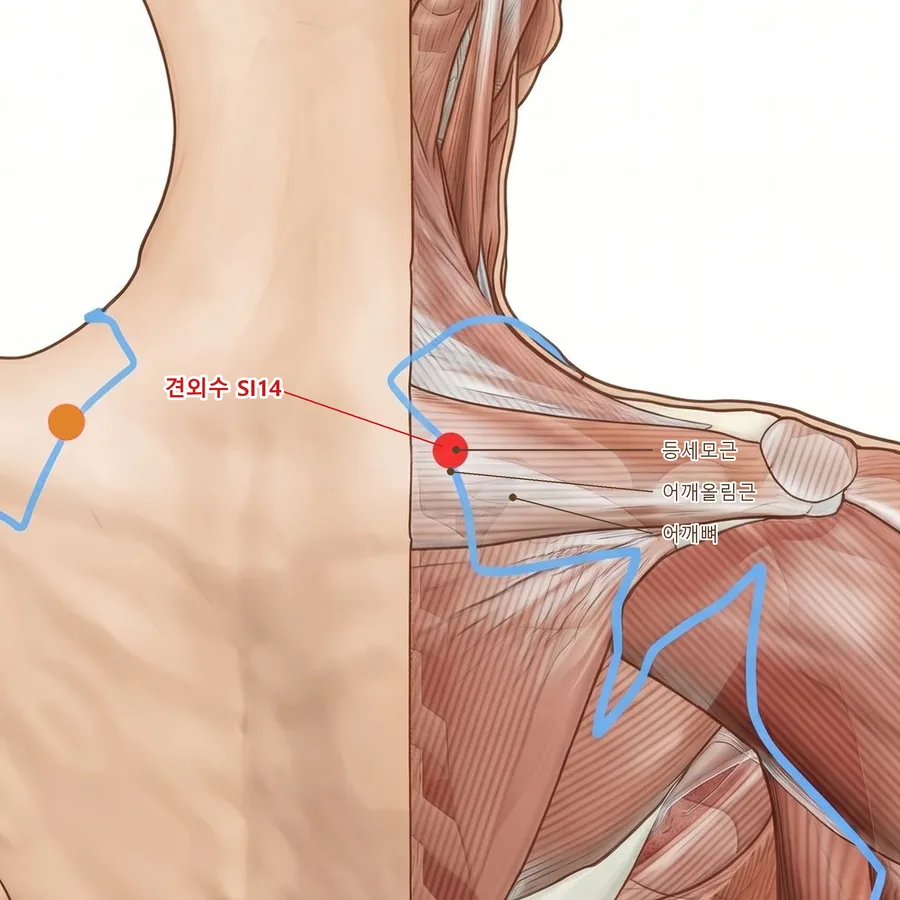
4. Jianwaishu SI14
Why this point? A point of the Small Intestine meridian. It was one of the four points needled in the katakori trial (Takakura 2023).
How to press It is hard to reach on your own; it is easier if someone else presses gently with a thumb for 3–5 seconds and releases. Never use a pointed tool.
Open point page →
5. Houxi SI3
Why this point? The Shu-stream point of the Small Intestine meridian and the confluent point of the Governing Vessel. A Ming-dynasty verse (Zhenjiu Juying) links Houxi with the Governing Vessel, the inner corner of the eye and the neck ('後谿督內連眥頸') — a historical classification, not a claim of effect.
How to press Make a loose fist and press with the other thumb for 3–5 seconds; repeat 5–10 times. Being on the hand, it is easy to reach at a desk.
Open point page →2Helpful habits
- Don't keep your neck in one position for long, for example at a desk. Sit upright, roll your shoulders gently back and draw a pushed-forward neck back.
- Try heat or cold — for example a hot-water bottle wrapped in a towel for up to 20 minutes, 2–3 times a day.
- Gentle movement is better than not using it at all. Only wear a neck collar if a doctor advises it.
- Use a low, firm pillow so your head stays level with your body, and avoid sleeping on your front.
3See a doctor instead of pressing points
- Tight or crushing chest pain that spreads to the arm, neck or jaw, or comes with breathlessness or sweating (possible heart attack)
- A drooping face, weakness in one arm, or slurred speech (possible stroke)
- Fever with a severe headache, neck pain that gets worse when bending the head forward, drowsiness or confusion
- Weakness or loss of feeling in an arm or leg, or pins and needles that do not go away
- Difficulty or pain when swallowing
- Sudden or very bad shoulder pain, or being unable to move your arm
- Pain that started after a fall or injury, or a shoulder that has changed shape or is badly swollen
- An arm or shoulder that feels hot or cold to the touch, fever, feeling unwell, or night sweats
- Severe pain in both shoulders
- Pain that appears or worsens with exercise
- Severe pain not eased by painkillers, or shoulder pain lasting over 2 weeks / neck pain lasting several weeks
119 = do not press points; call emergency services now (119 in Korea, 999 in the UK, 911 in the US). soon = see a doctor first, as soon as you can (same day to within a week).
- Do not press Jianjing (GB21) during pregnancy.
- The top of the lung lies below Jianjing, so do not press hard straight down.
- Over the upper back, the pleura and lung lie deep between the ribs — never use a pointed tool.
- Do not bend or twist the neck while pressing Fengchi or Tianzhu.
- Avoid broken or swollen skin and press only to a comfortable level.
- Acupressure is not a substitute for medical care.
4What does the research say?
| What | Study | Result | Certainty |
|---|---|---|---|
| Needle acupuncture — neck/shoulder stiffness (katakori) | Japanese double-blind randomised trial 2023 (400 people) | Real needling and a sham needle that never touched the skin both did better than no treatment; real needling beat the no-touch sham at the one-day follow-up | single-centre trial |
| Acupuncture, acupressure and others — chronic neck pain | Systematic review 2015 (75 randomised trials) | Acupuncture reduced pain slightly more than sham right after treatment; acupressure 'could' help | moderate for acupuncture, lower for acupressure |
?FAQ
Does acupressure actually help shoulder stiffness?
In a katakori needling trial (Takakura 2023, 400 people), people who got real needles and people who got a sham needle that never touched the skin both did better than people who got nothing — expectation and the ritual of care play a big part. Good studies of hand pressure alone are few, so its own effect is not known (low-certainty evidence).
Is harder pressure better?
No need to press hard — keep it comfortable. Over Jianjing in particular, the top of the lung is close, so do not press hard straight down. Combine it with heat, posture changes and gentle movement.
Could shoulder pain be a heart problem?
It can. Tight chest pain spreading to the arm, neck or jaw, or breathlessness and sweating, can mean a heart attack. Do not press points — call emergency services straight away.
Reference information on traditional use and research. If symptoms persist or are severe, see a doctor first.
Sources
- Classifications and traditional use: our own point cards (see each point page — Zhenjiu Jiayi Jing vol. 3, Lingshu, Nanjing, Yixue Rumen, AcuAtlas dataset CC BY 4.0)
- Zhenjiu Juying, 'Song of the Eight Confluent Points' — Wikisource https://zh.wikisource.org/wiki/鍼灸聚英/經脈交會八穴歌 (checked 2026-11-07)
- Takakura N et al. Acupuncture for Japanese Katakori (Chronic Neck Pain): A Randomized Placebo-Controlled Double-Blind Study. Medicina 2023;59(12):2141 (point list in Methods) https://pmc.ncbi.nlm.nih.gov/articles/PMC10745119/ (checked 2026-11-07)
- Yuan QL et al. Traditional Chinese medicine for neck pain and low back pain: a systematic review and meta-analysis. PLoS One 2015;10(2):e0117146 https://pubmed.ncbi.nlm.nih.gov/25710765/ (checked 2026-11-07)
- NHS, Neck pain (reviewed 27 Apr 2023) https://www.nhs.uk/conditions/neck-pain/ (checked 2026-11-07)
- NHS, Shoulder pain (reviewed 22 May 2023) https://www.nhs.uk/conditions/shoulder-pain/ (checked 2026-11-07)
- NHS, Heart attack (reviewed 31 Mar 2026) https://www.nhs.uk/conditions/heart-attack/ (checked 2026-11-07)
- NHS, Stroke — symptoms (reviewed 12 Sep 2024) https://www.nhs.uk/conditions/stroke/symptoms/ (checked 2026-11-07)
- MSD Manual Consumer Version (Korean), 'Neck pain' (reviewed 4 Nov 2024) https://www.msdmanuals.com/ko/home/뼈-관절-근육-장애/허리-및-목-통증/목-통증 (checked 2026-11-07)
Positions computed from the WHO standard locations (2008) on Z-Anatomy (CC BY-SA 4.0) · BodyParts3D © DBCLS. For reference only — not a substitute for diagnosis or treatment. See a clinician if you are unwell.